Hello folks, and welcome back to Wrong Every Time. Today we’ll be delving back into the adventures of Vox Machina and company, as they work to defeat the evil that they themselves kinda-sorta accidentally unleashed. Isn’t that always the way of it, though? You defeat one evil dragon, think you’ve done something good, and then some entirely other evil dragon decides to fuse itself with the corpse of your quarry, becoming a dread-creature of power beyond imagining. It’s enough to make a hero want to hang up their +2 sword and just take a load off, letting someone else save civilization as we know it for a change.
There’s certainly an inherent tension in the construction of a D&D campaign, a balance necessitated by the party’s simultaneous need for heroic validation and dramatic incentive. How do you as a DM keep going bigger while still validating the party’s prior process, telling them in the same breath “that was some glorious, consequential heroism you just did” and “also, things are now worse than ever before.” At what point do unintended consequences shift from feeling “earned through recklessness” to “inflicted by a hostile narrator,” and how do you manage that balance while both surprising and validating your party’s expectations? These are questions whose answers depend on a million factors, and which must be approached with a distinct tactic for any given player party – and that very variability is what makes DnD so endlessly interesting to me as a storyteller and game designer. No puzzle so compelling as one without a defined solution, so let’s get back to the board as we conclude season three of Vox Machina!
Episode 12
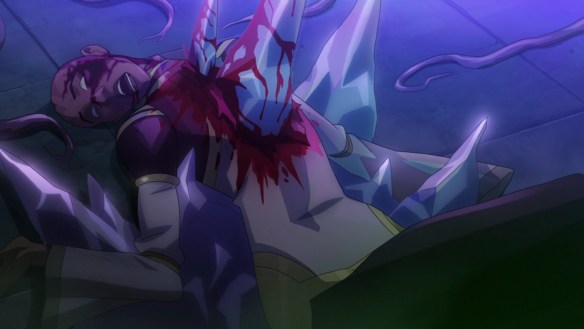
We drop in amidst the action, with Raishan’s original body speared through and silent. There’s no easier visual shorthand for gaining power than gaining size, and no more obvious indicator of the cost or transformative nature of power than losing your own physical form, so “the villain’s original body is sacrificed or contorted to achieve their ascension” is a conceit that comes up time and again across DnD and fantasy fiction more broadly. You can of course toy with these expectations and create new variations, but “I’m not going to do what’s expected simply because it’s expected” is a trap in its own right – one shouldn’t prize novelty beyond its ability to offer genuinely compelling ideas, and exploiting the audience’s built-in resonances is an easy way to lean on narrative shorthand in order to focus on your own unique embellishments to that narrative
This is one of many game design lessons I learned from Mark Rosewater, the lead designer of Magic: The Gathering. Audiences want to recognize things – as a creator you should seek your own satisfaction and creative advancement where you can, but not forget who you are designing for, particularly for such a collaborative experience as DnD
Keyleth is of course helpless against this new form, even in her powered-up state. Multiple boss stages allow for such a balance of challenge and reward; Keyleth overpowering Raishan’s initial form is the payoff for her individual struggle, while the subsequent boss stages reassert the necessity of the overall party
“I don’t gotta understand something to kill it.” Grog’s reaction to this body-swapping nonsense emphasizes the previous point – these twisting betrayals are basically a total miss for his interests, so you have to balance that with things that are more up his alley
It feels like that mismatch is actually true for Vox Machina more generally, and perhaps even a part of its charm. Mercer loves spinning convoluted schemes, but his players are much more “point us at what needs killing” types
Raishan uses Hold Person on Vax as he approaches, a time-tested approach to dealing with a pesky rogue. Speed is a great defense until you can’t move anymore
“Bring it! I can handle fire.” “These flames burn different.” Ooh, that’s a weak response. It is always possible to give a player a “fake boon” like this – to say they’ve earned a fireproof suit, and from then on equip every enemy with “super-fire” that burns right through it. But when the significance of your victories is instantly stolen from you, so goes your sense of accomplishment, as well as your incentive to keep seeking victories. The DM can always decide anything works whatever way they choose, but not respecting the efforts of the players risks losing your most precious resource: your players’ trust and investment in the campaign
Keyleth ends up trapped within a magic barrier with Raishan, facilitating a key beat between her and Vax, as she asks once more for the team to trust her judgment. This is the sort of area where the DM can helpfully tip the scales: manufacturing situations to let the players pursue their chosen forms of character development
“We’re both fueled by ambition. Admit it!” Raishan’s classic “we’re not too different, you and I” speech actually hits with some weight here, given the prior actions of the Ashari and Keyleth’s complicity in their overall project. It can be tough to satisfyingly seed dramatic turns which are framed as the consequences of the players’ own actions, as such twists can awkwardly draw attention to the players’ lack of agency in conjuring that outcome, but your average adventuring party is generally happy enough to be told “go there and kill that thing for some gold” that they’ll often freely concede they should well have asked if that particular thing demanded killing. There is wiggle room for unintended consequences within the player-DM contract
Meanwhile, the rest of the party’s conflict is “encourage Grog to punch through the barrier.” I imagine this fight was a little more democratically executed in tabletop form
Ohoho, that’s genuinely delicious. Keyleth uses her new earth elemental form as a conduit, transferring Raishan’s original wasting disease to her new body. A clever solution that actually fulfills the Ashari curse – I don’t know if that’s what they actually came up with at the time, but it’s certainly graceful plotting for this adaptation
You can describe general DnD plotting as many things, but with half a dozen cooks all simultaneously adding their own spices, “graceful” is rarely the word for it. Graceful stories proceed with a sense of inevitability that can only come from clear intent – in contrast, DnD is more like a community theater performance where everyone arrives with a character but no script
Keyleth understandably needs to take a sit-down after that trick, having become the living vector of a dragon-killing poison
Vax then checks in with his raven patron, hoping for a way to retrieve Percy’s soul. I’m intrigued by these frequent sequences of directly bargaining with the gods; though my players ended up being favored by the gods to some extent, there was none of this outright negotiating for celestial boons. I think that in part came as a result of the previous campaign I’d participated in, where godly boons were distributed so frequently that it felt like the game was being played for us – but obviously there’s a better balance point there, and I’ve been attempting to discover it in my post-campaign quests. Now that the party has saved the kingdom, the idea that the gods would see them as much as rivals or threats than as avatars or champions feels dramatically enticing
The next day, Vax’s plan is supported by Pike, who mentions how Zerxus suggested it is sometimes best to defy your deity. They’re doing some interesting work with Pike in this season; I know Ashley Johnson was rarely available to actively participate in the first tabletop adventure, and that showed in her disconnected presence during the earlier seasons, but now it feels like they’re giving her a lot of satisfyingly ambiguous drama. You wouldn’t expect the holy warrior to be the one saying “sometimes the gods ought to be betrayed”
I imagine this whole Percy revival arc was largely invented for the show as well. Perhaps DnD’s greatest dramatic weakness, at least in my mind, is the insignificance of death. Because it’s so easy for some player to randomly fall off a cliff and die, the methods of reviving dead characters are similarly easy – a mechanical concession that naturally trivializes death, making it almost impossible to build an arc around mourning, grief, succession, or any of the other countless human experiences that are intimately connected to our mortality. I’ve considered just removing such spells from my campaigns, and at the very least tend to insist on the “soft ban” of not using revival spells to constantly save story-relevant non-player characters
So yeah, in-game, this whole quest would at most require just seeking a magic user who can cast a high-level revival spell, no bargaining with fate or any of that juicy business. The moment revival becomes commonplace, lifespans and mortal sacrifices become meaningless, and characters become action figures
“Why have you come, Raven Champion?” Orthax understandably a little put out that he’s been replaced as the top raven-themed death-patron in the narrative. I assume Mercer’s been kicking himself for letting that happen ever since the Matron of Ravens was introduced; strong, distinct theming is a must for establishing your world’s greater powers, while this is always kinda confusing
The golden thread of fate guides Vax towards Percy. The thread of fate has been a motif in this series, but I’m not sure I’d call it a theme – this story isn’t really about fulfilling or avoiding your destiny, it’s more broad than that
He finds Percy, who does not recognize him or want to leave
Less than “defying fate,” Vox Machina is more about not letting your preconceptions about your identity limit your potential. It’s not fate that binds these characters, it’s their own negative self-images. Which is frankly more substantive, human drama than a battle against fate itself
Or here’s another good one: “our love for each other is stronger than our hatred of ourselves.” That’s a pitch I can relate to
And with that, Percy is revived! Good, I was missing that grump
The gang retire for chickens at Scanlan’s chateau. DnD spells are intentionally defined loosely; a properly invested player like Scanlan can turn “you make a magical house” into a full expression of identity
And then come the goodbyes, as the various members of the group detail their plans for non-adventuring life. A bittersweet payoff, but a payoff nonetheless; one of the rewards of building your character into a genuine, meaningful component of a wider world is that when the adventure is done, you generally have a clear idea of where they fit into the weave. My own campaign’s players all had clear retirements waiting for them: one married into royalty and became a political bridge between nations, one turned their full attention to their burgeoning economic empire, and one finally got to return to the home they’d long forgotten, reconnecting with their family at last
And Done
Yeap, of course they had to revisit that dang orb at the end, reminding us there’s still some mysterious evil left to slay. But that aside, our heroes have defeated the Chroma Conclave, revived their good friend Percy, and set off towards a variety of well-earned next steps, leaving us at an altogether cohesive conclusion. DnD’s mixture of narrative and mechanical elements, and of personal and collective drama, can make the process of touching down from a campaign either clumsy or awkwardly abridged, to say nothing of the countless campaigns that don’t make it to a proper conclusion. But fortunately, all the lessons regarding character integration, long-form plotting, and proper DM-player collaboration tend to point in the same direction; if you’ve set up the pieces correctly, threading that final needle can actually feel unexpectedly effortless. I’m happy to see Vox Machina not-quite-ending with such grace, and look forward to seeing how they fuck it all up next season!
This article was made possible by reader support. Thank you all for all that you do.