Wooper: Who’s ready for another 365 days of anime? I’m certainly not, but Japan won’t stop making the damn things, so our Winter First Impressions will start appearing soon. And what do you know, I actually managed to wrap up my thoughts on what I watched last season before the initial impressions post went live! I’d say “new year, new me,” but nobody is that gullible, so you’ll have to settle for the same old Wooper, plus whichever writers are game to keep this operation running (I know Lenlo will be doing some first impressions, at least). Hope everybody has a happy and healthy 2026 – we’ll be back again in a couple days!
Star Wars Visions S3 – 7-9
Of these last three Visions shorts, “The Smuggler” (number 7) was the most ordinary, with genderswapped Han Solo-esque heroine Chita trafficking a wanted prince away from his home planet – only to agree to take him right back at the script’s conclusion. This reversal underscored the shortsightedness of the writing, which prioritized adherence to a mission over character motivations, but the episode still had its positives, one of which was its animation of facial expressions. The character designs were appealing in general, but Chita’s head tilts and eyebrow arches gave her a good deal more personality than she had on the page alone. The quiet strength of the prince’s tall, thin ex-Jedi guardian was another plus, especially in her battle with a bomb-specializing bounty hunter. The Smuggler isn’t the most memorable of this year’s shorts, but it was fun while it lasted.
Polygon Pictures’ “The Bird of Paradise” was a much headier offering, following newly-blinded Padawan Nakime as she rebuilt her concepts of both herself and her environment through the Force. It was structured like a creation myth, split into five different days that were each themed around one emotion and one aspect of the natural world. While the jumps between these days could be jarring, the transitions between the real world and Nakime’s morphing mindscapes were well-handled, with the latter making good use of Polygon’s 3D expertise. Some anime anthologies I’ve seen in the past have included abstract segments crammed full of philosophical narration (Genius Party’s “Limit Cycle” is a good example), and while this one was in that vein, its main character completed a clear internal journey over its 19 minute run time. I didn’t connect with it, but I do respect the ambition.
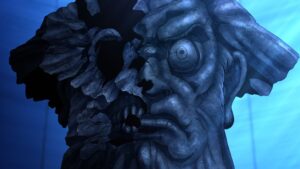
And then there was “Black” by Shinya Ohira – not the Visions finale we deserved, but the one we I needed. Ohira is the most idiosyncratic Japanese animator I know of, but I don’t want to recount his filmography or distill his visual style (as if I could even attempt such a thing) here – just watch Black and you’ll understand the otherworldly plane on which he operates. That’s a good adjective to describe this short, too, since it takes place both within the world of its stormtrooper protagonist’s mind and on other, literal worlds. This is a director’s raw vision of the line between life and death, incorporating battle scenes from Hoth and one (or both?) Death Stars to establish external chaos while diving in and out of a nameless soldier’s war-ravaged psyche. We see his memories and mad hallucinations play out atop fully animated backgrounds and chameleonic jazz music, which undergoes several subgenre switches to complement the stormtrooper’s frayed mindstate. The short lasts for a little over 12 minutes; I felt as though it had finished in fewer than 5. Its in-your-face style won’t be similarly transportative for everybody, but if you love animation (not just anime), you should most certainly treat yourself to a viewing.
Ganglion – 10-12
The sub group whose work on this show I preferred, [CicakRumah], was recently impacted by real world flooding – best wishes to whichever members of their team were affected! Ganglion was a noteworthy enough short that two groups were translating it, so I switched to the other one for these (last?) three episodes, which covered the trip to and from the site of a mission to destroy Mt. Fuji. Right off the bat, the voice acting during the bus ride in episode 10 won me over – there was an understated camaraderie between the members of the Belve Squad that gave this concluding “arc” a slightly sweeter feeling as compared to the rest of the show. All the mundane details of their trip, like protocol for wearing their masks or a time-sensitive toilet break at a rest stop, offered the usual mockery of corporate culture – but they also put the show’s various henchmen on the same page. This fellowship extended to their shared schadenfreude at their terrible boss’s injury (sustained during the failed attempt to blow up Japan’s most famous landmark) and Hopeman’s speeding ticket on the way home, which brought back a bit of the show’s trademark cynicism. I guess sometimes the misfortune of others is the best medicine for salarymen stuck in tokusatsu villain hell – “misery loves company” remains undefeated as an adage.
Fujimoto Tatsuki 17-26 – 7-8
“Nayuta of the Prophecy” (episode 7) has an interesting connection to Chainsaw Man through its title character, who shares her name and general appearance with a major figure in CSM Part 2. There are another handful of other similarities between the two manga, which makes “Nayuta” a key work in Fujimoto’s bibliography, but the same can’t be said for its adaptation’s place in this anthology. I suspected that this episode might not be a winner after reading that it shared a director with “Mermaid Rhapsody,” and while it was perhaps a step up from that entry, it still failed to capitalize on its supernaturality, violent imagery, and familial themes. There was no nuance to Nayuta’s position as a prophesied apocalypse-bringer, only the simple dichotomy of her helpless imouto act (while under her brother’s watchful eye) and her animal cruelty and magical weapon generation (while he slept or was otherwise occupied). And speaking of weapons, the climactic scene where Nayuta summoned a bunch of 3DCG swords and made tanks levitate in midair was so limply-animated that I felt bad for Fujimoto, who clearly has a lingering attachment to this oneshot. In short, this was an all-around disappointment.
Not so for 17-26’s final installment, however. If “Nayuta” was close in spirit to Chainsaw Man, “Sisters” was akin to Look Back, with a pair of gifted female artists going through relationship turbulence. Unlike Fujino and Kyomoto, these two girls were (as the episode’s title suggests) siblings, and the reason for their strained connection was more concrete: the younger sister painted a nude of the older one (without permission), which was displayed in the entranceway of their art school after it won a contest. Of course, the older girl’s jealousy of her younger sibling lay at the heart of the rift that formed between them, and “Sisters” explored that emotion reasonably well, but the added layer of her exposure was what elevated the story for me, since she was doubly disgraced by the praise heaped upon the younger girl. The changing shape of her plan to exact revenge was also unique, and the episode’s production was very Look Back-esque in its use of montage to capture the process of creation. I wouldn’t watch this one in public (there’s nudity, though it’s not gratuitous), but I’d be sure to check it out if you liked the film that clearly shares its DNA.
Pokemon Concierge – 8
Pokemon Concierge has always focused on Haru, her job, and her co-workers, so I was initially surprised by its decision to skew romantic in this episode, the last of four new ones from 2025. Thankfully, the show kept its footing the whole time, dropping hints (exceedingly subtle ones by anime standards) about her ex-boyfriend Kent’s lingering feelings for her, and to a lesser extent, Haru’s for him. While they had a couple conversations on the serious side of things, the episode’s presentation provided balance, using 80s synth stings and self-aware freeze frames with bright color grading to parody the romance genre. (This bit of direction felt specific enough that it might have been referencing a real-life series, but I’m not a J-drama fan, so I wouldn’t have been able to catch it.) Arcanine was a great choice of Pokemon for Kent, with an energy that contrasted his Trainer’s mellow temperament while still symbolizing protection and loyalty. Visually, I was amazed at the detail put into Arcanine’s footsteps – given its complicated model, a limited approach would have been fine, but the Dwarf team went all-out for the conclusion of this “season.” Whether there will be more Pokemon Concierge in the future I don’t know, but I surely hope so.
Hyakushou Kizoku S3 – 10-12
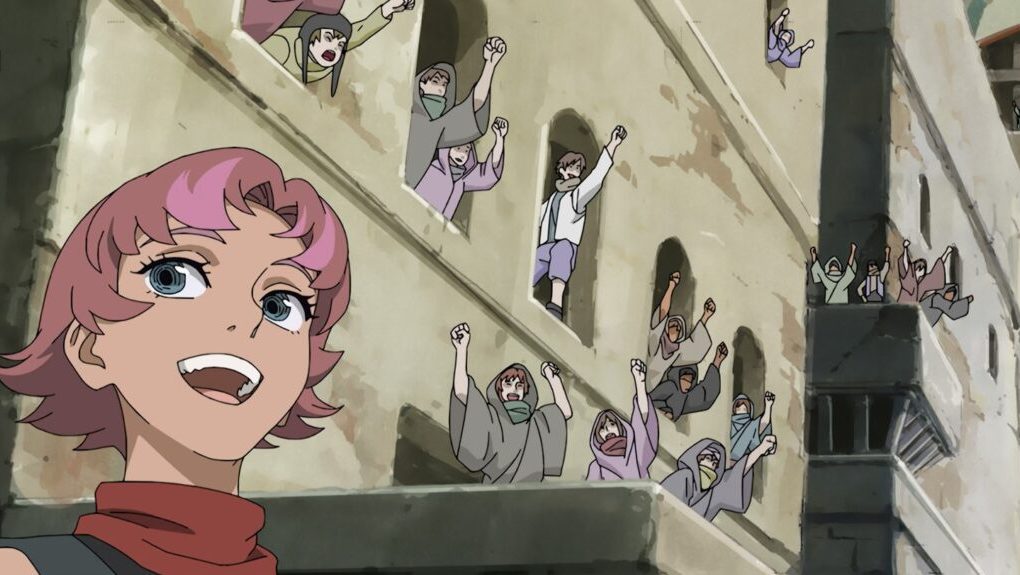
A couple of these episodes were about pigs and bears (popular topics for a show about farm life), but I want to focus on Hyakushou Kizoku’s season 3 finale, entitled “That Time Arakawa Hiromu Reincarnated in Another World and, Using Her Knowledge of Farming, Became Unrivaled and Turned Into a Real-Ass Noble.” I have no idea whether it was based on an existing manga chapter or if the staff went anime original with it, but either way, this was a great isekai parody – better than most of the full-length series created for that purpose. The synergy between Arakawa’s stressful occupation and what preceded her rebirth (expending all her “energy”) was much funnier than the traffic-related accidents that frequently kick off this subgenre’s adventures. A swift detour away from farming and into her talent for drawing portraits commented on the shallowness of this otherworldly kingdom’s population. Eventually she did fix their food shortage by cultivating potatoes, but this backfired spectacularly, as the peasants (no longer starving) were thus empowered to overthrow the monarchy, which got an honest-to-god laugh from me. If you’ve never watched Hyakushou Kizoku before, try this episode in isolation (number 40 overall) – it’s not representative of the series as a whole, but it’s great fun regardless!
The post Fall 2025 Check-In – Weeks 11-13 appeared first on Star Crossed Anime.