Hello folks, and welcome back to Wrong Every Time. Today we’re returning to the storied halls of Oushin Academy, as our fledgling high class ladies continue to “rock out with their cocks out,” as Lilisa so eloquently put it. Having rocked out so successfully they actually conscripted Lilisa’s sister into their conspiracy, they have since learned that their symphonic band mutiny attracted a good deal of additional attention. Now both the accomplished guitarist Shiro and council vice-president Tina want to join their band, forming an unruly quartet where it’s unclear if any of these rock stars actually like each other.
Nonetheless, a collective love of music can be a powerful binding agent. And with such distinct and potentially incompatible personalities vying for power, my main hope is that the friction will force them to reveal more of themselves; both the personal histories that led them to rock music, as well as whatever ambitions they might possess regarding their musical future. So far, rock music has been framed as a form of “rebellion” that is as ethereal and temporally bound as the vision of queer love presented by this story’s Class S influences – a lark that might be tolerated during their questing adolescent school years, but which will surely be “outgrown” by the time they emerge from their chrysalides. Modern versions of these narratives have directly challenged this assumption of eventual passive integration into society’s conservative expectations, and given it’s actually starting from a point of “conservative social norms are bullshit,” I’m eager for this story to also chart a course beyond fully closeted expressions of identity. But for now, let’s see how the first full band meeting goes as we return to Rock is a Lady’s Modesty!
Episode 7
We open by rolling back the clock a bit, returning to the moment after Bitter Ganache’s performance at this local club. I’m quite intrigued by the local band scene of greater Tokyo; it seems like the sprawling yet compacted city lends itself to fiercely loyal local scenes, and a massive number of local club-touring bands. Bocchi the Rock is the only one of these current band dramas I’ve seen directly dig into that dynamic, with its cast members lamenting the slow death of local venues and the communities they support. Most groups blow up via the internet these days, which doesn’t really lend itself to the kind of tight-knit, DIY, inherently class-conscious communities of local music scenes
God, Shiro’s eyes are so intense. In a show that has so clearly defined eyes as windows to the soul, her repeated concentric rings and shocking white eyebrows feel like a sniper’s scope
Extremely pointed layout as we return to the practice room, with a foreground table leg cleanly dividing the band’s two apparent factions
Tina attempts to greet Shiro, who just growls and barks at her, prompting another conference with the stuffed bunny. Tina is excellent
This episode’s got a nice energetic format, as we bounce between segments of explanation and relevant flashbacks for each of our leads. The discordant, almost combative structure matches the perpetual one-upmanship of Lilisa and Otoha’s friendship
Bitter Ganache have some amusingly mismatched designs; feels like someone just sorta went wild in the character creator
The group is understandably upset that Shiro is so casually abandoning them
“You’re so damn preoccupied with popularity, you’ve forgotten all passion and respect for rock, not to mention how to give society a giant f-you!” Shiro reveals her own predictably shallow passion for rock music. “Giving society an f-you” is a fundamentally adolescent desire – even if you want to rebel against an established social order, that rebellion requires more tangible substance than “fuck all normies” to have any meaning. Music can certainly be a tool of liberation, but to do so it can’t also just be a vehicle of pure self-indulgence – bands like Fugazi or Rage Against the Machine have specific political grievances they’re addressing in song, not just a shapeless desire to piss off their parents
Also interesting how thoughts on “selling out” have shifted over the years. Shiro seems to embody a very old-school distrust of actively courting popularity or financial remuneration; these days, it’s so impossible to make a living in music, and the younger generations have so completely abandoned any sort of antipathy towards capitalism and corporate branding (understandable, given their social spaces are all online and governed by a handful of corporations), that the stigma around “selling out” has largely disappeared
This in turn is part of why local scenes were so important, as places where you could actually meet folks of different backgrounds who had found their own ways to avoid embracing the machine
Bitter Ganache’s leader laments how she put her pride aside for the sake of the band in begging Shiro to join them in the first place. I’m reminded of Ave Mujica’s Nyamu, who was similarly attuned to the economic realities of professional musicianship, and who I similarly felt great sympathy towards relative to her flailing bandmates
Otoha’s face lights up at the mention of a rock battle. Basically everything that has happened so far has been delightful for her personally
Shiro bluntly points out that there’s no benefit to a battle of the bands for either herself or Otoha, but of course Otoha’s already enraptured by the prospect. But yeah, an ultimatum that “forces” you to be stuck in a band is not going to result in a particularly joyous musical collaboration; after all, the most important thing for a group is not necessarily their individual skills, but instead their collective harmony
Hah, another fourth wall-breaking flourish bringing visual embellishments into the real world, as we see Otoha actually holding the superdeformed models of herself that were employed in the previous cut. A slight touch of unreality fits this production well, and the playful intelligence of its storyboarding is its greatest strength
Otoha assures Lilisa that Shiro is “really kind deep down.” Clearly deeper down than any of us have excavated
Shiro shows off her accomplished fingerpicking style. Rather than holding a guitar pick which you use to strum and pluck strings, fingerpicking means you just use all five fingers, which is harder both in terms of managing finger placement and in terms of striking with sufficient, precise force to create your desired sound. Both a much higher ceiling and floor than using a pick, requiring a greater awareness of your finger positioning in a similar manner to how drums require mentally dividing your limbs into individual instruments
Of course, one of the interesting things about music is that technical virtuosity isn’t necessarily preferable to a specific style or energy. My band’s bassist was absolutely a more accomplished, traditionally trained singer than I was, but my vocal tone often fit our songs better for the lead parts, allowing him to shine creating harmonies
Shiro continues to provoke Lilisa. I suppose this style of “aggravation into excellence” competitive collaboration must work for some people, but for me, an atmosphere of mutual trust and consideration is basically the first prerequisite to any artistic collaboration. The second someone tries to make a collaborative project into a competition, I immediately understand they are not a partner for me
“I used your rejection as fuel to hone my skills.” Like, can you imagine how this would play out for Bocchi? Us musician types are often pretty sensitive
Tina’s enthusiasm about this life-changing band experience raises another “fun” quirk of musician life – how to fire someone who’s just not working for the group. Bands involve a unique blurring of friendship and professional collaboration that can certainly be rewarding, but which also makes it hard to separate personal feelings from artistic ambition
Otoha assigns Lilisa to get Tina in shape. Otoha is clearly very comfortable using her overbearing, ostensibly genial personality to browbeat others into compliance
“This is all because of Otoha’s selfishness…” I do wonder if we’ll hit a breaking point eventually, where Otoha can no longer just make puppy-dog eyes and get what she wants
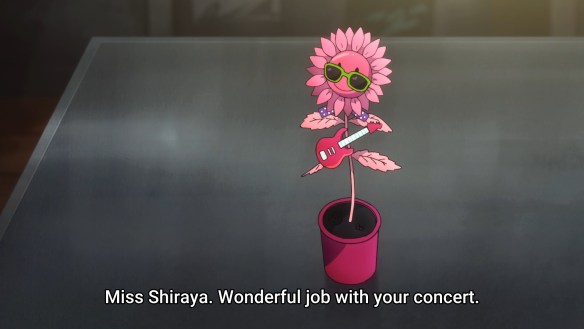
We cut to the vase on the window during practice, or actually pair of vases at this point – Tina’s blue flower is kept in a second vase, emphasizing the distance between her and the rest of the group
Otoha and Shiro kinda demonstrate the limits of their approach to music after practice, leaving after Tina’s progress report without a word of instruction or support. Music is a naturally unifying force, but those two are particularly selfish players
“It’s okay if you make mistakes. Just keep playing through to the end.” As I said before, audiences generally won’t notice single mistakes in a performance – it’s only when you let those mistakes derail your ongoing performance that things get messy
Ooh, this is good. Lilisa prepares to reject Tina, reflecting on how she can’t compete with Shiro and also teach Tina at the same time, before noticing the many bandages on Tina’s hands and recalling her own painful practice as a child. A sequence that implies the collective effort they apply is more important than the result; that the work they have put in to shine together must always be respected. This feels like a meaningful divergence from Otoha and Shiro’s “my way or the highway” competitive approach
“Why pressure yourself to be what we want?” And yet, Lilisa can fuse that spirit of solidarity with a message of independence, emphasizing that Tina should find her own truthful on-stage self
Lilisa at last suggests Tina play with the group, thinking it might motivate her to improve more, “like it did with the symphonic group.” Of course, the symphonic group didn’t subsequently suffer through an onslaught of verbal abuse from Otoha, which would likely have put a damper on their enthusiasm
Tina’s flower is of course integrated into the central vase for this new display of unity – but as expected, Shiro pretty much immediately asks her to leave, prompting a single falling petal
And Done
Man, fuck these guys, Tina! Go out and find a nicer bunch of musicians, and please don’t be discouraged by the blatantly antisocial attitudes of Shiro and Otoha. I’d been wondering when this group’s distinctly antagonistic vibe would cause some real problems, and can only hope that Lilisa’s newfound appreciation of effort and commitment to the group as virtues in their own right will place her on Tina’s side in this conflict. And beyond that, I’m desperate for an interrogation of Otoha’s own motives, and to see if she has a more substantial grounding for her love of rock than Shiro’s philosophy. What right does someone who plays purely for self-indulgence have to judge the passion of another?
This article was made possible by reader support. Thank you all for all that you do.