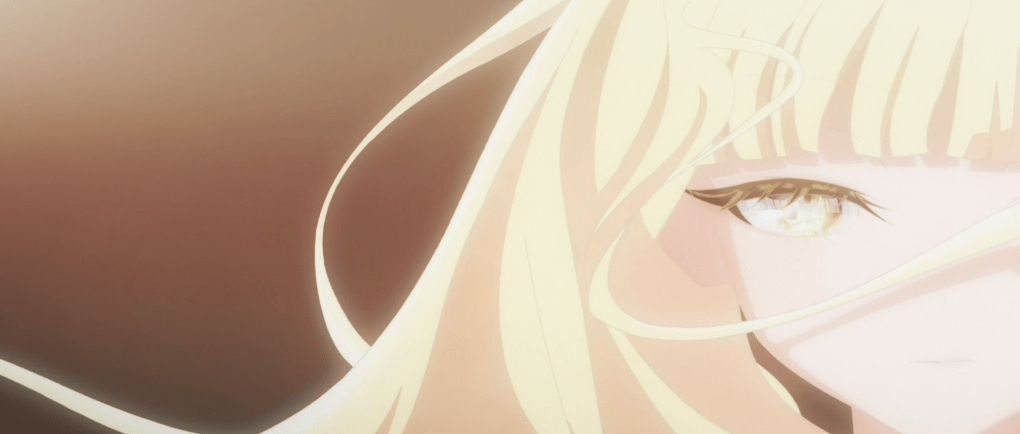
I don’t like death games, but I do like maids. I don’t like rampant killing, but I do like it when people make anime in interesting ways.
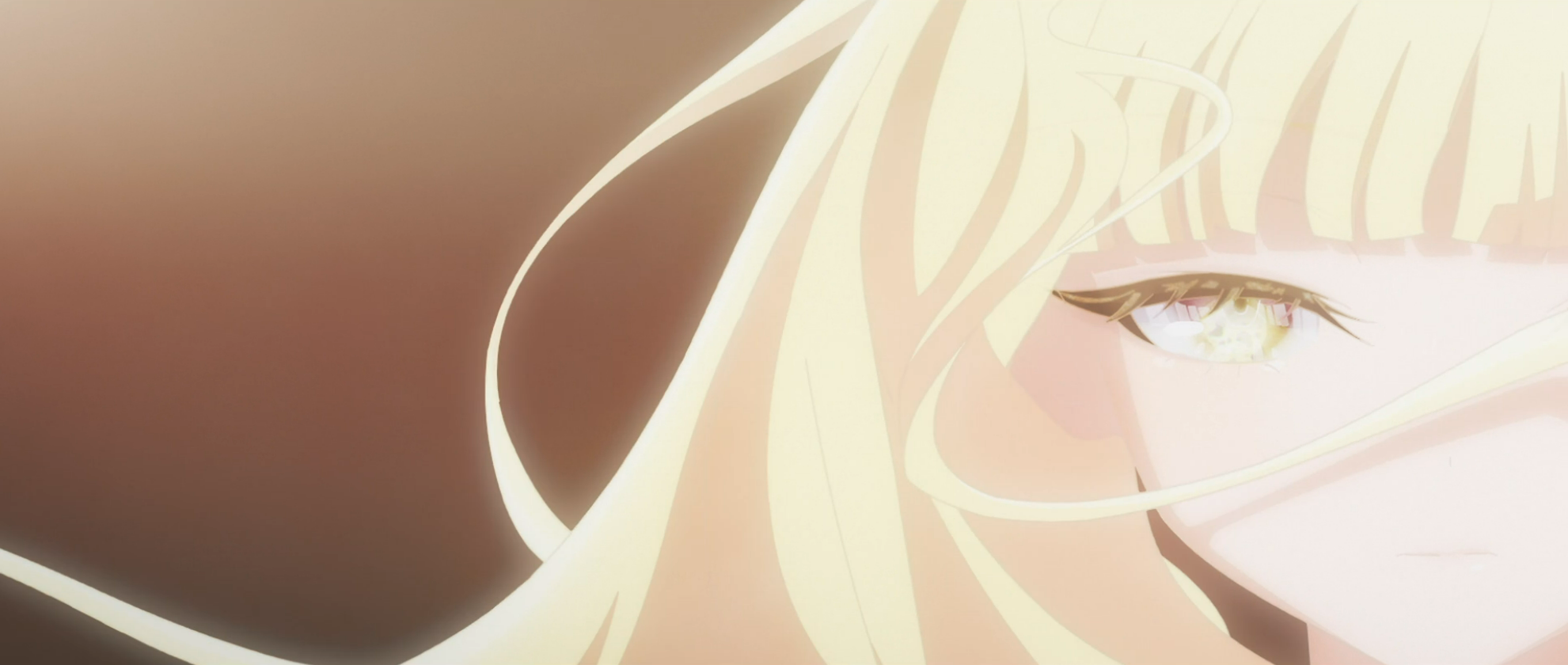
Mineral eyes, you know?
SPOILERS FOR EPISODE 1 OF SHIBOYUGI
Many years ago, I watched an anime called Akame ga Kill. In that show, there’s a pink-haired character named Chelsea who dies in a pretty horrible, pretty graphic way. In the wake of that episode, I penned what is very likely one of the most naïve pieces I’ve ever written, titled “Akame ga Kill: A Reflection on the Futility of Violence?” You can still go read the article; I basically answer my own question in the first sentence of the third paragraph (the answer was no), but I was younger then.
(Interestingly enough, I referenced that same article much more recently (relatively) in a piece on the Shibuya Incident arc of Jujutsu Kaisen in the wake of that show killing off a major character. Let me tell you: I was not trying to find some kind of deeper meaning that time around.)
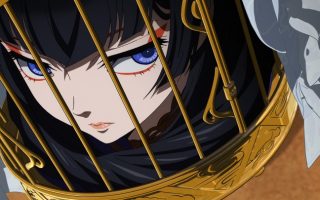
That brings us to today, and the recent premiere of the TV anime adaptation of Yushi Ukai’s Shiboyugi: Playing Death Games to Put Food on the Table, directed by Souta Ueno at Studio Deen. For those who haven’t seen it, Shiboyugi is about a girl named Yuki, a veteran of televised death games where the survivors win cash. You can guess from the premise alone that there are more than few horrible deaths to be had, and indeed the premiere offers three such ends.
What’s different about Shiboyugi, though, is the delivery. Or at least, that’s one of the differences.
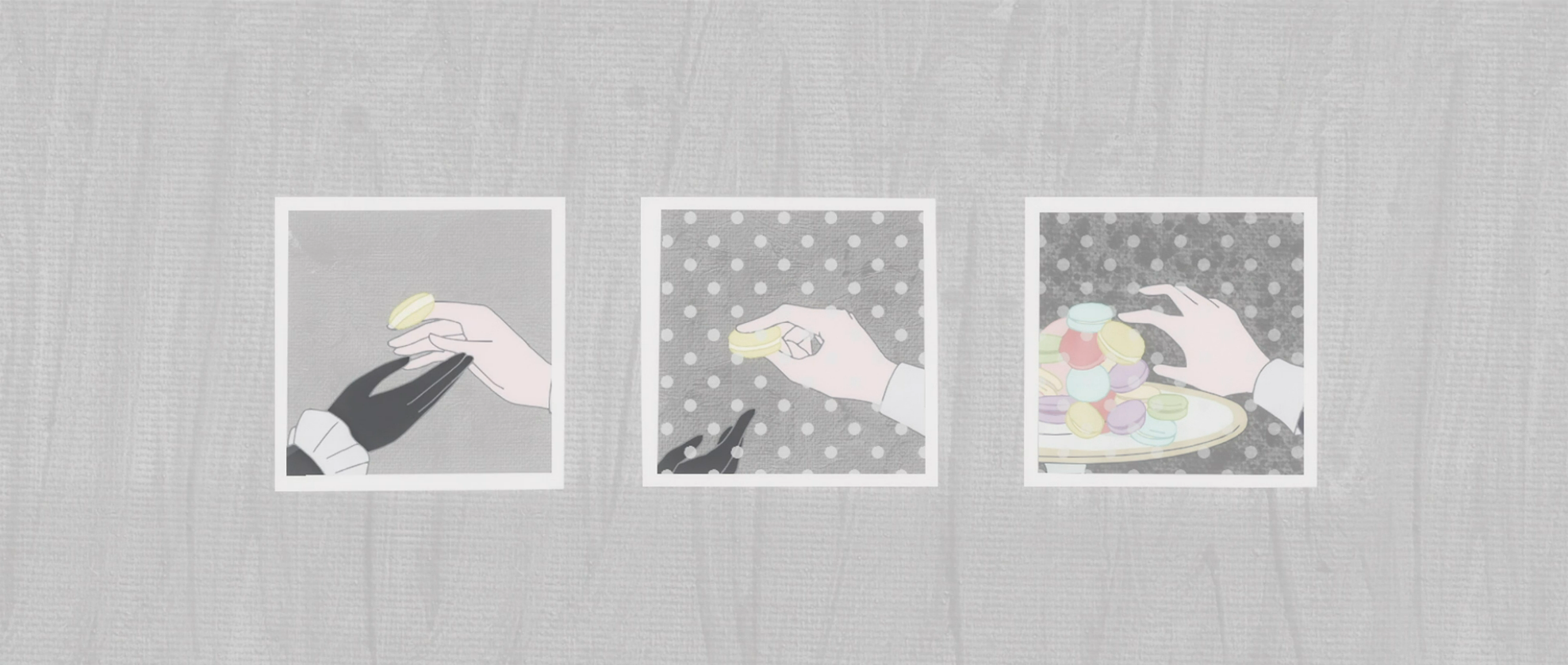
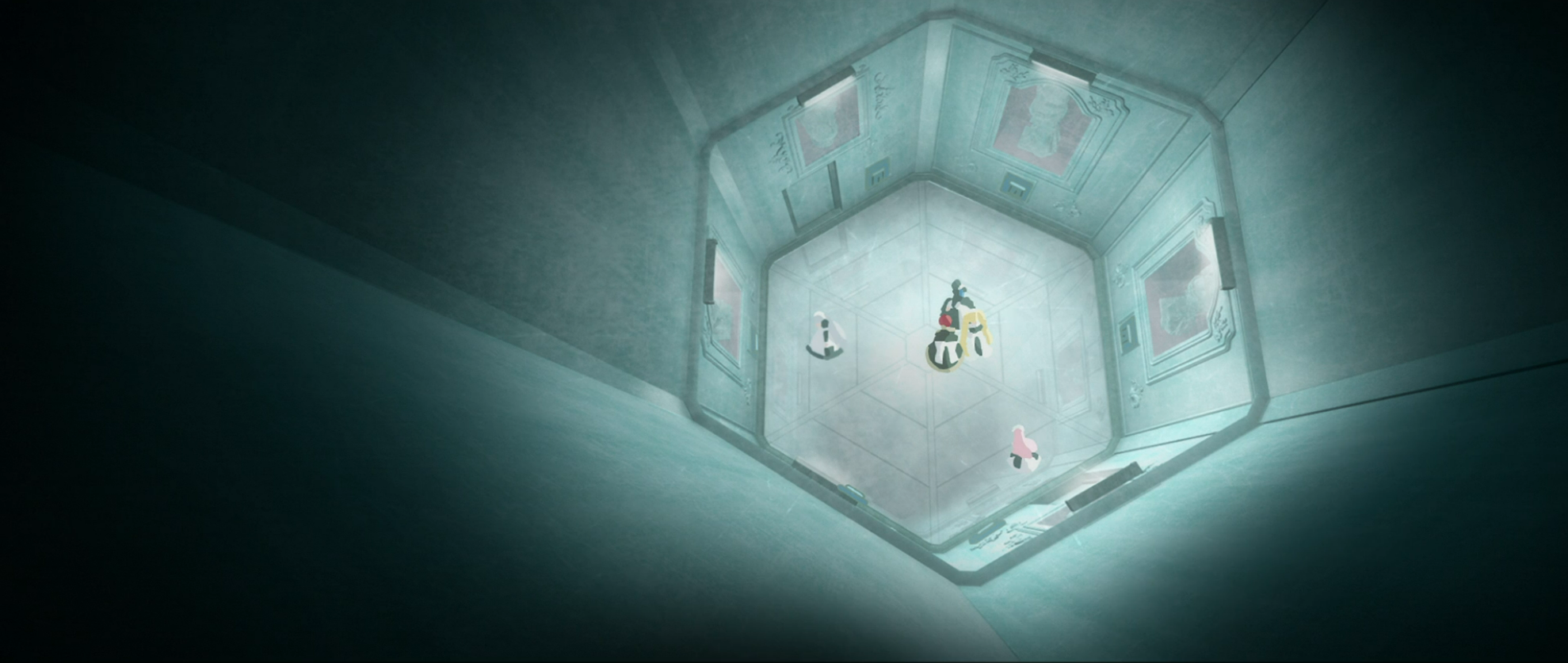
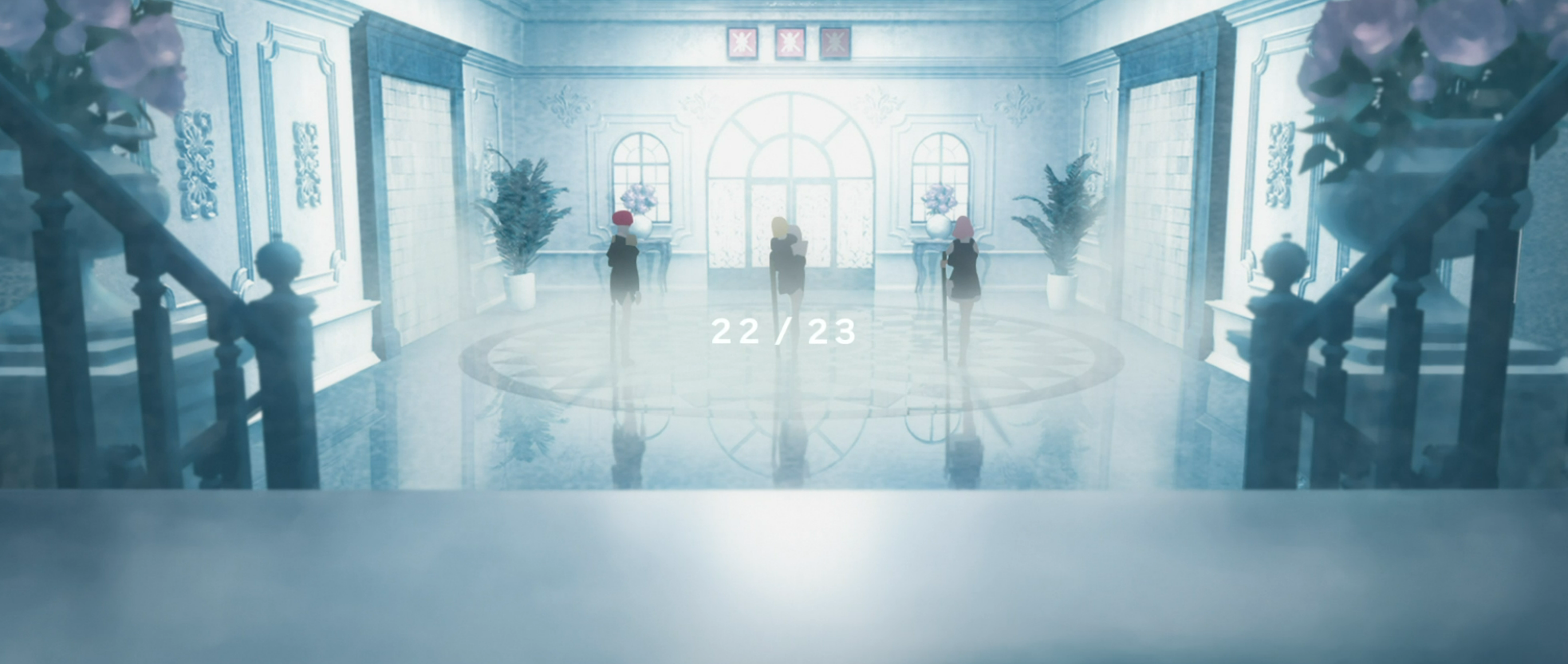
Director Ueno exploded on to the anime scene (at least, if you’re in a the particular turbonerd sphere that cares about things like TV animation directors with arthouse sensibilities) in 2024 with his work on Gimai Seikatsu, and his spacious, desolate yet near-ornamental delivery of a single-episode story about six girls in a death game appears to be continuing along the path that drew so much attention two years back. Shiboyugi‘s premiere is arresting from the outset; quiet, restrained, and tense. The first head rolls (metaphorically) takes a while to roll, but the combination of protagonist Yuki’s matter-of-fact response and Ueno’s sedate direction keep the impact muted.
The same can’t be said of the second death, as the pressure of rising water and falling saws lead to Aoi’s non-exceedingly-graphic yet nonetheless horrifying exit. Although her screams aren’t quite in the forefront of the sound mix, they’re impossible to ignore. In contrast to Kokutou’s sudden offing, which I imagine had little emotional impact on most viewers, Aoi’s death feels much, much worse to watch. The stress of the set-up, the human complexities of Beniya, Momono, and, ultimately, Kinko’s saving of themselves, the extended time allotted to the sounds of Aoi’s agony, and the juxtaposition of it all against Yuki’s emotionless monologue is genuinely distressing.
At least, it was for me.
When it comes to art, craft is on its own inherently interesting, even if as nothing more than a curiosity. How craft informs and impacts experience is, without question, the more personal and thus more interesting topic to consider. I don’t think this is a particularly fresh conclusion, but some have said that most wisdom is simply saying obvious things in easy-to-understand ways—not that someone doing the watermelon otter with a pretty girls death game anime could claim to be wise.
Nonetheless, I can’t help but think that, had Shiboyugi been delivered in the tactless manner of Akame ga Kill or with the insulting carelessness of Jujutsu Kaisen, I would not have found myself quite so unable to look away.
In fact, it is the very craft of Shiboyugi‘s premiere that left me pondering not only the episode itself, but also dissecting my own response to it. For example, let’s return for a moment to the contrasting reactions I had to the first two deaths. My description of Kokutou’s death was probably enough to make clear that I didn’t have anywhere near the same level of upset about a quick, soundless dart through the skull as I did about Aoi’s extended anguish.
I had at one point in the wake of Aoi’s death been thinking something along the lines of, “Well, I’m actually glad to know I don’t feel good about watching a death scene like that.” But is that really the case? Like, actually, what the hell am I talking about? Is a death only bad to watch if the person is desperately screaming while getting ripped apart (off screen, even!) by saws? Am I not just a hypocrite when a quick, sterile death makes barely a ripple? Sure, there was a clear difference in physical and emotional suffering, but even so…!
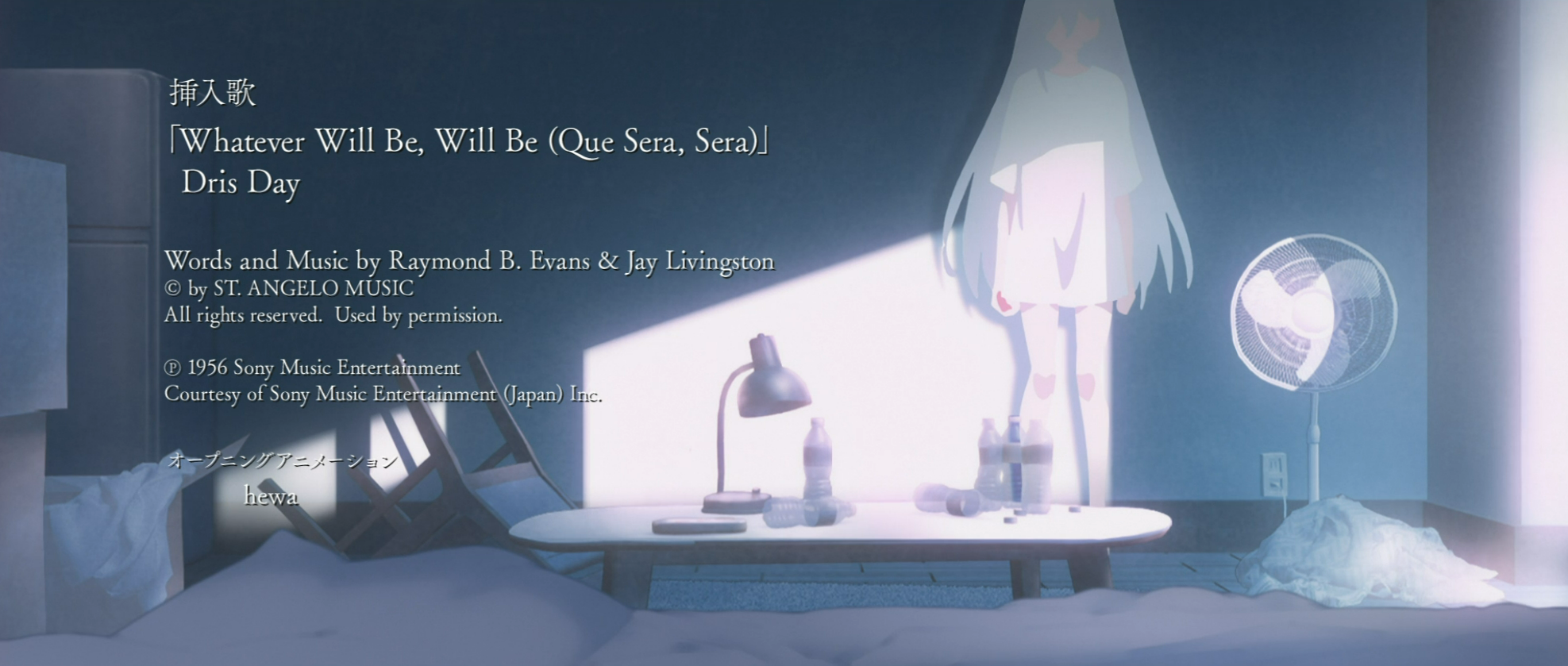
Or, what about when I allow the (deranged but extremely funny) decision to play “Que Será Será” in the intermediate aftermath of Yuki’s decision to coldly murder Kinko to interrupt the feelings of misery I might have other dwelt in following a death that destroyed the seemingly redemptive narrative mini-arc that preceded it?
Apparently, I’m not quite as commendably touched by death as I might like to think.
In my defense, I’m only human. Also in my defense, this is, as I’ve said, what craft is all about. The difference in delivery—visually, aurally, and contextually—not only mediates my experience but also impacts (or perhaps you could even say manipulates) my reaction to each event. And the fact that I can sit here and reflect on this, interrogating not only the show itself but also the ways in which I felt it was interrogating me, excites me. Although the material isn’t the kind of thing I’d naturally gravitate toward, this kind of complexity is something I do find myself craving more and more.
So, a word on the content. A part of me wonders just how much different this blog post talking in part about Ueno’s directorial choices would be given a story with different material; that is, a story that didn’t feature quite as much death. In particular, death game anime seem almost inevitably designed to prompt strong reactions. When the deaths aren’t sanitized of their associated physical and emotional suffering, regardless of how graphic they are, when the deaths are bleak and senseless and, in a way, meaningless, what are you left with but the rawness of a life ending? I’ve been told that Shiboyugi is likely heading in the direction of even more of that, so we’ll have to see if it’s something I can stomach.
Where this all ended is with me asking myself, both during the episode and afterwards, whether I was enjoying what I was watching and, even if I wasn’t, whether I liked it. The combination of content that I’m not inclined to enjoy (this is the “nothing I want” part of the post title) with craft that I very much did enjoy meant that the answers to those questions were not at all easy. In fact, I still don’t know. The craft of Ueno and his team prevents me from dismissing the material on instinct and engages me in a way I would not otherwise be engaged.
At this point, I don’t know if I’m going to watch all of Shiboyugi. It may turn out that even the unique direction isn’t enough to let me tolerate all the death that is on the way. We’ll have to see how I feel about the next episode. But, even if I check out only two episodes in, I’ll be thankful to have gotten to watch something as unique as this premiere and gotten to enjoy the mental and emotional process of considering my own feelings and reactions to it. That really is the kind of thing I’m craving from anime.
Even if I philosophically disagree with killing maids rather than cherishing and protecting them.