
Hello folks, and welcome back to Wrong Every Time. My house is currently buried under the biggest snowfall we’ve received in half a decade, making travel anywhere beyond a five hundred yard perimeter basically impossible. Fortunately, that only gives me all the more incentive to sit here and watch movies, thereby passing all those savings on to YOU, my beloved readers. And we’ve certainly been doing plenty of that, alongside variable anime and TUBI screenings. We actually just polished off the last season of My Hero Academia, which was forced to compete for screentime with “The Pirates of Dark Water,” an early ‘90s Hanna-Barbera relic that turned out to be an unexpected delight. I particularly appreciated how its characters just sorta kept integrating more of their own world’s lingo in the place of any child-unfriendly swear words, resulting in a production whose final episodes involved more exclamations of “chungo-lungo!” and “noi jitat!” than actual words. Anyway, that’s all on TUBI if you’re curious, but in the meantime, let’s run down some films!
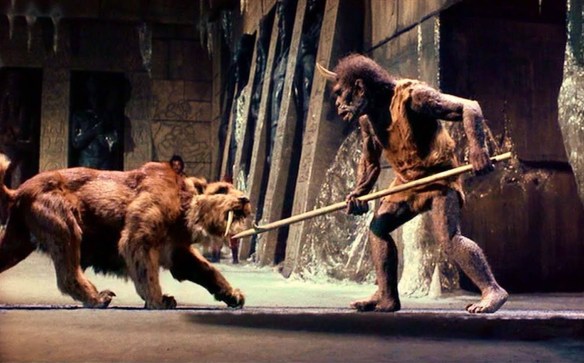
First up this week was Sinbad and the Eye of the Tiger, the third and final Sinbad film featuring the talents of Ray Harryhausen. Now played by the unfortunately stoic Patrick Wayne, Sinbad is tasked with breaking a curse cast on his friend Prince Cassim by the nefarious Zenobia, which transformed Cassim into a marvelously animated stop-motion baboon. Sinbad and his companions will travel to the land of Hyperborea, where legends say the Arimaspi people hold the cure to Cassim’s plight.
Harryhausen himself admits that the production of this one was somewhat rushed, leading to a certain shapelessness of plotting, as well as a sense that the awkwardly self-derivative stop-motion sequences aren’t gracefully fitted within the contours of the narrative. Additionally, Patrick Wayne can’t act; John Wayne’s talents apparently didn’t filter down to his second son, and so every time one is asked to pay attention to Sinbad’s words rather than his delightful series of pink shirts, the drama suffers.
Nonetheless, while an uncharismatic Sinbad is certainly a letdown, neither actors nor plot have ever been this franchise’s claim to fame: that honor belongs to Harryhausen’s miniatures, which still delight here in their diversity of form and complexity of choreography. Prince Cassim’s baboon form is frankly astonishing, and the final battle between a giant and sabretooth tiger (Harryhausen sure loves sabretooth tigers) counts as one of the most impressive in his career. Eye of the Tiger is inconsistent relative to its predecessors, yet still eminently watchable; in truth, a lighthearted adventure adorned with Harryhausen creations enjoys as high a floor as you could hope for.
We then checked out Latitude Zero, a ‘69 tokusatsu American-Japanese co-production directed by Godzilla legend Ishiro Honda. When three men in a bathysphere become trapped by an undersea eruption, they are rescued by a submarine hailing from Latitude Zero, an undersea paradise full of doctors, scientists, and other notables who were presumed lost at sea. However, the tranquility of Latitude Zero is soon threatened by the nefarious Dr. Malic (Cesar Romero), prompting a battle between humanity’s greatest and most maliciously warped of minds.
Latitude Zero gestures towards thematic heft in its disagreements regarding individualist versus collectivist society, calling to mind the arguments of 20,000 Leagues Under the Sea, but is otherwise content to be a campy, enjoyable, and unfortunately shapeless adventure romp. Cesar Romero is the film’s saving grace; his melodramatic performance feels like the only one that actually matches the indulgences of the narrative, which include such fanciful devices as a woman whose brain is transferred to a winged lion with no apparent loss of functionality. Otherwise, Latitude Zero proceeds like an overlong yet underwritten original Star Trek episode, revealing too little of its titular paradise to either dazzle or emotionally engage. An easy viewing, but nothing I’d actively recommend.
Next up was Tank, an ‘84 action-comedy that pits an aging military officer against a corrupt small-town sheriff. James Garner plays an NCO looking forward to retiring and spending time with his wife and son, who faces off with G.D. Spradlin in the role of the nefarious sheriff, one in a long line of villainous starring roles. When Spradlin puts Garner’s son in jail for a crime he didn’t commit, Garner responds in the only way he can: by driving his old Sherman tank straight through the jail, up the highway, and onward to a presumably fairer trial.
Tank is a film of humble means and humble ambitions, mostly concerning itself with feel-good takedowns of corrupt cops and upbeat sequences of Garner’s tank rumbling down the avenue. It takes a while to get there, though; the film’s first half is actually a pretty straight-laced portrait of Garner’s integration into near-retirement, after which it swerves dramatically into farcical territory for the whole tank adventure. But Garner’s genial presence keeps the whole enterprise enjoyable enough, making for an entirely unexceptional but mostly agreeable experience.
We then checked out Rec 2, the sequel to the acclaimed Spanish found footage production, wherein a reporter assigned to cataloging a firehouse’s night shift ends up stuck in a zombie-infested apartment block. This sequel actually takes place at nearly the same time as the first film, following both a tactical police unit and a group of teens as they infiltrate that same increasingly blood-drenched building. Answers are sought, zombies are fought, and the two groups must eventually come together, seeking a cure to the sickness before it breaks containment entirely.
I generally don’t consider this particularly meaningful criticism, but the main word I’d use for Rec 2 is “superfluous.” I know, I know, that’s a very limited, novelty-first way of approaching a film, and god knows there are plenty of films where “more of the same” is exactly what I want from a sequel. But without the slow buildup and frantic surprise of the original film, Rec 2 feels like it loses more than your average second verse/same as the first sequel, demonstrating that it was the act of lightning escaping the bottle that made the first film so compelling. Without an apartment full of living residents to winnow away while ramping tension, Rec 2 proceeds too much like a videogame, a series of corridors that all feature more or less the same rabid bad guys.
There are bright spots here, for sure. I believe leaning more into the Catholic lore of the premise was an effective shift, as it offered the film a more central, intelligent antagonist than its predecessor, as well as giving the film a structure and quest beyond the chaos of the original. I also quite liked a trick they pulled near the end regarding natural versus UV light, finding a fresh thread of horror in the mechanical fundamentals of found footage cinematography. And it’s still a competent production on the whole – it’s just an inessential follow-up to a subgenre classic, which is ultimately a perfectly fine thing to be.