
Hello folks, and welcome back to Wrong Every Time. This week has seen us brave winter’s fury and emerge victorious, after having shoveled roughly eight tons of snow from my apartment’s driveway. I’m still sniffling, coughing, and generally enduring the personal indignities of nature’s most hateful season, but it appears there may well be a light at the end of the tunnel.
That aside, this has mostly been a week of tidying up outstanding projects. My house at last finished Ranking of Kings after initially losing momentum early in its second season, and also munched through Fantasy High’s Junior Year, leaving us with just one season of Intrepid Heroes adventures to watch through. Fortunately, the great drought of Critical Role’s end-of-year vacation has ended, leading us into the distinct pleasure of Mercer versus Mulligan as we join up with the second of Campaign Four’s three separate tables. We’ve also just cracked the seal on Fallout’s second season, which has in turn prompted fresh stabs at Fallout 4’s inconsistent pleasures. It frankly boggles the mind that Bethesda has spent a straight-up decade making games nobody wanted when the next Elder Scrolls is sitting right there, but I’m doing my best to find joy in blasting mudcrabs while we wait. Oh, and movies! Yes, let’s talk about some movies.
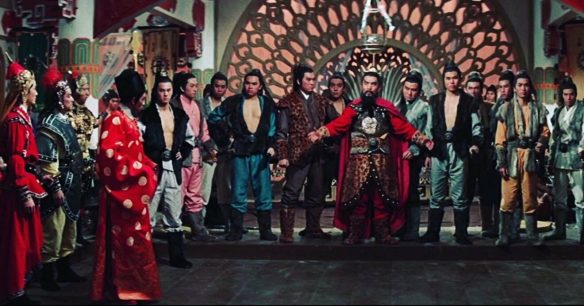
First up this week was The Heroic Ones, a 1970 Shaw Brothers production directed by the legendary Chang Cheh (One-Armed Swordsman, Five Venoms, Kid with the Golden Arm, and many more). The film is set in 880s Imperial China, and centers on a pair of local chieftains: the rebellious Huang Chao and the loyal Li Keyong. After Huang Chao invades the imperial capital, Li Keyong sends his thirteen adopted sons, the “Thirteen Generals,” to restore peace, prompting a great deal of bravura spearmanship and a series of scandalous betrayals.
The Heroic Ones stands as a particularly lavishly scaled and costumed entry in the Shaw Bros canon, with great parades of warriors and massive battles encompassing full martial encampments. Sadly, the actual story being conveyed in such decadent fashion is a bit of a disaster. In spite of significant screen time spent delving into the theoretical machinations of the film’s central political dispute, its lead characters act so stupidly that it’s difficult to feel invested in their struggles; the film would be more accurately titled “The Gullible Ones,” given how swiftly and wholeheartedly they fall for every half-assed ruse.
To provide one example, a key scene involves the heretofore central general being tricked into believing his lord is angry at him, purely because two characters who openly despise him tell him so while holding his lord’s sword. To pay penance, he submits to being tied up to be quartered before actually meeting with his lord. In a brief moment of lucidity, he stops to question whether this is the proper method for demonstrating fealty; upon being assured this is all on the up and up, he again submits, and is promptly quartered. Such flourishes of idiocy dog the film from beginning to end, wherein the villains manage to pick off a few more generals by repeatedly saying “wait, time out” during the final battle, only to immediately stab a guy when their opponents relent. All in all, The Heroic Ones is overlong relative to its simple narrative, weak in characterization, and only so-so in terms of its action; a lesser Chang Cheh effort on all counts.
We then screened Howard’s Mill, a found footage horror feature framed as an investigative report on the titular plot, where a local man’s wife has recently disappeared without a trace. After initially laying out the facts of the case and investigation, the film digs into the larger history of the site, discovering that mysterious disappearances have been a feature of the land for nearly a century. And though some answers eventually do surface, their implications only cast a deeper shadow on the land, implying a presence beyond mortal reckoning.
Howard’s Mill is a scrappy production constructed largely with a drone and a dream, one which successfully apes the stylings of exploitative true crime or ghost hunt operations. An intriguing premise and novel conceptualization of the supernatural does a fine job of obscuring the film’s lack of meaningful horror payoff; weird horror often thrives in implication, and contrasting the lonesome power of the mill against the clumsy, exploitative trappings of budget investigative reporting results in a satisfyingly queasy tonal mix. Probably too slow and reserved for most horror fans, but of note to enjoyers of slow-burn mixed-media ghost stories like Ghostwatch or Lake Mungo.
We then continued our march through the grand Godzilla canon with the redundantly titled Godzilla 2000: Millennium, the first film in the franchise’s third major era. With Godzilla apparently a known quantity in this era’s chronology, the film follows dueling groups of scientists, some working with the Godzilla Prediction Network to better identify Godzilla’s movement patterns, others with the government’s Crisis Control Intelligence group in order to destroy the beast altogether. However, when a massive meteorite raised from the sea floor reveals its own nefarious intentions, scientists and giant lizards alike will need to work together to save the planet.
It seems pretty much universally acknowledged that this third Godzilla era is the weakest stretch of films, and this introductory entry offers some obvious reasons why. Millennium relies heavily on two visual techniques that have both aged terribly: early CGI models and clumsy multiplanar composites, wherein Godzilla is superimposed over footage of Japan’s cities and coastlines in an entirely unconvincing visual patchwork. The film fortunately climaxes in a good old-fashioned rubber suit kaiju brawl, but its earlier acts are a visually unsatisfying semi-spectacle, and its narrative feels more thinly written than even the “Godzilla fights aliens I guess” middle years of the Shōwa era. Certainly an inauspicious start to a new millennium of kaiju features.
Spurred on by my recent viewing of a Yoshikazu Yasuhiko documentary, we then checked out the Crusher Joe film adaptation. Based on a series of novels by Haruka Takuchiho, the film follows the titular Joe and his trusty crew, who as “crushers” basically take on any kind of above-board mercenary work. After being tricked into illegally transporting a scientist possessing galaxy-threatening professional secrets, Joe and his allies must race to both clear their names and save the universe, fending off assassins, private armies, and the space police force all the while.
Crusher Joe is a classic, old-fashioned space adventure, exemplifying in its every aspect the punchy stories and glorious animated possibilities of the medium’s ‘80s heyday. The film’s speedy pacing and regular reversals of fortune keep things moving as Yasuhiko and his team offer an embarrassment of visual riches, pulling off absurd flourishes of perspective shift and scale-raising, alongside copious quantities of playful, personality-rich character acting. The larger beats of the plot won’t surprise you (everybody’s chasing a space McGuffin that’s actually a human woman!), but the narrative is sturdy, characters likable, and animation astonishing more often than not. Highly recommended for any fans of scifi adventures.