Hello folks, and welcome back to Wrong Every Time. Today I once again find myself in the unexpected position of screening a universally acclaimed Star Wars production, the much-heralded ninth episode of Star Wars Visions’ third season. Each of these “Visions” seasons features a sprawling collection of animators and production studios, with each individual episode offering a different team’s take on some aspect of the Star Wars universe.
While I’m generally a big fan of animated anthology projects, that overarching “Star Wars” label has kept me from checking out Visions in particular, as I’m just plain tired of the franchise’s wildly oversaturated tropes and tones. However, just as Andor successfully harnessed Star Wars’ mythology in service of an original, astonishing work of political theater, so have I heard that Visions’ most recent season offers a work of singular talent and vision, in the form of its Shinya Ohira-helmed ninth episode.
I doubt there’s an animator in the industry who would refer to Ohira as anything less than a living legend. His fluid, ever-morphing forms possess a vitality unlike anything in the medium, and his contributions to productions ranging from Akira to The Boy and the Heron are some of the most captivating, unbelievable feats in animation history. His style of relentlessly shifting full animation is an outlier in an industry defined by compromise, and having assembled a preposterous team of similarly talented animators (Kou Yoshinari! Bahi JD! Daniel Kim! Masaaki Endo! Takeshi Honda! Weilin Zhang! Vincent Chansard! Toshiyuki Inoue!) for this project, I imagine we will here see him working without compromise, demonstrating a fluidity of form, scale of visual drama, and ambition of concept that will surely boggle the mind. Let’s get to it!
Black
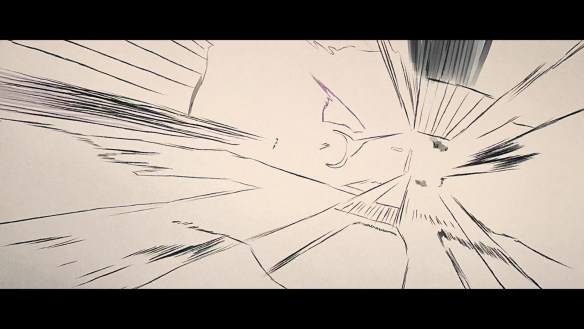
As expected, even our very first cut is a marvel. It’s a sequence conveying movement into depth through rough-hewn gestures towards mechanical surroundings, the texture of the paper itself clear in the roughly sketched outlines of great structures, the full blots of ink conveying space and shadow. There is little in anime like it, and that’s true of basically everything Ohira works on; my first points of reference are his lightly sketched yet incredibly voluminous contributions to Ping Pong the Animation’s opening, or perhaps the physical flights of fantasy realized in Fantasia
We appear to move through the synapses of a mind or some similar network, all of which is lovingly painted rather than digitally colored. There is a tactile sense of substance to traditionally painted animation, a sense of texture that promotes its own feeling of internal reality
At last these forms resolve into recognizable shapes – an X-wing, a tie fighter, a bombing run on a presumed Death Star. And yet the sense of momentum remains astonishing, as our “camera” floats and soars alongside these dancing ships, often tracing the path beside a mechanical starship too massive to convey in a single shot. This is what I was referring to by “scale of visual drama” – Ohira often conceptualizes scenes that stretch animation’s capacity to coherently convey visual concepts, and only holds such scenes together through preposterous attention to detail in the continuity of partial shapes flowing across the scene. Rather than his morphing forms creating a sense of dissolution or incoherence, it is precisely the naturally, continuously flowing lines of these forms that maintains our understanding of their overall shape
We then cut to an extreme closeup of the eye of a presumed soldier, the forms still flowing, linework and color design evoking a sense of almost chalk scribbles
The battle is messy, almost incoherent, yet parsable as two wounded men fighting aboard a dying starship. The overall theme seems visually clear – the violence of war is senseless, madness, like two wolves biting at each other in a burning building. What will this brutal, desperate fight accomplish?
Love the rough-smeared paint of this next sequence, with forms dissolving like chalk in the rain. Inoue, maybe? It wouldn’t surprise me
The individual drawings are exceptional, yet all fly by in a chaotic swirl. As I said, Ohira’s style is incompatible with anime production as a whole; this is a medium of shortcuts, yet he takes none, actually pouring more into each individual drawing than an audience can even perceive at first pass
The principle of squash-and-stretch is drawn to a grotesque extreme as the two fight, their forms distorting with the fury of their scrambling, to the point where one even starts to perceive the other as a massive green wolf
That color-coding also points to the senselessness of battle – these men are nothing more than “red” and “green,” separated by nothing consequential, aligned in their desperation to survive
Whew, this sequence where we draw back to see both of them grappling is remarkable all in its own ways. Love the rough application of color beyond the lines, as well as the contrast of this battle against its twin reflected on the ground
We then cut to a remarkable full-scale assault with its own visual vocabulary, this one offering wobbly hatched shading that serves to compliment the variability of the line weight; the forms embody the commotion of battle while the overall composition retains absurd clarity, depicting weighted movement of half a dozen soldiers as we pan forward across an exploding battlefield
The next sequence is all variations of shadow, once again conveying the demon of war as a living beast in its own right, a black hand looming over the soldiers and spurring them onward
Our soldier recalls his training as the fires burn, seemingly at a loss to understand how such a path led him to this hell. The fact that this is a Star Wars property seems wholly incidental to its purpose; this really could be any war at any time
More excellent flourishes of shading as the soldiers are drawn up into a maelstrom, this time conveying a sense of shattered black chalk or even sand. I recall Mob Psycho 100 had an artist who employed a somewhat similar trick, constructing Mob’s form in an almost pointillist style
Our next sequence revels in digital innovations, embracing our ability to transpose partial images atop each other bound by contiguous post-production lighting effects, as we see a presumably dying mind reflect on both the lost joys of human existence and our existence within the natural cycles of death, consumption, and rebirth
Our one-armed soldier imagines himself lying by the water next to a lost love, before recalling his current position within this endless graveyard. The perpetually dancing butterflies create a surreal connection between the two scenes, while also simply punching up the composition by offering points of moving interest all across the screen, thus maintaining continuity with the constant fluidity of the prior sequences. One of the great failings of modern anime and cinema alike is our movement towards shallow compositions offering only one point of interest; truly great compositions are often designed to be lost in, overwhelmed with the small stories taking place in the backdrop of our principle drama
This sequence of rows of stormtroopers marching towards oblivion calls to mind one of Hayao Miyazaki’s most persistent images: the endless passage of warplanes and battleships into the afterlife, all the lost souls making their way to whatever lies beyond
We then cut to a swirling closeup of a pilot’s eye, which eventually pans out to reveal a flight of tie fighters approaching battle. Though there’s obviously some continuity across Ohira’s AD’d work here, I believe this sequence is actually Vincent Chansard; his ability to conjure a sense of voluminous solidity while panning through 3D space is unparalleled, and that strength seems clearly at work here
The fluidity of movement and freedom of camera perspective is ludicrous; a base principle of animation is “detailed objects are much harder to animate, particularly if you’re shifting perspective,” and the absurd detailing of these spinning tie fighters flies fully in the face of that wisdom
A wild sequence in all red, white, and black as a stormtrooper flies a speeder over a collapsing starship. The shifting forms ably convey the speed of the craft in motion, while our closely bounded perspective allows the CG backdrop to fade in our perception
The movement of these bikes is glorious yet erratic; spinning through space, it appears as if no one controls their wild flight. It is difficult to portray action scenes without in some way validating the idea of violence being “cool” or validating; here, the mania of the motion makes it emphatically clear that no one is controlling the outcome, that this fight is something every participant is being equally, meaninglessly subjected to
We then cut to another animator to follow an X-wing in flight. I particularly love the flame animation here; these explosions coil and burst like lightning, capturing the inherent sense of perpetual reconstitution that is the essence of a roaring fire
I wonder who handled this sequence of stormtroopers falling into an emerging hole in the ship? The forms seem more solid than the standard, which I assume points towards one of the new gen animators
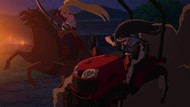
Excellent pacing of the movement here as our two warriors clash atop galloping steeds; the motion of the horses and visually perceivable panting of the soldiers is perfectly timed to the beat of the backing track
Their forms collapse and merge into a giant spectral eye, which in turn echoes the collapsing Death Star. In spite of their desperate battle, they dissolve equally and as one into shapeless stardust
God, the way this sequence conveys both the weight of their exhausted bodies and the overpowering pressure of the air drawing them off this doomed battlefield. Ohira’s fluidity of form being championed as the overarching principle of a project like this is resulting in some unbelievable achievements
The dying men struggle to clasp hands as the ship collapses around them. Though they have accomplished nothing, they at least both survived to offer companionship in this moment of oblivion
And Done
Dear lord, what a goddamn incredible production! What a ludicrous amalgamation of animation talent, with every artist lending their unique visual sensibilities to a harrowing vision of war’s absolute hysteria. That’s the kind of cinematic vision that forces one to remember to take breaths, to not be fully swept away by the urgency, vitality, and horrible beauty of the events on screen. Absolutely tremendous work by Ohira and his team, demonstrating multiple generations of the absolute peak of animation talent, and fitting them all into a somehow semi-coherent tribute to Ohira’s own distinctive visual fascinations. While anime’s increasing globalization has led to a number of negative consequences for the industry, I’m always happy to see creators like these given an open canvas to work their wonders. That was something special indeed.
This article was made possible by reader support. Thank you all for all that you do.