Can human beings truly come to understand each other? Can we untangle ourselves from the bitter biases of our own hearts, applying only what insight might be considered “universal” to our judgment of another’s feelings? And what is truly “universal,” what core of humanity might be extracted from the threshers and autoclaves of lived experience, might be applied without error in our assessment of another’s feelings? Is there any way of analyzing human psychology while removing the human element, or are we all just applying personal frameworks of purpose, passion, and morality to stories built on wholly incompatible fundamental assumptions?
As Monogatari tells it, the core prerequisite of effectively reaching out to another is to have already reached out to yourself, to have navigated the traps and terrors of self-analysis and arrived at some semblance of peace with your own identity. This is not as easy as it seems; many people go their whole lifetimes without engaging in this process, seeking through external validation the contentment they could never find through clear-eyed engagement with their own underlying motives. And even to unflinchingly pursue self-knowledge can only ever be a practice; our passions are less a fixed point than a living creature, a beautiful beast whose needs must be tended and form reassessed on a daily basis.
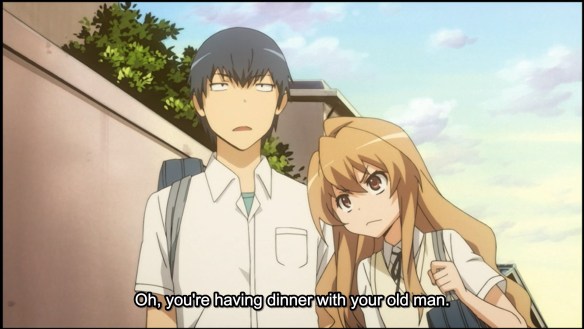
All of this is to say that it is not surprising that Ryuji hurt Taiga so badly. Though he has come to a certain peace with his oft-lamented appearance, and acquired friends who respect and care for him, he has never grappled with the beast inside him, the sense of abandonment that motivates so much of his moral philosophy. Everything Ryuji believes about “what a man should be” is derived from his father’s shadow, and Ryuji’s determination to not fail others the way his father failed him. This wound has made him loyal and gentle, soft-spoken and kind, but it has also left him blind to the ways that even a father who stays in their child’s life might still be failing them. He cannot see Taiga’s father, not really; he only sees his own father walking eternally out that door.
As such, when Taiga was given the “opportunity” to again be a part of her father’s life, Ryuji encouraged it with all the guarded hope he still held for his own long-sought reunion. If he had previously shared his true feelings regarding his father with Taiga, perhaps she would have been better equipped to interpret his words – but these are two teenagers we’re talking about, each of whom have been given every reason to conceal their desires, and neither of whom fully understand what they themselves want. They have arrived at an assumed closeness built on the one form of longing they felt comfortable sharing, but when the topic at hand diverged from their shared feelings of romantic desire, their assumption of shared premises became a trap. Though they wish only the best for each other, the distance between their experiences of fatherhood, and their inability to actually talk through their feelings, ensured Ryuji’s unspoken needs would trample Taiga’s lived experience.
Thus we endured the calamitous first day of the festival, wherein Ryuji’s assurances led Taiga to embrace the unflattering costume her classmates had assigned her, determined to realize a performance transposed from Ryuji’s own fiercely guarded desires. Stacking falsehood on top of falsehood, she played the contemptible villain for a chance to play the beloved daughter, only to be reassured that the first performance is all she’d ever be good for. Their fragmentary mutual understanding has led them to an accidental betrayal, as Ryuji’s dreams of parental reunion collided with a parent ill-fitted for their fulfillment.
Still, life marches on, as Toradora!’s thirteenth episode immediately reminds us. We open on a shot of their play’s poster, now taped over with the announcement that all performances have concluded. But though both Ryuji and her father have failed her, Taiga is currently receiving support from an unexpected source – Ami Kawashima, whose antagonism towards the palm-top tiger has now faded into a grudging concern and respect. Having failed to trade places with Taiga during the play performances, it seems her sense of obligation has led her to ply her honed talents in service of a make-up performance, as she literally applies Taiga’s makeup for the school’s beauty contest.
Meanwhile, Taiga herself remains certain that her father was merely held up by work, and will surely make up for his tardiness with a consolation gift. As she delays acknowledging this fundamental betrayal, Ryuji can only offer superficial support, handling incidental physical challenges like the tailoring of Taiga’s dress. His obliviousness to the true problem at hand is exemplified by his ignorance of Taiga’s assumed beauty contest lines; his directives have overstepped his understanding of Taiga’s feelings, to the point where he can’t even imagine how Taiga will fulfill them. Their disconnect is underlined by an eerie piano line that would feel right at home in Twin Peaks, as they each dream of a father that doesn’t exist.
“No matter how late it is, he’ll surely come running, right? That has to be it, because that’s what it means to be a father.” Bound by his own lifelong disappointment, he sees fatherhood as a binary proposition – there are no “bad fathers,” there are only good fathers and the man who abandoned him.
Then it’s on to the beauty pageant itself, hosted by Ami Kawashima in a goddamn dominatrix costume. It’s certainly a bold choice, but also feels appropriate for this moment in Ami’s journey, as she begins to integrate her own honest feelings into her stage performances. It’s a choice that also raises a question of her intentions regarding the preceding performance; just as Taiga wished to for once be seen as the hero, perhaps Ami wished for the privilege of embracing her uncharitable feelings, and playing the villain she knows she’d embody so well. Even if her spite can only be realized through the mask of an assumed identity, that’s still progress; and hey, if her indulgent costumes only amplify the adoration of the crowd, that’s just a convenient side benefit.
As Ami introduces one contestant after another, Ryuji at last receives the news via a text message: not only will Taiga’s father not be appearing, but he’s also abandoning his intentions of living with her altogether, claiming only that “something came up.” What’s more, he isn’t even willing to break this news directly – just as he relied on Ryuji to convince Taiga to trust him, so now is he forcing Ryuji to break that trust. The most closely guarded hope of both Ryuji and Taiga’s hearts was only ever an idle fancy to him; Taiga was right, Minorin was right, and Ryuji has brought his best friend to ruin.
“Why did I believe him?” Ryuji wonders to himself, still unable to fully recognize his desires. Yet in spite of failing to grasp the source of his feelings, he remains dedicated to the task of interrogating them, acknowledging how he actually felt lonely at the thought of Taiga leaving with her father. All we can ever do is try to make sense of our actions, and that’s not a pursuit that leads to clear winners and losers. It is the work of perpetual questioning that makes us understand ourselves and empathize with others, and it is to Toradora!’s credit how it consistently demonstrates what a difficult, unending process that is.
Thus he at last comes to understand his selfishness, his eagerness to impress his own feelings on Taiga’s situation. And as he wonders what face he might present to Taiga, his friend takes the stage, having assumed the angelic costume that she hopes might earn her father’s favor. It’s a brutal moment of self-rejection, as she abandons her defiant posture in order to play for the crowd – and the following moments are harsher still, as Ami announces her father’s alleged presence in the audience. Playing the perfect angel for her father, “getting along” with the expectations of her classmates – none of it brought her any closer to validation or acceptance. And these clothes don’t even fit; stumbling and falling, she rips the lie apart at the knees, rejecting her own plea for acceptance with tears in her eyes.
In the face of Taiga’s defiance, Ryuji can only offer a tenuous slow clap, in which he is soon joined by a teary-eyed Minori. Thus our crowd of easily swayed students is drawn into a round of applause, prompting Taiga to roar out a condemnation of all fathers everywhere, followed by a somewhat incoherent magical trick. It’s messy and earnest and true, the kind of well-observed personal moment that populates any worthwhile character drama, and a reminder both that everyone is just muddling through, and also that Taiga is far stronger than she might appear. She doesn’t dissolve into hysterics at her father’s betrayal – she’s fought this fight before, and earned the scars to prove it. She is who she is, and if that person is both angry enough to scare her peers and tiny enough to fit in a suitcase, so be it. Standing before her suddenly supportive compatriots, she has nothing at all to prove.
Thus Taiga wins the beauty contest on her own terms – not as her father’s perfect angel, but as her defiant, earnest self. And though Ryuji failed her completely, he is at least given a chance to physically demonstrate his repentance through the festival’s preposterous followup race. He doesn’t wish to direct her or cheer for her or find out what’s best for her; he seeks only what he gained and then lost, the precious assurance they shared, each standing proudly at the other’s side. And Toradora!, in its tremendous generosity of mechanical expressions of emotional intent, is happy to provide him with a physical challenge through which to earn his repentance.
And so Ryuji charges through his hapless classmates, embracing an unglamorous, ferocious disposition in a mirror of Taiga’s defiant stage performance. And as the contestants fall away, it becomes clear he has only one real competitor: Taiga’s stalwart defender Minori, who has always challenged convention, always sought the truth behind another’s facade, and always respected the feelings of her friends. Like Ami, Minori is a few steps ahead of our leads on the path to true self-awareness; unlike Ami, she’s generally willing to extend a hand backwards, to scuff her knees and get mud on her shoes in support of her companions’ painful personal journeys.
In practice, that spirit of charity can often seem quietly heartbreaking. From the first moments we actually got to hear Minori reflect on herself, it has been clear her public persona is an aspirational performance. She has continuously fought her own natural inclinations in order to become the person she wants to be, yet at the same time, her moments of vulnerability have demonstrated that there are vital elements of her personality that have no clear outlet in her public self. She longs to be understood and loved in a way neither Taiga nor Ryuji seem capable of providing; in spite of that, she loves them all the same, and frequently denies herself in order to help them along their path. So it goes for this race, where her delightfully stretchy softball pitching is employed wholly in service of Ryuji’s unearned victory.
Flinging herself atop the next wave of would-be victors (an admittedly excellent comedic beat), she urges Ryuji to run “faster than anyone! Faster than me…” It is a bitter, painful admission – Minori recognizing that in spite of understanding Taiga’s feelings even better than Ryuji does, he is nonetheless the only one who can reach her heart. And to his credit, Ryuji for once recognizes how hard Minori has been working for both of them, and delays his own victory to help her to her feet.
It’s a moment that might well be more important for them than for Taiga herself. Watching this clown show from the sidelines, she is struck by the realization that she will be okay, and that her self-confidence no longer relies on her father’s attention. Though it’s never the happiest feeling, there is a certain delirious freedom in realizing someone who has hurt you no longer has any power over you, because you no longer care about their approval. And whether Taiga is alone or with friends from now on, she will maintain that power – the right of self-definition, unbounded from the approval of others.
At the festival bonfire, Ryuji and Taiga affirm their renewed trust through a bout of their old-fashioned bickering, as Taiga needles Ryuji for somehow secretly making up with Minori. Of course, that isn’t actually what happened; Minori simply accepted the necessity of being the bigger person, as she has always done. She explains herself to Ryuji when the two have a moment alone, acknowledging that she felt genuine bitterness at how Ryuji had taken her place at Taiga’s side, and thus retaliated by letting Ryuji fall into a trap she already knew existed.
As always, her truest words carry that edge of pain at not being fully understood; in explaining her silence, she laments that Taiga hasn’t told her a single thing about her family for the last year. She concludes with one more personal revelation, reflecting that she might actually like girls – a statement that Ryuji, with his own discordant feelings and general lack of emotional intelligence, is entirely unequipped to handle. Minori’s greatest tragedy might be that her quest for personal reinvention worked too well – for now even her closest friends have learned to engage only with the performance, and not the conflicted soul underneath.
This article was made possible by reader support. Thank you all for all that you do.