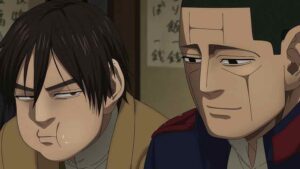
With mortal series I’d be worried about starting a(nother) flashback arc this close to the end. But this is Golden Kamuy, and Noda Satoru doesn’t get the big stuff wrong. In Noda we trust – and this is Sugimoto’s origin story. He is the protagonist after all, though the details of his personal life have gone largely unexplored while seeming scores of minor characters have had their life stories told. Golden Kamuy is a series full of characters who act like protagonists of course, so that tracks. But still – it’s nice to finally see Sugimoto fully at center stage.
The seeds of this were planted at the end of Episode 7, of course. And we have heard bits and pieces before, like his best friend and sweetheart marrying after his family died of tuberculosis and he fled to protect her. But most of this is new. We catch up with Sugimoto in Tokyo, 1901, humming “Singing in the Rain” while doing a bit of Gene Kelly’s lamppost number. Which is funny when you consider that the song was written in 1929 and the musical in the ’50s, but with Noda it’s safe to assume the anachronism is quite intentional and here for absurdist effect.
This is also the most screen time Warrant Officer Kikuta has gotten, I’m pretty sure. He’s a relatively minor character in the big picture but his connections throughout the plot and cast are extensive and deep. Everyone who knows Kikuta seems to respect him – and that includes Sugimoto. They meet when Kikuta saves Sugimoto from being beaten and eventually arrested by a bunch of soldiers. Sugimoto is a street rat at this point – “stealing food from people’s cats” – so it’s not hard to buy him off. But he’s no fool, even here – an uneducated bumpkin perhaps, but a clever kid with a clear sense of right and wrong.
The gist of this is that Kikuta has been given an assignment by the commander of the Seventh Division – Hanazawa Koujirou. Some of this we know – like his son is Yuusaku, who will become a flag-bearer and be shot and killed by his bastard brother Oogata. Flag-bearers have a horrendous casualty rate for obvious reasons, and military superstition dictates that they be virgins. Yuusaku’s mother, in defiance of her husband’s wishes, schemes to get him laid and the woman knocked up to spare him from this fate. But Cmd. Hanazawa finds out about this and dispatches Kikuta to execute a plan to foil his wife’s machinations. Kikuta ropes Sugimoto into this with the promise of all the food he can eat, and a bond forms between them.
Another bit of intrigue here involves the commander of the First Division, Okuda Hidenobu (Nakano Yutaka). He too has gotten wind of this – and of the Ainu gold, too – and he recruits Lt. Tsurumi to help find the gold and take down Hanazawa in the process. The roots of this go back to the rivalry between the Satsuma – who dominated the army – and the Choushuu, who dominated the navy. That extends all the way back to the 17th Century but it was raging at this point. Tsurumi is uninterested in any of that, but he already knows about the gold of course and figures he can use Okuda as cover to help him pursue his own ends.
If Tsurumi is in town that means Oogata is too of course. Kikuta’s scheme is to have Sugimoto – who he’s given the affectionate nickname “Norabou” (after norabouna, a traditional vegetable) impersonate young Yuusaku and take a bullet (metaphorically of course) for him. And the “shooter” is Kaneko Haneako (Itou Shizuka), a wealthy young woman in danger of becoming a spinster if she doesn’t get hitched soon. Norabou plays the game well, and being taken under Kikuta’s wing feels good to him. His education is amusing, and there’s a genuine warmth in their relationship. But Sugimoto is troubled by the fact that he’s stealing another man’s life, and depriving him of the choice his mother is trying to offer him.
Sugimoto is a good man, and obviously always was. He goes to Hanazawa Yuusaku and tries to find out what he really wants from his life, but the young man has sipped the kool-aid pretty hard. Sugimoto is also troubled at involving Kaneko in this, as she knows things Hanazawa Koujirou doesn’t want known – what happens to her if Kikuta’s plan goes south? Which it does, of course. Eventually Kaneko can contain her libido no longer and stages an attempt to deflower “Yuusaku”, which Tsurumi – with Koito, Usami, and Oogata in tow – bursts in on as the farce is playing out at the Imperial Hotel (designed by Frank Lloyd Wright, by the way – the lobby has been preserved at Meiji Mura).
It’s worth remembering that at this point, Oogata has never seen his brother and thus will have no idea of the truth that’s playing out here. We know how that drama ends, of course, but the connection between he and Sugimoto certainly is cast in a new light with this turn of events. There’s so much chaos ingrained throughout Golden Kamuy that it can be easy to assume Noda won’t find a way to tie it all together – that much of it is here for effect. But that’s not the case – the connections always reveal themselves, and the big stuff always happens for a reason. And this flashback arc is clearly a big part of that process.
The post Golden Kamuy: Saishuushou – 08 appeared first on Lost in Anime.