Hello folks, and welcome back to Wrong Every Time. This week a fresh carpet of snow has descended to terrorize my poor neighborhood, meaning I’ve had plenty of time to stay inside and screen fresh projects. We completed the second season of the Fallout adaptation, which continued to nail the aesthetics and rightfully bleak philosophy of the games, while apparently receiving enough of a budget boost to include dramatic full-scale clashes of New Vegas’ various factions. I thought Mr. House’s preoccupation with an ultimate “man behind the curtain” felt more about providing plot hooks and incentive for a third season than furnishing the show’s main themes, but was otherwise a fan, particularly since this season actually upped the Walton Goggins quotient significantly. That aside, we’ve of course been plowing through our regular allotment of feature films, so let’s get down to the Week in Review!
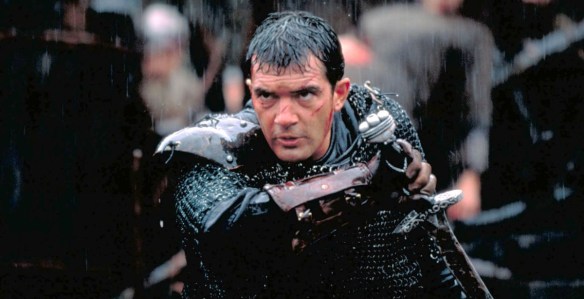
First up this week was The 13th Warrior, a historical adventure film starring Antonio Banderas as Ahmad ibn Fadlan, an amorous court poet in Baghdad who is exiled to the north as an alleged ambassador. Fadlan eventually joins up with a group of vikings, and strikes up a friendship with their new king Buliwyf. The pair join eleven others in a quest to support the besieged king Hrothgar, a fight that will pit them against the ominous “Wendol,” who steal the heads of their victims and are rumored to eat human flesh.
The 13th Warrior is richly appointed and well-cast, though unfortunately suffers from an indifferent script and lack of personal texture. It’s a problem common to epic dramas, where in their quest for operatic or anthemic scale, they end up sacrificing the human moments that actually make their big emotional broadsides strike home. Though it pulls from both historical reflections and Beowolfian myth, The 13th Warrior still feels oddly impersonal; it is billed as “from the writer of Jurassic Park and director of Die Hard,” but I’d much prefer a take from the writer of Die Hard and director of Jurassic Park.
We then continued to chart the march of Godzilla through the new millennium with the laboriously titled Godzilla, Mothra and King Ghidorah: Giant Monsters All-Out Attack. This film once again disregards all continuity beyond the original film, and furthermore redefines Godzilla himself as not a consequence of atomic testing, but a supernatural amalgam of all the souls lost to Japan’s violent incursions into Asia. Intent on punishing Japan for its crimes, Godzilla can only be thwarted by the nation’s guardian deities – Mothra, King Ghidorah, and the delightful bat-eared Baragan.
In spite of its wild reinterpretation of the Godzilla canon, Giant Monsters All-Out Attack actually feels like the most traditional and successful of the millennium films so far. The film simply nails the fundamentals, beginning with its preposterously generous smorgasbord of giant suit-versus-miniature city action. Largely dispensing with its predecessors’ focus on unconvincing CG, Giant Monsters All-Out Attack returns us to the vivid wrestling matches of the franchise’s salad days, utilizing more rubber and dynamite than perhaps any other entry so far.
In addition to its generous apportioning of kaiju combat, this one also possesses the crucial secondary features of a coherent, propulsive human narrative on both the political and individual levels. The reframing of Godzilla’s motivation injects some fresh thematic sizzle into the proceedings, the war room drama feels like a triumphant return to prior eras’ persistent press briefings, and the human element is winningly represented by tabloid reporter Yuri (Chiharu Niiyama) and her team, the first human characters who’ve really made an impact since the psychic visions of the preceding era. There are no real curveballs here, and the film’s redefining of Ghidorah is frankly absurd, but it’s refreshing to see another Godzilla that just absolutely nails the fundamentals.
Our next viewing was the straightforward disaster feature San Andreas, starring Dwayne Johnson as a rescue helicopter pilot with the LA fire department. After a sudden earthquake destroys the Hoover Dam, a new earthquake prediction model reveals this is only the prelude to a massive shift in the entire San Andreas fault. With Johnson’s family scattered between LA and San Francisco, he’ll have to pilot his heart out to ensure none of his loved ones are gobbled up by the hungry earth.
San Andreas is an unexceptional but mostly functional slice of genre silliness. The film hits all the crucial beats of your standard disaster film: a crisis grounded by coherent human stakes and relationships, an escalation of larger-than-life threats, a balance of ground floor and top-level drama, and a satisfying sequence of unique physical obstacle courses to pressure the leads. The balance of these ingredients is certainly less than exemplary; both Paul Giamatti’s top-level drama and the core character relationships are underdeveloped, each likely a victim of the script’s numerous rewrites. That said, if you’re signing up for a film where Dwayne Johnson’s head takes up a third of the poster, you likely know what caliber of experience you’re in for, and San Andreas hits that bar with moderate distinction.
Last up for the week was Heart Eyes, a recent horror-comedy feature intent on joining My Bloody Valentine as one of the definitive Valentine’s Day spookers. Olivia Holt and Mason Gooding star as fellow pitch designers at an advertising firm, working together to make a Valentine’s Day pitch as the nation reels from the violence of the “Heart Eyes Killer,” a mass murderer known for specifically targeting couples on Valentine’s Day. After a suspiciously romantic work date, Holt and Gooding are soon mistaken for a couple themselves, and will have to fight for their lives to overcome their murder-happy Cupid.
Heart Eyes is one of those rare and welcome genre blends that really gets it, committing fully to both its horror and romantic comedy instincts, and thereby elevating each with the pleasures of the other. The film’s greatest strength is the chemistry shared by its leads; the two are funny individually and hilarious together, trading jabs and sulking at emotional injuries with such convincing theatricality that you really do want them to succeed. Mason Gooding in particular has been impressing me for years now; he was great in the recent Screams and scene-stealing as the villain of Aftermath, giving me every confidence he’ll be selling features with his presence in no time.
Alongside the energetic, character-rich script and the strong cast, Heart Eyes is also determined to be a genuine horror feature, doling out nasty deaths and tense setpieces regularly, and culminating in a delightfully over-the-top confrontation with its titular terrorizer. The film is so effective that it’s almost annoying; it’s clearly aiming to have its cake, eat it too, and save a third cake for later, simultaneously desiring romcom, general horror, and iconic slasher design accolades. Fuck it, have your cakes, Heart Eyes. And keep me posted on the sequel.