Hello folks, and welcome back to Wrong Every Time. Today I’m happy to report our return to Kemonozume, Masaaki Yuasa’s bloody and enthralling full-series debut. The series has wasted no time in introducing us to a series of generational, political, and emotional conflicts, as we were introduced to the proud warriors of the “Kifuuken,” a clan dedicated to destroying Flesh Eaters that hide in human skins. While our protagonist Toshihiko seeks to overcome his fears and carry on the family traditions, his half-brother Kazuma sees this battle as an opportunity, a chance to introduce his mechanical warriors to the world at large.
The clan’s drama is already providing us a hearty stew of thematic variables, from questions of inheritance and familial duty to the relationship between war and technological progress. And that’s before we add in this narrative’s actual thrust – the burgeoning relationship between Toshihiko and one of the Flesh Eaters, a woman who seems determined to constrain her violent nature. Then of course, there’s the contrast of the opening sequence’s conflation of flesh eating and misogyny with the reversed power structure of this new bond. Yuasa’s works generally delight on both a visual and thematic level, and between Kemonozume’s wild aesthetic flourishes and layered conflicts, I’m eager to see how this story unfolds. Let’s get to it!
Episode 2
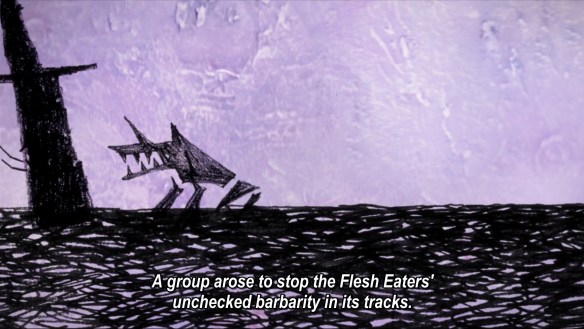
More lovely cave painting-esque animation as our narrator details the methods the Kifuuken developed to defeat the Flesh Eaters. This aesthetic does more than just add some visual diversity to the show’s drama (itself an inherently worthy goal) – it emphasizes a long chronology beyond what we’re explicitly witnessing, implying a distinct history of humanity harkening back to the early days of mankind. The temporally fixed nature of certain art movements can inherently set drama in a certain time or place, a trick also frequently employed by the various Monogatari flashbacks
Apparently the nature of “Kifuuken” is this technique of separating the arms from the Flesh Eaters, thereby disabling their power
Interesting repeated imagery in this OP, of a humanoid form striking as an egg-like mass expands within its core. Presumably the egg is the monster form attempting to break free?
We open with our two lovers in flight, as Toshihiko’s lover guides him through a skydiving descent. Remarkable efficiency of storytelling here, with their bond basically established through the briefest possible interactions. The sky also serves as a fine backdrop for Yuasa’s dynamic camerawork; with no clear objects in the background, it’s easier to pan around these characters and celebrate the rough angles of their fluid designs. And finally, this sequence also furthers that reversal of power dynamics inherent in their relationship, with the male “warrior” being drawn into a terrifying activity by a woman who finds such danger inherently liberating
That bond also gestures towards a potentially messy development for these two: Toshihiko’s lover giving him the confidence he needs to become a proper killer of Flesh Eaters. Is she accidentally training the enemy of her people to assume his proper mantle?
A rapid montage reveals their swiftly developing relationship, while also demonstrating the richness of character acting made possible by this rough character art style. Detail and precision are not the same thing!
Toshihiko’s bright Hawaiian shirt contrasts dramatically against the grays and browns of his fellow warriors; he has found a light in his life that they lack
“A Hard Farewell”
The roughness of the linework compliments the frantic energy of the moment as we cut to another Flesh Eater being pursued
“Noodles again tonight?” is contrasted against the entrails of a victim hanging from this Flesh Eater, implying a parallel between our species
The color design reminds me of The Tatami Galaxy’s frequent use of single splash colors of different hues for coloring a full composition. It’s an effective trick, dousing an entire scene in the color that best represents its tone – the murky red of violent battle, the clinical green of this control center. As basically all of Yuasa’s works testify, realism is not an inherent aesthetic virtue
Both the clan leader and Kazuma reflect on how they don’t feel safe with Rie being so close to the action. It feels like her death may end up being the catalyst for the clan’s division
Toshihiko’s next date is defined by blue tones – the rain-damp airport roof, a blue purse, the pair’s blue coat and dress. Contrasted against her yellow hair, the scene evokes a sensation of looking into a clear blue sky, with Toshihiko’s lover representing the sun itself
“That’s because I’m only showing you my good side.” She makes the metaphor explicit, with the Flesh Eaters’ duel identities echoing how we all have multiple forms
“I’ll gladly let you kill me, Toshihiko.” Even she seems certain she cannot live peacefully, that it’d be best to at least be killed by a warrior she loves
This image seems to define their relationship – the two of them hanging upside-down from a railing, their love persisting only on the edge of oblivion
At last we learn her name is Yuka, from a third party that apparently knows her
That concept of love in freefall is carried on to his deliberations on his cot, as he seems to consider proposing to her while going on another skydiving trip. Their liberation can only be realized as they plummet towards mutual destruction
Excellent choreography for this fight between Toshihiko and the clan elder, clearly demonstrating Toshihiko’s preoccupation as he attempts four wild strokes for every practiced, precise counter by his opponent
“What is the most important thing to you?” is answered by shots to the bird in flight, that icon of liberation. Can they fly without falling?
After squabbling with her ex-boyfriend, Yuka meets Toshihiko and draws him into a fountain. Excellent lighting here, with the blinding spotlights of the fountain’s perimeter reflecting off the water, and returning us to that dreamlike revery of their first meeting
She can’t reveal her true nature yet, so gently writes her truth in lipstick on his back
And just like that, the clan elder is dead, and the brothers are left to pick up the pieces. Solid sound design here, as the clamor of the train echoes Toshihiko’s racing thoughts
The rain echoes their tears as they gather around their departed leader
Kazuma is certain this is the work of the Flesh Eaters, a direct challenge
Yuka ultimately attends the funeral. Apparently she is from that Kamitsuki family, and is the spitting image of her mother, someone who had some connection to the clan. So are Flesh Eaters the children of regular humans? That would certainly complicate this idea of “purging” them, if they’re basically just a spontaneous, variant form of humanity
Thus Toshihiko is now considered an enemy as well, with even Rie participating in the clan’s subterfuge by planting a bug on his collar
The expression work is so strong! Though the character forms are somewhat loose, the art is evoking such precise gradations of embarrassment, surprise, and hungry cunning
That strange monkey keeps stalking the funeral, an odd tonal counterpoint to Kazuma’s trap. Yuasa loves his fluid mascot characters, the moral innocents observing humanity’s cruelty
Kazuma claims the scent of Yuka’s perfume was found at the murder site
Thus Toshihiko is forced to make his choice, brandishing his sword at his fellow warriors as Yuka’s form is revealed
And Done
My god, what a propulsive episode! I could never have anticipated we’d already have Yuka’s nature revealed to both Toshihiko and the clan at large by the end of the second episode, and can scarcely speculate as to how the story might evolve from here. And yet, in spite of its extraordinary pacing, this episode never felt rushed – it simply excised the unnecessary narrative junctions, giving us plenty of time to luxuriate in Yuka and Toshihiko’s evolving relationship. And as far as the animation goes, this episode was a marvel of specificity through looseness, demonstrating the remarkable expressive potential of Yuasa’s fluctuating character art, as well as the dynamic impact of his aggressive color design. Racing through the fundamentals of this star-crossed lovers narrative, Yuasa is crafting a human tale as simultaneously poignant and irreverent as any of his classics. I can’t wait to see what’s next!
This article was made possible by reader support. Thank you all for all that you do.