Wooper: I know this column is about currently airing anime, but have you all seen the surplus of cool shows set to debut next month? Our spring season preview is going to be packed (by my standards), and that’s without counting mid-March premieres like Steel Ball Run and Rooster Fighter (which should show up in a future post this March). Ikoku Nikki is holding me down this winter, and I can easily envision a future where it retroactively outclasses every new spring series, but I’ve got to say, I haven’t been this optimistic about an upcoming crop of anime in a long time. That’s not what you’re here for, though – read on for my thoughts on the usual suspects, plus one new show before the jump.
Oneechan Gokko – 1
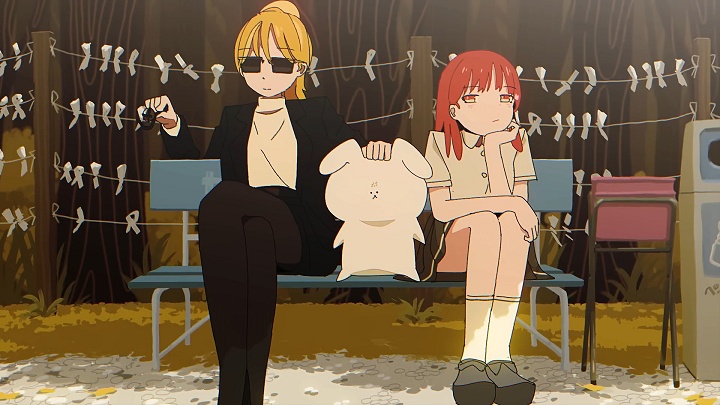
I’m not exactly tapped in to the world of indie anime, but the YouTube series Oneechan Gokko (produced at the fledgling Studio Gohan) still found its way onto my desk somehow, and I’m glad it did, as its first episode was much more polished than expected. It doesn’t move at the same speed as a mainstream seasonal anime, but scenes of the main character Akane jogging home from school or riding a bike are still plenty immersive thanks to detailed lighting and autumnal background art. Given the season, red, yellow and brown are the dominant colors here, with Akane’s green-haired sister Sui serving as an exception to the series’ visual palette. That nonconformity makes sense on several levels, because she may be more (or less) than she seems – at several points during this episode, Akane receives phone calls from someone claiming to be the real Sui, who claims that the girl in her house is an impostor. Oneechan Gokko is set in the future, with service robots having been partially integrated into society, so we may be headed toward a “machine supplanting man” theme – one with spooky overtones, as Gokko’s presentation takes that tack at several points (especially in its closing minutes). You can watch the first episode [here] to see whether it sucks you in – just know that the follow-up won’t be out for several months.
Sousou no Frieren S2 – 4-6
Demon slaying isn’t my favorite part of Frieren’s story, but as of episode 6, we’re headed into just such a miniature arc, with our party encountering Genau and Methode (a proctor and candidate, respectively, from last season’s mage exam) at the site of a massacre. Still, I’m choosing to view this development optimistically, as a way for the show to regain some focus after a pair of aimless episodes in 4 and 5. The latter of those in particular was among the most humdrum that Frieren has produced thus far; its stories of overhyped liquor and vague decade-spanning debt did feature the series’ trademark present-past parallels, but those alone don’t make an episode worthwhile. Why spend three months of in-universe time helping a dwarf breach a magical vault full of spirits that you know are disgusting, or refuse to elaborate on a nearly century-old obligation that “traps” Frieren in the service of a trading company? The show may be more about the journey than the destination, but narrative listlessness isn’t always a boon. Episode 4 was a little better, playing host to Fern and Stark’s muted first date (a fan favorite segment, I’m sure), but the unimaginative scripting of its second half was sorely disappointing. When people refuse to leave their increasingly dangerous homeland due to deep regional ties, you’ve got to support that decision with stories about their ancestors, traditions, cultural beliefs, etc. Frieren didn’t do that, so the northerners’ attachment to their precariously positioned village felt less authentic and more like a series recycling a common fantasy theme.
Ganglion – 16-18
This mini-arc marks Belve Squad’s first successful mission, or more accurately, Isobe’s, since he scaled Tokyo Tower solo after his subordinates had gone home for the night. (Who’d have thought that taking down one of Japan’s most famous landmarks would be as simple as unscrewing the aircraft warning light at its apex?) Ganglion made sure to position Isobe’s success separately from the usual Hopeman farce, linking it instead to his desire to impress his son. In fact, families in general were addressed in the last of these three episodes – the narrator tells us that without a TV signal (which Tokyo Tower still provided to the surrounding area when the Ganglion manga was written), “the sound of families laughing echoed across Japan” that night. Episode 18 was also presented in a traditional 4:3 aspect ratio to match the low tech status quo ushered in by Isobe’s sabotage. I’m always tickled whenever a TV show comments on the harm done by television, or how society would benefit from its absence, and this was no exception. Maybe the Ganglion organization’s future successes will have similarly positive side effects – we’ve got just six more episodes (totaling fewer than 20 minutes) to find out.
You and I Are Polar Opposites – 4-6
I have way too many complimentary things to say about Seihantai na Kimi to Boku to fit in a single paragraph, so allow me to focus on just one aspect of the show: its refreshing messaging. Suzuki and Tani are teenagers, so they’re naturally self-conscious, but they’re still clearheaded enough to view their lives from the outside. When they unexpectedly bump into each other during episode 4’s convenience store visit and Suzuki explains her mortification at being seen without her makeup and hair done, Tani disagrees that it’s a big deal, but still listens respectfully to her thoughts; later, when he sees her all put together for a summer festival date, he unhesitatingly calls her “beautiful” in acknowledgment of her efforts. Their relationship so far is chaste, but both are open to the idea of physical intimacy, with poor timing (rather than shame) being the primary obstacle there. And the concept of purity (which often crops up in romance anime thanks to Japan’s adoption of the loanword “pyua”) is reinterpreted by Suzuki to deal with emotional honesty rather than one’s romantic past – this in response to her concern about a visit from a middle school friend she used to flirt with. That scene was blatantly scripted, but the show is generally so entertaining that preachiness isn’t an issue, even as it provides perspectives that teenagers could apply to their own lives.
Ikoku Nikki – 4-6
A little less than halfway through its 13 episode run, Ikoku Nikki is still batting 1.000. I know I’m behind on most of these shows, but when it comes to this one in particular I don’t feel guilty in the slightest, as each episode deserves to be savored. And they’re not worth treasuring just for their adult writing, as the show can also be playful (singeing the edges of some on-screen text as a character burns their hand, lowering Makio’s defenses after she’s had a bit of wine) and surprising (whisking Emiri away to a teahouse in the woods in another food-themed fantasy sequence). If it were merely a contemplative drama, Ikoku Nikki would still be worth celebrating, but it really is the total package; still, its meditative qualities are the main draw for me.
I think I previously described the show as grief-themed, but these episodes really opened it up to speak about isolation, and not only that of the two primary characters. When Asa lost her mother, her grandmother also lost a daughter, and Makio and Asa’s visit to the widowed matriarch’s home was thick with solitude and regret. Emiri’s interest in others’ love lives and hesitation to discuss her own may indicate confusion about her own sexuality, putting distance between her and her peers (Makio recommends her a DVD labeled “Tomatoes,” likely the LGBTQ-adjacent 90s film Fried Green Tomatoes, as a way of connecting with her). And Kasamachi, who had his heart broken by Makio in the past, has a measured conversation with her about resuming their physical relationship, even if it may be unfair to one or both of them emotionally. As someone who’s watched entirely too much anime, it’s not often that I can’t predict where a show will take a particular plot thread, but I have no idea whether this reunion will ultimately end in love or loneliness, so I’m enjoying the lifelike imprecision of it all.
The post Winter 2026 Check-In – Weeks 4-6 appeared first on Star Crossed Anime.