
Hello folks, and welcome back to Wrong Every Time. We’ve been keeping busy this week, as we continued to munch through Aura Battler Dunbine, and also screened the entirety of the live-action One Piece’s second season. I think we’re all a little understandably hesitant about live-action anime adaptations, but god damnit, they’ve actually nailed this one. The tone, the energy, the costumes, the characters; this feels less like a pale imitation than a loving revision, drawing on thirty years of One Piece history to make a concise, cohesive version of the story that still hits and often even expands on the pleasures of the original. The casting remains superb, the Straw Hats have largely settled into their personalities, and the emotional gut-punches of the early Grand Line have been preserved in full. I’m frankly astonished by the production’s combination of trust in its base material and willingness to boldly reorganize; this is a real “whoa, two cakes” situation, and I am savoring the flavor.
One Piece aside, we of course munched through our usual assortment of cinematic spectacles. So let’s get right on that, as we run down the latest Week in Review!
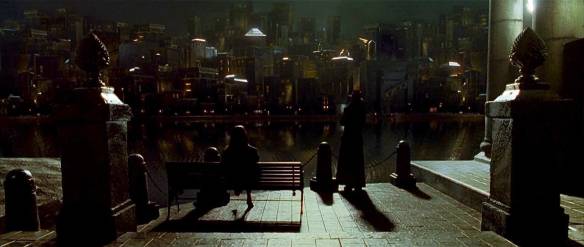
First up this week was Dark City, a gothic neo-noir production by Alex Proyas, the director of The Crow and I, Robot. The film centers on a man who wakes up in a bathtub with no memories, in a hotel room also housing a woman who appears to have been ritually murdered. Desperate to discover his identity, he wanders out into a city of perpetual darkness, where the architecture itself seems to shift at the will of unknown arbiters. With both the police and darker forces after him, he must race to uncover both his own past and the nature of his city.
Dark City is pure urban gothic invention, fitting neatly into the fanciful subgenre also occupied by Proyas’ The Crow, alongside features like Johnny Mnemonic, Mimic, and Tim Burton’s Batman films. The scenery of the city itself is the film’s principle preoccupation, and Proyas does an excellent job of constructing and enlivening an alternate nightmare world, a place where it’s always simultaneously too late at night and too far from morning. The fundamental secret of the city is just as compelling as its ornate setting, making it easy to invest in our John Doe’s uncovering of its secrets.
Of course, the film’s overwhelmingly aesthetics-focused priorities do come with their own limitations. Because the film is essentially two mysteries stacked on top of each other (who is our protagonist, what is this city), it’s necessarily ungrounded; the characters are mostly ciphers, tools for advancing the plot more than active agents in their own right. That plot is also a tad unfocused, without much connective tissue or urgency driving the characters’ actions. Nonetheless, Dark City is a visual marvel that’s well worth your time, and offers the additional pleasure of Kiefer Sutherland playing a stammering mad scientist. Didn’t know he had it in him!
We then screened Until Dawn, the recent adaptation of the 2015 cinematic horror game, which tasked players with guiding a collection of friends through an exceedingly lethal evening. Given the game was basically already a film, an adaptation seemed uniquely superfluous; fortunately, the film crew seem to know that, and thus Until Dawn (2025) offers a new setup and new narrative, with a collection of old friends now trapped in a time-looping manor intent on repeatedly killing them.
The film keeps only what is truly essential to the original: the collection of variably bonded youths, the survive-the-night conceit, and the presence of Peter Stormare. With all that established, Until Dawn sends its cast through a meat grinder ouroboros, killing them in increasingly improbable ways as Stormare makes grim, winking proclamations in his signature rottweiler accent. As with the game, the film makes some steep demands in terms of handwaving the utter impossibility of everything that’s happening – but if you can make that bargain, it’s an enjoyable, breezy watch with some unexpectedly brutal punchlines.
We then continued our rampage through the Godzilla canon with Godzilla: Tokyo S.O.S. This film is actually the only direct sequel within the Millennium series, featuring the return of the previous entry’s Mechagodzilla “Kiryu.” Unfortunately, it turns out exhuming ancient Godzilla bones and using them to construct a half-metal abomination is an environmental no-no, and thus this entry sees both Mothra and her reliable mediators the fairies taking the stage, intent on both pacifying Godzilla and returning Kiryu to his watery grave.
In spite of being a direct sequel to Godzilla Against Mechagodzilla, Tokyo S.O.S. largely abandons the Top Gun-reminiscent stylings of its predecessor, and even ejects original Mechagodzilla pilot Akane. The film’s human drama is frankly scattershot and lacking, leaving it up to the kaijus to keep things interesting. Fortunately, Mothra has always been one of Godzilla’s most compelling companions, reaching beyond the general appeal of large monsters smashing into each other to offer something almost mythic in tone, truly fulfilling her promise as the earth’s guardian deity. With Mothra here supported by both the ever-reliable fairies and her rough-fighting larval descendants, S.O.S. succeeds well enough as pure action spectacle, in spite of being a significant step down from the effective multi-tiered drama of its predecessor.
Last up for the week was Critters, an ‘86 scifi horror feature reminiscent of Gremlins, but which director Stephen Herek would be quick to point out was actually written well before Gremlins hit the scene. Anyway, the film centers on a rural family beset by feisty alien furballs, whose only hope lies in a pair of interstellar bounty hunters sent to defeat the critters, or “Crites.” Hemmed in by creatures with wicked teeth, poisonous spines, and a devious intelligence, it will take all the courage this family can muster to survive the night.
The main thing that stuck out to me about Critters was its curious generosity of worldbuilding, particularly for a feature about tooth-laden tennis balls assaulting a farmhouse. The film opens with a segment in space that introduces multiple alien races and an entire intergalactic order, all seemingly to justify the escape of our titular monsters. This uncommon attention to scene-setting detail continues throughout the film, exemplified through the careful illustration of the main family’s routines (love the dad’s “Pin Buster” bowling shirt that eventually pays off in a bowling alley brawl), as well as the unexpected characterization of the critter-pursuing bounty hunters.
That sort of care in the details is one of the great pleasures of passionate, low-rent horror cinema, and Critters is otherwise at worst functional and at best genuinely propulsive. The beasts are nasty, the field of battle is coherently illustrated, and the cast is convincing on the whole, so much so that they can afford to casually murder a wandering Billy Zane. It’s not scary, but what Gremlins-adjacent film actually is? The film has passion and technique, and that’s what matters.