
Hello folks, and welcome back to Wrong Every Time. Today we’re continuing our journey through Monogatari’s Monster Season, as Araragi’s investigations of the high school basketball team take him first to Mayoi’s shrine, and then deep into the underworld. Emerging in an alleged hell that looks a lot more like paradise, he is confronted by the Beautiful Princess, an apparent echo of Shinobu’s former life. Will this doppelganger lead him to the blood pond, and if so, is Araragi even right to sate the hunger of the amoral Deathtopia?
It’s certainly a messy stew of questions, and a flight of fancy only grounded by this arc’s clear parallels to Kizumonogatari. Back then, Araragi’s lack of self-worth actually made these questions easier; he would have sacrificed his life for anyone, and freely consented to a cursed existence in order to save Shinobu while preventing her from killing others. Logistics aside, he is not that person anymore – he knows how much his life is worth, has come to embrace even the rejected parts of himself, and looks confidently towards a future shared with the people he loves. It takes a certain kind of madness to persist as an oddity investigator, and with Araragi’s future now accounted for, it seems like we may have to dive into Shinobu’s past to find a remedy for her first savior. Let’s get to it!
Episode 11
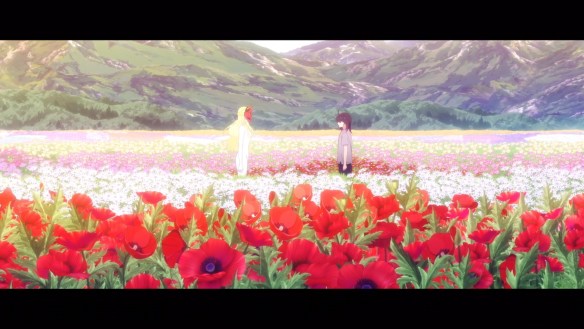
Rendered in Monogatari’s distinctively sterile aesthetic, these flowers all look oddly artificial, like plastic flowers arranged in a simulacrum of a meadow. It feels appropriate for this simulated heaven
Seeing the Beautiful Princess firsthand, Araragi reflects how much he was like the citizens of her original kingdom, instantly ready to commit suicide for her sake. Of course, that wasn’t actually Acerola’s fault – he was ready to relinquish his life for practically any cause at that point. An inversion that calls into question Acerola’s original story – was it her “fault” for being so beautiful, or the others’ fault for valuing their lives so lightly? As we saw in the case of Deathtopia, even if not for Acerola’s presence, her own pride was already carrying her to the point of self-destruction
Araragi posits that when Acerola became a vampire, her original “beautiful soul” was separated from her body and sent to heaven
But how can a soul be beautiful when abstracted from the actions of the body it inhabits? It’s basically an inversion of any useful conception of morality – judging us based on our immediate impulses rather than our ultimate actions. It’s a terribly self-defeating view of identity, essentially assuming that our active minds, the systems of assessment and self-control we’ve developed to shepherd our unbidden impulses into morally just actions, are all irrelevant. Unless we think morally good thoughts right from the get-go, we are damned – all the work we’ve done to “become better people,” ie shape those immediate impulses into justifiable actions, is meaningless
It also denies the possibility of genuine transformation – of actively tempering your ungenerous impulses over time, such that your first instincts eventually become righteous ones. The Beautiful Princess feels like a denial of everything Monogatari represents
When Araragi mentions he must continue his quest, the princess merely begs him to spend a little time with her, in this mirage she created
Araragi essentially posits the same conjecture regarding destruction that his first meeting with Acerola implied – that if beauty could destroy a country, that country was already on its way to ruin
This princess regrets becoming a vampire, and thus setting a burden on both Deathtopia and other humans. A firm rejection of Acerola’s eventual commitment to living
It seems she believes vampires occupy a delicate point in the ecosystem, and that her existence made less room for Deathtopia. Again, such a clear rejection of her right to live. Perhaps all Acerola truly lost was her desire to die, cloaked in these trappings of noble self-sacrifice
The Princess does raise a good point – given Deathtopia’s gourmet proclivities, she’s not likely to accept generic blood gathered from a pond
The Princess kissing him leads into our OP for the first time. Fairly standard for Shinobu arcs – no vocals due to Maaya Sakamoto’s contract requirements, but a bounty of distinctive Hajime Ueda art. The images here emphasize folk horror ritual and detective drama tropes, obvious narrative touchstones for this particular arc
Araragi awakes back at the shrine. Mayoi swiftly rips out his ahoge in despair, but fortunately it apparently regenerates instantly
Gaen is also present, and more than a little annoyed that Araragi didn’t contact her once he found Deathtopia
Thus Araragi transfers the Princess’ gift of saliva to Deathtopia, rehydrating her in the process
With Shinobu now directly involved and clearly attached to Deathtopia’s survival, Gaen recommends a “spirited discussion” to figure out how they can happily resolve this. One more echo of Kizumonogatari, with the party once again attempting to find a happy end to an impossible situation, a way out of this that doesn’t involve sacrificing either humans or vampires
Gaen found the fourth victim, and this one was clearly, intentionally hidden – their body was sunk to the bottom of a reservoir with weights attached. So whoever they’re seeking knows they’re being hunted
Mayoi reveals that Deathtopia was also hidden when discovered, buried in a mountain of dirt. If she was a fellow victim, then the challenge is to draw a connection between her and the basketball team members, discover whatever common condition made them equally susceptible to this foreign entity. And in that case, there are plenty of conditions to choose from – like Deathtopia, the basketball team members felt isolated after Kanbaru’s exit, worshipping an idol that had abandoned them. And then there’s the feelings articulated by our first victim back in the arc’s cold open, her desire to invite harm upon herself in order to escape an intolerable present
Apparently the fourth victim also had a code related to prime numbers
“I don’t think Suicide-Master even knows what a prime number is.” Yeah, that seemed like an odd choice for Deathtopia from the start. Deathtopia is a very direct character, and generally scornful of that which lies beyond their immediate interest; why would they be leaving finicky math puzzles to solve?
Gaen suspects that some other vampire is actually looking to place the blame for these incidents on Deathtopia. So what was actually happening in that first scene of the arc?
And even if this were true, Gaen notes this wouldn’t matter to most specialists, who would kill Deathtopia simply for being a potentially murderous vampire. For most people, truth is less significant than the validation of one’s own perspective – if the fake is more flattering, it is more valuable
Mayoi of course takes full advantage of her moment on-stage, turning her retelling of Deathtopia’s discovery into a rakugo performance
I appreciate their commitment to the bit; having watched a fair bit of rakugo through anime at this point, it’s clear they’re taking care to mimic the specific gestures that accompany the various emotional turns of a traditional performance
Oh my god, Deathtopia’s tiny even compared to Mayoi
Her rakugo costume is complimented by another, one that feels morbidly appropriate for Mayoi: a traffic crossing guard
Shinobu notes that Deathtopia’s regressed even further in age than before. It makes particular sense for Monogatari that age itself is a metric of power, since “power” is essentially just life experience here
Shinobu’s very pride in being Deathtopia’s sole sustenance raises an ominous possibility: that she came here not to meet an old friend, but because Shinobu was the only food that could revive her
We end on a threat: if they don’t resolve this tonight, Kagenui will handle it her way
And Done
Thus our investigation winds towards an uncertain conclusion, with Deathtopia potentially exonerated and a second aberration seemingly lurking in the shadows. In spite of some potential thematic parallels, it’s still unclear how this vampiric drama relates to the girls’ basketball team – however, as far as the supernatural side goes, Isin is clearly reveling in this fantastical variation on classic mystery storytelling. Isin’s love of mysteries feels similar to his love of language; he enjoys playing with structures of rules that can through their very rigidity reveal unexpected truths, and one of the most fundamental rules of mysteries is “the killer must be introduced before the resolution.” That restriction points me towards a revived Tropicalesque attempting to force his master into consuming Shinobu, and thereby once again embodying the unblemished perfection he saw in her – but that hypothesis has little grounding beyond its adherence to traditional detective drama form, a thin rationale for electing a killer. In any case, the clock is now ticking, and I’m eager to see how this fractured reprise of Kizumonogatari concludes!
This article was made possible by reader support. Thank you all for all that you do.