
Hello folks, and welcome on back to Wrong Every Time. This week we’ve been continuing our march through Turn A Gundam, which has proven just as delightful and idiosyncratic as on first viewing. It’s been an interesting experience seeing this as a culmination of Tomino’s Gundams, rather than an introduction to them – the man seems to have grown gentler in his later years, and more sympathetic to the idealism embodied by characters like Loran and Dianna. That aside, we’ve also screened most of Jujutsu Kaisen’s third season, which has proven to certainly be more Jujutsu Kaisen, and followed up the frustratingly unbalanced Monster Train with… Skyrim. Yep, it’s Back To The Ol’ Me again, but it’s just hard to play games that are not Skyrim when I could potentially be playing Skyrim. I’m sorry! I’m basic, I know it, but my comfort games are probably not shifting at this point in my life. We’ve got new movies, though! Yeah, let’s get to that.
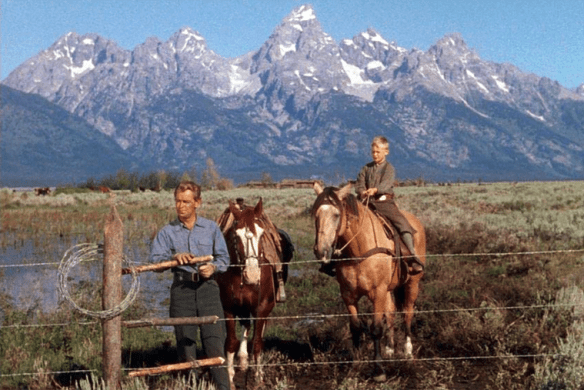
First up this week was Shane, a ‘53 western starring Alan Ladd as the titular drifter. While riding through the lightly settled Wyoming Territory, Shane takes a job as a farmhand on Joe Starrett’s family ranch, eventually growing close with his wife Marian and son Joey. However, the family soon comes under threat by local cattle baron Rufus Ryker, who intends to drive Starrett and his fellow homesteaders off the prosperous soil. Eventually, Shane is forced to return to his old ways as a gunslinger, that a more peaceful age might ultimately endure.
Shane is an utterly quintessential western drama, offering the classic “mysterious drifter takes up arms for an innocent community” narrative that might well be the genre’s most-often-repeated tale. What distinguishes the film from its fellows is, well, its distinction. The script is taut, performances excellent, and color photography by director George Stevens absolutely breathtaking. Seriously, if you want a clear example of the unimpeachable merits of classic technicolor, take a look at Shane; every frame is a visual wonder, whether saturated in the blues and greens of the prairie or sunken in the heavy shadows of the local saloon.
Along with its general excellence of form and aesthetic, I was also impressed by the deftness with which the film explored the toxic influence of violence and martial culture. This theme is rarely expressed within the dialogue itself; instead, the creeping, insidious cultural effect of violence is conveyed through the attitudes of the young Joey (Brandon deWilde), who takes after Shane far quicker than his mother would like. Joey’s eyes are the film’s moral compass, and in scenes like his frenzied fake-gunfighting as his mother sobs in despair, it feels emphatically clear that violence can never be simply just, and will always exhibit a corrosive influence on any culture that allows it. Gripping, gorgeous, and infused with a lasting melancholy – Shane is pretty close to a perfect picture.
We then checked out another Roger Corman adaptation of Edgar Allen Poe’s stories, the ‘62 anthology feature Tales of Terror. Vincent Price stars as narrator and participant in each of the titular tales, as Corman leads us through “Morella,” “The Black Cat” (here combined with “The Cask of Amontillado”), and “The Facts in the Case of M. Valdemar.” Accompanying Price are Peter Lorre (the paranoid lush of The Black Cat) and Basil Rathbone (the imperious hypnotist of M. Valdemar), all here to tingle your spine with tales of madness and murder.
Tales of Terror isn’t Corman’s best, but the base fundamentals of the material and talent on display here ensure a significant floor of execution. None of these tales are particularly scary, but the set design is quite reasonable by Corman standards, and it’s always a pleasure to watch Price chew on the scenery. The second of these three tales is the highlight, as Price gets to play a mincing, pompous dandy opposite a sullen Peter Lorre, a pairing that suits each of them fabulously (as also demonstrated in fellow quasi-Poe adaptation The Raven). Plus we’ve got Shakespearian mainstay Rathbone stopping by as a demented hypnotist… it’s all in all a pile of sundry pleasures for any fans of horror’s mid-century titans, lacking only a sudden appearance by Boris Karloff.
We then stomped our way through another classic kaiju feature, as we screened the original Gamera, the Giant Monster. After an American plane carrying a nuclear bomb explodes in the arctic, it unleashes the titular terrible turtle, a prehistoric beast that eats fire, loves children, and can spin through the sky like a flying saucer by retracting all of its limbs. After dramatically demonstrating all of these faculties, Gamera faces off with the combined forces of humanity, who plan to defeat it through employing the ominous “Z Plan.”
Gamera is a bit of a messy artifact compared to its big brother Godzilla, featuring a somewhat unfocused narrative and a kaiju that feels stranded between its “animal as natural disaster” forebears and “animal as hero of the children” successors. Its production studio Daiei films was apparently in a moment of crisis during the film’s creation, which feels apparent in its somewhat outdated spectacle and desire to be everything to everyone. Nonetheless, Gamera himself is a delightfully designed beastie, and I actually do appreciate this film’s insistence on humanizing him through the unerring support of his young friend Toshio. Certainly less of an auspicious start than the genuinely timeless Godzilla, but that only leaves me all the more eager to see how this franchise continues to revise and define itself.
Last up for the week was Winners & Sinners, an action-comedy written and directed by Sammo Hung. The film centers on five luckless criminals who become friends in prison, and upon their release establish the Five Stars Cleaning Company. Their carefree days of cleaning and comic shenanigans are interrupted when they accidentally acquire a trio of counterfeiting plates, which sets them on a collision course with a ruthless group of Triads.
Winners & Sinners falls right in the midst of Sammo and company’s Hong Kong halcyon days, boasting an array of comedic talents alongside regular Sammo collaborators Jackie Chan and Yuen Biao. Constructed more like a series of skits than a straightforward narrative, the film’s scattershot action-comedy sequences tend to focus far more on the comedy than the action, to the film’s unfortunate detriment; scenes will frequently hammer on simple jokes until well past their expiration date, and the film only has about a fifty-fifty hit rate on its gags to begin with.
There’s certainly some charm in watching these idiots bumble through their cleaning company days, but it’s still a frustratingly slow watch until our leads get rear-ended by the actual plot. Fortunately, things pick up significantly in the film’s second half, as the introduction of those counterfeit plates adds both momentum and an excuse for the film’s martial stars to strut their stuff. An endearing picture on the whole (and Jackie’s mid-film rollerskate chase is an all-timer), but certainly far from a top shelf Sammo or Jackie production.