
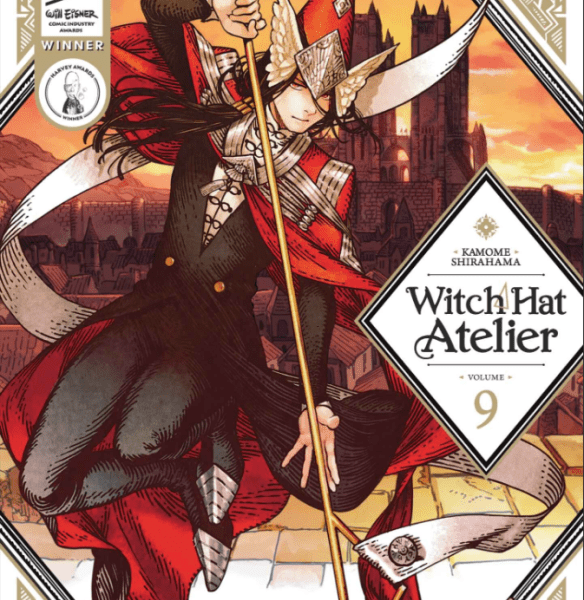
After eight volumes of covers depicting the bright-eyed students and considerate teachers that have defined Coco’s journey so far, it feels grimly appropriate that Witch Hat Atelier’s ninth volume spotlights one of the wardens of magic, the enforcers dedicated to preventing its dangerous misuse. Through their collective efforts to create a magical accessory that might aid their friend Custas, Coco and Tartah arrived at a sort of wing suit that let him soar through the air, granting him a mobility greater than he’d ever possessed before. Their gift was kindly intended and thoughtfully designed, but the realization of these wings may well have inspired Tartah to fly too close to the sun, driven by his sympathetic desire to grant magical aid to those who need it most, and thereby climbing like Icarus to a disastrous height.
Thus we find ourselves staring into the stern eyes of Easthies, the Knights Moralis who once sought to wipe the memories of Agott and Coco both, and who would clearly waste no time in condemning the brash cross-disciplinary experimentation of Tartah. Whatever the benefit, whatever the value in striving beyond the contours of accepted magical experimentation, it clearly cannot compare to the terrible consequences inherent in taking the world’s very form in our own hands, and casting ourselves as gods of a new world. It was that natural human instinct that prompted this society of secrecy; but an order based on a secret so easily revealed is tenuous by nature, and would only take one dissident to irreparably crack.
The consequences of their creation begin to ripple outwards right from the start of this volume, as Custas’ assigned caretaker is surprised to learn his walking chair has been returned to its creators. Her confusion further emphasizes both the precious nature of such artifacts and their intentional rarity; each chair is identified by its own tracking ward, and considered so valuable that simply marking its location is seen as equivalent to tracking its bearer directly. Magical objects are not to be constructed or distributed without consideration; like the care Kamome Shirahama herself takes in the ornate framing of this official, each production of magic is essentially framed as a work of art, a choice that emphasizes both the personal touch of their creation and the necessity of keeping them from uncautious hands.
As if to make that point all the clearer, our return to our young witches on the road offers an immediate reminder of magic’s proper practice, as they diligently repair old roadside wards intended to keep beasts off the main roads. Magic is not intended for personal glory, and its practitioners are essentially public servants – sometimes achieving great deeds, but for the most part working to keep the roads clear and bridges sturdy and fires of humanity lit. Even the active practice of magic is a sequence of mundane considerations; balancing the size of your runes to the intention of your spell, embodying best practices as established over hundreds of years of study, and being careful not to make any hasty, potentially disastrous mistakes. As ever, magic is not good or bad, but it is certainly powerful, and any great power demands an equally great degree of prudence.
That might seem like a disappointment, but it is ultimately essential to Shirahama’s philosophy on both a narrative and meta-narrative level, as illustrated when Qifrey draws Coco’s gaze away from her monomaniacal study of advanced, potentially dangerous magic. For all of magic’s wonder, the natural world is a wonder in its own right – and if we dedicate ourselves too fully to advanced magical mastery, we risk losing the context of that beautiful world, and the greater human community to which we are forever indebted. And that point extends beyond the pragmatic in-universe necessity of avoiding magical self-delusion; it carries all the way to us in the audience, who may not have access to magic specifically, but who can similarly share in the wonders of the natural world, and dedicate ourselves to making some small positive impact within it. The most magical things are free to all of us, so long as we do not lose ourselves in delusions of grandeur.
Of course, it is an exceedingly human instinct to grasp beyond our understanding, and seek to tame the wildest outbursts of our imagination. Qifrey clearly speaks from experience as he reassures Coco that everyone has considered such forbidden applications of magic, with Shirahama’s paneling smartly emphasizing the ranging melancholy of his thoughts. While Coco is portrayed in close-bordered panels that keep her form centered, Qifrey’s musings on magic’s dark potential cast him at the corner of the frames, the negative space surrounding him implying the wide-ranging ambiguity of his thoughts. Negative space in panels is just as important as the space you fill; thoughts loom in stillness, like a lingering ellipsis, an open canvas in which the reader inserts their own conclusions.
A more ostentatious trick of paneling carries us to the party’s evening encampment, as Olruggio literally rolls up the panel like parchment in order to offer his own commentary. Then it’s on to demonstrating the girls’ various magical inventions, each of which reflects their own personality in a crucial way. As Qifrey states, knowing why you made an invention is just as important as constructing the thing itself – for the clearer our intentions are, the more careful and precise we shall be in the construction of something that speaks to sympathetic human desires, and the less likely we are to stray into danger. Thus Tetia engineers a staff that that embodies her love of comforting, cozy things, while Richeh designs jewelry that reflects her fierce attachment to her hard-won personal bonds. As for Agott, whose heart still smolders with her family’s rejection, the only choice is a spell to prove her worthiness to the royal family.
The party’s arrival at the festival returns us to the joyous, tactile celebration of craftwork and artistry that is the heart of Witch Hat Atelier. Our entrance is heralded by a beautifully illustrated fairy tale telling of magic’s first arrival in the world, and how from the start it was a force meant for careful rationing, yet destined to be embraced by all. Shirahama’s emphasis on the physical ephemera of craftwork isn’t just about underlining the necessity of study; she clearly finds a great satisfaction in the intriguing bits and bobs that attend any student of a physical craft, as well as the satisfying physical sensation of rifling through a beloved manuscript. There is a lesson in celebrating the tools of your trade, but those tools are also a physical pleasure in their own right. Every task is a potential source of wonder, and every excursion its own sort of game.
Once again, it is Qifrey’s darker thoughts that eventually cast a shadow on this carefree celebration. Shirahama’s paneling and shading do a terrific job of manipulating the tone here, as Qifrey overhears an array of accusatory gossip regarding his mysterious past. Heavily shaded figures give way to inverted full-black word balloons, as if their accusations were drops of blood spilling across his figure. Meanwhile, the strict lines of the panel make a visual prison of Qifrey’s reflections – a black tone only overcome when Coco arrives, her uplifting presence banishing the paneling altogether. I have rarely seen any mangaka manipulate their paneling with as much clear, effective purpose as Shirahama, whether it comes to the big flourishes or plain visual fundamentals like this.
Then it’s off to the castle, an immense, looming structure heralded by Shirahama’s characteristic visual fanfare, as crows haunt the skies and curtains part to reveal its high towers. As every volume of Witch Hat Atelier attests, there is only benefit in a cross-disciplinary approach to artistic creation; if you want your manga to also be theater, then by all means, set your characters on the stage. Thus our party at last meets up with Tartah and his master Nolnoa, alongside a bizarrely clean-shaven Olruggio. His arrival leads swiftly to another telling reveal, as Qifrey informs his students that no magic is permitted within the royal castle. To our students, magic is a source of curiosity, inspiration, and wonder – to those with power and a will to protect it, it is mostly just an exceedingly untamable weapon. With that framework firmly in mind, we return at last to our arbiter of magical prudence, Easthies of the Knights Moralis.
Easthies’ reunion with his old mentor begins in classic Shirahama style, with ornate in-universe curtains serving as tidy panel bookends, and the combination of her arm and a handy sound effect bubble gracefully drawing the eye towards her unexpected attack. After her dramatic demonstration of force establishes the uneasy peace between wizards and nobles, the introduction of new magical scion Lagrah pushes the tension further, demonstrating King Estus’ clear distrust of magic-users at large. His feelings are understandable; for as much as this nation is ruled by nobles and their laws, such forces ultimately serve at the pleasure of magical scions, whose prior preeminence established the bedrock of this post-war era.
Thus at last we are introduced to the greater political tapestry of magic and the continent, as we meet the leaders of the five kingdoms, and are swiftly acquainted with their jaded perspectives on the wielders of magic. Claiming political neutrality when it comes to matters of collective state is already a presumptuous stance; claiming it when you alone have access to actual magic, a force that both maintains order and could easily destroy it, seems a preposterous assumption. Little wonder that magic’s avatars attempt to cloak their role in almost religious iconography, drawing back on the fairy tales of magic’s arrival in the world of man; if conceptualized as a semi-independent nation-state with sole providence and mercurial policies regarding the strongest force on the planet, the complaints of these lords seem abundantly reasonable. “We must keep all the power and remain obscure in our application of it because only we know best” is rarely a winning political position.
Reasonable accusations mount as the great lords rail against their magical counterparts. Why are mages beholden to no other nation in their reasoning, even when it comes to matters as important as the very course and philosophy of their leadership? Why must magical aid be rendered only in matters of natural disasters, when all with eyes can see that brigands and pirates only bring harm to the common people? And why should mages be allowed to live in such extravagant luxuries as an entire undersea city, paid for by the taxes extracted from those who live in magically unaided poverty? Ultimately, it takes the dramatic entrance of King Deanreldy and his exceedingly cool cats to quiet the throng, whose questions indeed strike at the ambiguous heart of how magic should be managed and executed. Of course, even Deanreldy’s intervention is its own sort of motivated feint – by harnessing the grievances of his contemporaries, he inevitably leads magic’s caretakers towards his own desired concessions.
The reasoning for Lagrah’s swift, unexpected appointment is then made painfully clear, as we witness his predecessor being dragged away for exploiting his station, accepting all manner of personal magical tasks in exchange for hefty bribes. On both the magical and mundane sides, the balance of this world is incredibly delicate; magic only exacerbates the underlying truth of political brinkmanship, and the consequences of even the appearance of impropriety. “If we desire never to be conquered, we must seek never to subjugate” is not just a moral policy, but a genuine survival strategy. What else but remaining aloof to the internal squabbles of mankind might prevent the steady slide into a new era of magical conflict, one where our modern understanding of magic’s power ensures no subsequent society could ever bloom from the ashes?
But enough about political contests and magic’s inevitable, destructive potential. We’ve got a festival to enjoy! Look at all these wacky attractions! Look at all the knickknacks of their magical shop! And what’s that, a prince who wishes to become a witch? Unfortunately, these cheerful celebrations cannot mask the approach of the coming storm, or the tenuous fragility of this mundane-magical balance – for even this prince-and-pauper-esque narrative flourish speaks to the line that cannot be broken, between the magic-bereft rulers who lead this world and the terrible secret that magic is available to everyone.
We then check in with the rest of the Knights Moralis, who in typical Shirahama fashion are humanized with extraordinary efficiency. They are neither unreachable moral paragons or vengeful magical scolds – they are simply people, mages assigned to a relatively thankless duty, who have a wide variety of opinions on both their own labor and the reputation it brings them. It is no surprise that the wardens of magical restraint would be considered unwelcome among other students of magic; after all, their appearance can only mean that someone is getting in trouble, and might even have their memory of magic wiped entirely. Thus this society’s magical wardens remain aloof, unloved by either the mundane world they defend or even their fellow witches.
The knights’ pursuit of an unlicensed magical device vendor offers another fine opportunity for Shirahama to demonstrate her knack for action storytelling, a faculty that generally doesn’t see all too much use in Witch Hat Atelier. But many of the same principles used for things like following a character’s journey through a landscape apply – it’s all about drawing the eye of the viewer with clear momentum, as demonstrated through the flourish of this Knight Moralis’ spear and banner. The sharp, isolated angles of the spear’s point first catches the reader’s attention, then draws it around and downwards along the banner’s arc, creating a sense of the knight actively catching up with their target even just within the one panel.
In contrast, the Knights Moralis Luluci’s swift capture and condemnation of this vendor offers a demonstration of another deeply appreciated Shirahama strength – her unflinching moral clarity, within a field that often demonstrates anything but. While many manga tend to downplay the psychological effects of leering characters, or even include a “mascot” pervert character who’s treated as “naught but lovable,” Luluci speaks clearly: “peeping is sexual assault.” There is no ambiguity here, and in fact a direct line between validating such behavior and allowing even more heinous actions to go on unquestioned. As Luluci’s painful history makes clear, downplaying sexual assault on any level only lets the rot spread, and in a world where the powerful are already capable of taking whatever they want from the powerless, such capitulation feels like a steady surrendering of the soul. At least within the Knights Moralis, she has the capacity to fight this trend – to seek clarity and freedom, whether it be from the leering of a sexual predator, or the overpowering terror of unconsidered magic.
Moving on from that unsavory business, we return to the tent of Coco and her companions, where Shirahama can once again revel in the tactile satisfaction of well-designed crafts. From the texture to the shading to the plain diversity of form and runic inscriptions, Shirahama is clearly in her element celebrating the fruits of dedicated practice. These lovely wands draw into the universe itself the meta-point embodied by Witch Hat Atelier at large: every craft is a form of magic, and every form of magic must be approached with diligence and passion to truly shine. And as Tartah explains, there is more to this diversity of wand shapes than simple aesthetic differentiation; the thought put into their creation builds off the lessons shared by him and Coco, with an intent to allow all the more people to enjoy a wand perfectly suited to their needs.
It’s a lesson that any craftsman could take to heart; to think not solely in terms of what is most pleasurable or pleasing to yourself, but instead how any creation might be shaped towards its intended recipient. Tartah’s committed efforts to ensure all can enjoy his wands, his totally ego-free approach to his craft, is lent a harsh contrast in the form of Agott’s demand to join the Silver Eve Procession. As Olruggio says, Agott is not thinking in terms of what might best please and dazzle the crowd – she is thinking about her own regrets, her own desire for recognition from her family, a motivation that would surely undercut the universality of her creation. As with Olruggio’s own “heatless fire,” pursuing a craft with only our own motives in mind can easily lead to disaster; it is only by taking a holistic, open-minded approach to creation that we might realize any unintended consequences of our efforts.
Even then, the power of magic can always lead to unintended consequences. For all the careful consideration Tartah and Coco put into Custas’ wing suit, their demonstration of the device at this festival leads to another unexpected outcome, with its readily-accessible fantasy convincing a young girl that she too could become a witch. Though Witch Hat Atelier attests that all craft is a form of magic, that thematic reassurance is of little comfort to those who actually seek magic specifically, in all of its otherworldly potential. There is a contradiction at the heart of this world, a lie woven within the fabric of that hopeful “anyone can find their own kind of magic.” How can Coco, or Shirahama herself, attest to our infinite potential, when the truth is that magic will always be guarded and exclusive?
As if in answer to that impossible question, Custas appears at last, his forbidden magic legs literally splitting the unity of perspective shared by Coco and Tartah. His explanations and accusations channel the sorrow of Coco and Tartah into vengeful fury, the well-earned anger of one who was struck low by magic, and subsequently told that magic could do nothing for him. “Magic must be practiced with prudence” is well and good for those who can wield it casually – but what help is that to someone like Custas, particularly once he’s learned that magic could help him, if only mages were willing to bend their own sanctimonious rules? Given his situation, it’s little wonder that he’d immediately frame magic in terms of class restrictions, seeing it as one more gift for those of noble birth, something that couldn’t possibly be trusted in the hands of a commoner.
In a glorious two-page spread, Custas lays bare the hypocrisy at the heart of magical society. Making terrific use of his full-black pants and hair, Shirahama presents his words as a poison spreading through the veins, throwing back the doubts of Coco and Tartah in their most violent possible form. Why is that magic, which could actually heal people, is more harshly regulated than actual tools of violence? All Coco and Tartah can offer are apologies – hollow words, the only gift mages will offer freely. Thus our pair find themselves bound by the Brimmed Caps, called to account for all the cruelties of their world’s delicate balance.
This article was made possible by reader support. Thank you all for all that you do.