Hello folks, and welcome back to Wrong Every Time. We’re truly entering the holiday season now, which tends to be a period of profound self-recrimination to me personally, as I attempt to make up for missed family time and finish off a year’s worth of outstanding ambitions. But I’m trying to take it easy on myself this year, and it’s certainly helping that I’m about to pass the hundred page mark on my ongoing fantasy story. I’ve been writing dubious fantasy novels since middle school, and it feels incredibly validating to be back in that space and making steady progress, actually chasing my ambitions rather than admiring them from afar. I only sorta half-believed in this DnD writing to traditional fiction pipeline when I started off, and it sure is nice for something to turn out right for once. Anyway, enough navel-gazing for now, we’ve got some movies to break down. On to the week in review!
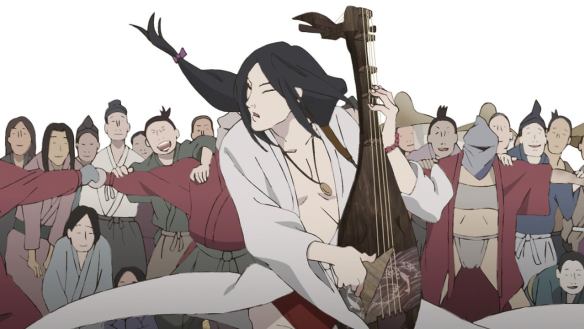
First up this week was Inu-Oh, the latest film by the incomparable Masaaki Yuasa. Set in the fourteenth century, the film centers on two outcasts: Inu-Oh, a man born with unusual proportions and frightening features, and Tomona, a blind biwa player who dreams of revolutionizing his art form. Together, the two form a music-and-dance duo that dazzles audiences across the land, introducing new chapters to the venerable Tale of the Heike. Of course, any such disruption in tradition will have its detractors, and thus our two eventually come into conflict with the shogun himself.
Inu-Oh is a visually and sonically joyous victory lap for Yuasa, one that takes his abiding love of dance sequences to a whole new level as the impetus for a brief social revolution. The film is at its best when Yuasa is reveling in anachronistic aesthetic cross-pollination, combining biwa music with blues and hair metal, or Noh dance with breakdancing and interpretive, figure skating-reminiscent grandeur. In these sequences, and their contrast with moments of Tomona’s father seeking his long-lost son, I feel like I can see Yuasa himself in profile, defiantly proud of his artistic innovations yet still seeking a true, lasting home.
Perhaps it is because Yuasa himself is still seeking an answer that Inu-Oh seems to lack one, beyond the bleak reflection that the powers that be will always crush innovation in its time, only to prove helpless against the ways such innovations inform future artistic traditions. The film’s climax feels cut short, its character journeys harshly unresolved, and I can’t help but feel that such realism was not the initial intended takeaway, but the result of Yuasa not quite realizing the next step in his artistic development. And frankly, that lack of fulfillment gives me hope. Inu-Oh is lovely, but it’s also lacking in anything I haven’t seen from Yuasa, a potential sign that the man defined by innovation has run out of new tricks. If this film left Yuasa as hungry as it left me, I’m excited to see what he conjures next.
Still on the hunt for more appropriately Thanksgiving-themed horror features, we next screened the 2021 feature Black Friday. The film centers on the overnight staff of “All-Mart” as they prep for the Black Friday rush, only to find themselves under siege when a parasitic infection starts zombifying the shoppers. Thus begins the usual progression of panicked flight, high-pressure airing of personal laundry, and ultimate death-defying escape attempts.
Black Friday is a generally passable riff on Dawn of the Dead, with its predictable proceedings somewhat elevated by the committed-bordering-on-manic performances of its lead cast (the film features three former child stars seeking a break, the ever-hungry Michael Jae White, and Bruce friggin’ Campbell). Director Casey Tebo mostly works in capturing live performances, and that unfortunately comes through in Black Friday’s unconsidered cinematography, but the monster effects are reasonable, the film makes solid use of its unique venue, and the characters bounce off each other with consistently effective energy. I particularly liked how messy our players were; there’s a convincingly human pettiness to all of them, which makes their moments of solidarity feel all the more earned. Inessential but breezy.
Our final stop in the first era of Godzilla films was Terror of Mechagodzilla, which was also the last film directed by franchise originator Ishiro Honda. This one features the return of those dastardly Mechagodzilla-constructing aliens, who have now upgraded their creation into an even deadlier incarnation, while simultaneously recruiting the help of mad scientist Shinzo Mafune. With Mafune’s help, the gentle giant Titanosaurus is roused into a great fury, forcing our noble protector to face foes both ancient and mechanical at once.
Terror of Mechagodzilla basically runs all the hits of late-Showa Godzilla films: there’s aliens, mind control, international espionage, superpowered wave oscillators, and even a cyborg love interest. Alongside the generous scenes of destruction provided by Mechagodzilla, the tale of Mafune’s cyborg daughter is actually the most compelling aspect of this one, continuing the recent franchise trend of fully furnished human dramas to compliment the kaiju chaos. As an attempted continuation of the franchise in the mode it’d been pursuing, I can see why Terror of Mechagodzilla failed to entrance audiences; it’s really just Mechagodzilla all over again, adorned with several more series staples and one more rubber suit. But as the swan song of the Showa era, it acquires significantly more pathos in retrospect; Godzilla would return, but the era of these charmingly ramshackle rubber suit slugfests had ended.
It would be nine years before Godzilla would return to the silver screen, in the appropriately titled Return of Godzilla. Deliberately framed as a thirty-year-on sequel to the ‘54 original, Return of Godzilla also sees its star regaining his status as a figure of thematic resonance and unknowable menace, a far cry from the “Our Friend Godzilla” humanization of his prior incarnation. Driven back to the surface by a volcanic eruption, the physical threat of Godzilla is now matched by the threat he represents to global peace, as an embodiment of unmatchable nuclear escalation.
While the original Godzilla was clearly a post-war metaphor for nuclear weapons specifically, The Return of Godzilla rages through a world where nuclear proliferation has given us the power to destroy ourselves utterly, in the long days of a cold war that could at any point set the world on fire. Shifting from either disaster film or adventure romp to political thriller, the franchise resculpts itself in line with the times, centering much of its drama on how the United States and Russia react to Godzilla’s presence, and whether Japan can maintain its policy of nuclear abstinence with these two giants peering over its shoulders.
The resulting film is pointed, propulsive, and genuinely refreshed, a clever re-envisioning of Godzilla that simultaneously returns it to its politically charged, horror-adjacent roots while charting a new structural path for the franchise. You can recognize the seeds of Hideaki Anno’s Shin Godzilla in this film’s focus on the politics of martial escalation, the theater of public approval, and its fundamental distrust of Japanese bureaucracy, wherein avoiding blame is always prioritized over finding solutions. Poised between two belligerent giants, Japan feels more vulnerable here than it ever did at the hands of Showa-era space aliens; couple all that with the film’s luxuriously constructed and expertly demolished Tokyo, and you end up with a very fine Godzilla feature indeed.