
Hello folks, and welcome back to Wrong Every Time. Today we’re continuing our journey through Monogatari’s aptly named Monster Season, having just concluded the tale of the Princess Acerola’s transformation into Kiss-shot Acerola-Orion Heart-under-blade. As we discovered, that name is not just an ornate title, but also a statement of intent: from her first moment as a vampire, Kiss-shot pledged to make her violence an act of love and sacrifice, always killing with a kiss so that she might eventually extract her heart from the blade of her inherent nature.
That brief arc demonstrated Nisio Isin at his most fanciful, turning a twisted fairy tale into a reflection on how we sculpt our own identities, externalizing Acerola’s self-hatred and Deathtopia’s self-regard as reflections of their respective curses. Acerola’s journey towards valuing her continued existence mirrored Deathtopia’s path towards valuing the life of another, and with Acerola now having theoretically achieved the bond Deathtopia hoped for, I’m curious to see just what the original vampire makes of Araragi and Shinobu’s whole deal. Let’s return to the season of monsters!
Episode 9
Our first chapter title card provides a playful structural segue from the last arc, reframing that arc’s focus on consumption through the image of a modern table setting. The ravenous vampire in our polite modern era
In front of the familiar high school we are introduced to a new character, first-year Kie Harimaze
Interestingly, Araragi is our narrator, raising an immediate question of his connection with this girl
Kie regrets enrolling at this college prep school, and furthermore regrets joining their ridiculously intense basketball team. Given Kanbaru’s reflections on basketball, I can imagine just how stressful their practices must be
Unmoved by the harsh expectations already constricting her life, she actively wishes for someone to assault her, to upend her life and let her start over, to give her an excuse to reroll the dice. When you’re existing in a stasis of your own making, a stasis you feel powerless to overcome, the idea of a violent disruption that is both out of your hands and not your fault can feel like a liberating possibility
Another parallel with our last arc – both Deathtopia and Acerola actively danced with the possibility of total destruction, rather than accepting continued existence within the lonely stasis of their own lives
“I don’t care what it is, so long as it sets me free.” We’re also setting up a separate parallel here, echoing Araragi’s sense of displacement and total lack of concern for his own life at the beginning of Kizumonogatari. Kie is basically hoping for a Kizumonogatari to occur and set her on a new path; with her knowledge limited to the fact that her current life is making her unhappy, she has no direction in mind beyond disruption, a willingness to follow wherever the night’s terrors will take her
And thus Deathtopia arrives, as if in answer to her prayer. Deathtopia signals her distrust for Japanese convention by riffing on the term “itadakimasu,” a cheeky reflection on our transition from last arc’s “bon appetit”
Excellent non-sequitur of a transition from this moon-haunted meeting to Shinobu stuffing her face with donuts. She’s come a long way from the tragic expiring creature of Kizumonogatari
We jump to the hospital, where Gaen appears to be surveying what remains of Kie’s blood-drained body. And then Araragi enters, self-conscious as ever, brandishing a graph paper introduction of himself from three perspectives: as an actor within a story about apparitions (Human x Vampire x College Student / 3), as an individual (Koyomi Araragi, 19), and as a narrative roleplayer (Me (Protagonist))
Kie is alive, her vital signs “sickeningly normal.” Monsters and apparitions are to be expected; their form matches their nature. This girl, whose form does not match her still-living nature, is something unusual
Apparently it was a “failed vampirization,” which are more common than successes
“There must be a way to save this girl.” Araragi has learned to value himself, but he’s still Araragi. One of the key insights of Monogatari – there are things we can change about ourselves and things we must come to accept about ourselves, and sorting out the two is the work of a lifetime
Cute effect when Gaen says she “rarely leaves her home,” with the walls projecting the rainbow skyline that accompanied her appearance in the Mayoi void arc. It’s like she’s a valkyrie that descends from the clouds for occasional exorcisms
Continuing the pattern of goofy Shinobu-centric title cards, akin to Oda’s tangential adventure title cards from One Piece
We visit another mummified patient, Aburi Honno
A nice visual effect emphasizing the sanitizing effect of this hospital environment relative to the terrible violence being described, as red-painted crosswalk figures tumble down the screen like a rain of corpses. Monogatari often walks a thin line on the verge of outright body horror, occasionally erupting when the pleasant, circuitous conversations cede to the finality of violence
Yotsugi is on a secret mission and Kagenui is apparently several days away, so it falls to Araragi to assist Gaen
“I’ll help you in areas that won’t affect my academics negatively.” Gaen is pulling on familiar strings to draw him in, and it’s satisfying to see him now establish ground rules like this, refusing to give up on his ongoing personal aspirations just because someone asked for help. He’s learned to value himself more, and has specific goals he hopes to fulfill in his own life
They find a third victim, yet another female student of Naoetsu High School. This one is found in a backyard shed, another echo of Araragi’s adventures back during Kizumonogatari
This victim was holding a set of flash cards in her hand, with the top one reading “B777Q,” which Araragi interprets as her “dying message.” There’s always a hint of mystery fiction in Monogatari’s DNA, and Isin himself has more directly embraced and critiqued the tropes of mystery narratives through his Decapitation Cycle books, so it’s little surprise to see him more fully indulging that passion for these supplementary tales
Amusing to imagine Isin reading Agatha Christie and thinking “you know, this is pretty great, but it could stand to be at least thirty times more horny”
The victim’s phone strap is adorned with two “K” dice, presumably referring to her name, Kuchimoto Kyoumi. I’m appreciating the returning use of live action photography for these little interludes – first that shot of the second victim’s futon (a jolt of uncomfortable realism grounding the violence), and now this playful inclusion of actual beads and dice as we closely examine the evidence. It’s as if the scene is only animated because it’s far away, but if we look closely, anything can be brought into realistic focus
Gaen points out the previous victim had a similar strap, a coincidence worth investigating. I’m reminded of Shoushimin Series “to what percent would you consider that suspicious” speech
Araragi heads to a decryption class at his college, where he meets a fellow student named Meniko Hamukai
In spite of the lecture being cancelled, she sits in class because that’s “where she was scheduled to be.” A response that makes her seem both orderly and absentminded, which presumably works well for abstract math problems
On the back of the card is written “231,” which apparently solves it for her instantly
I like how she refers to Araragi as “Araragi-chan” rather than Araragi-kun. Part of him accepting the whole of himself at Monogatari’s original conclusion would necessarily involve embracing his somewhat complicated relationship with gender. Ougi’s gender fluidity was not a random choice
Meniko’s answer involves taking the lower case versions of B and Q, which are essentially the same shape flipped, and transposing them for the Arabic numerals that are similarly linked, 6 and 9. As pretty much always the case for me, this seems to involve leaps in deductive reasoning that just never would have made intuitive sense to me. Mysteries do not work for me, but I’m glad you’re all having fun!
“It’s clearer than day that 67779 can be separated into three prime numbers.” But what would compel you to think that separating it into three prime numbers is a useful exercise, rather than doing any of the other million things you can do with any given number? As I said, whatever logic drives the mystery fan’s deductions is entirely alien to me; I work in narrative, thematic, and psychological deduction, all of which feel more intuitive and logical to me than however mysteries are constructed
Regardless, Meniko’s answer is “D V S,” Deathtopia’s initials, a name that is apparently familiar to Gaen
Gaen proudly declares she broke into all their phones and snooped through their private photos. Apparently all three victims were connected to the basketball team
More fun uses of color-altered live action photography as the two summarize their findings. The town actually feels much more alive as a result of both these tricks and this arc’s general surplus of characters, an effect that seems to echo Araragi’s increasing engagement with and appreciation of the world around him
Araragi at last offers a question I’ve been considering for a while now – would this victim really have left such a complex code as their dying message? Thus a natural question – did this message truly come from the victim, or is it a calling card left by the vampire? If so, that raises the further question of why Deathtopia would use such a convoluted method to announce their presence – why were they attempting to make sure whoever followed up on them would be capable of cracking this code?
At Kanbaru’s house, Araragi meets Seiu Higasa, the new basketball team captain
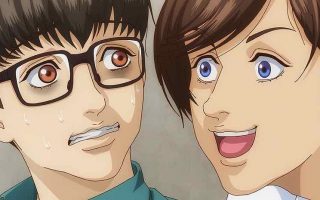
Araragi must now endure the fundamental curse of all ascendants to adulthood: being razzed by the kids these days
Higasa bears the same kind of initial-marked phone strap
She reveals that currently the team has lost its sense of solidarity, and developed a terrible social atmosphere. Additionally, there are actually five members of the team now missing
And Done
Thus Araragi is once again drawn into the fantastical troubles of his old stomping ground. That said, I quite appreciated how this episode made his growth clear in a variety of ways, from his insistence on setting ground rules and boundaries regarding how fully he’ll commit to this task, to the general shifts in his affectation now that he’s set his eyes on a specific destiny. Given all that, it was actually quite pleasant to be reunited with our old protagonist, even if his course through solving this mystery was largely baffling to me. We’re clearly constructing a narrative and thematic echo of the original Kizumonogatari, a test seemingly provided by Deathtopia in order to discover what her old companion has made of herself. Which of course raises a natural question: what exactly are Shinobu’s thoughts on all this vampiric violence?
This article was made possible by reader support. Thank you all for all that you do.