
As we return to Witch Hat Atelier, our first title page sees our young mage bedecked in flowers, with even our adorable squirrel-caterpillar creature in attendance to celebrate the fun of an approaching festival. The intent seems clear – after the heavy, portentous drama of the last few chapters, both Qifrey and his students have clearly earned a moment of rest. Witch Hat Atelier is perfectly comfortable stretching towards fantasy action or large-scale drama, but its heart resides in the day-to-day interplay of these young witches, as both their collaborations and the manga’s distinctive realization of those actions demonstrate the inherent thrill of bettering yourself, of marching determinedly towards your next skill horizon, and of making sure to be kind to yourself and stopping to smell the roses along the way.
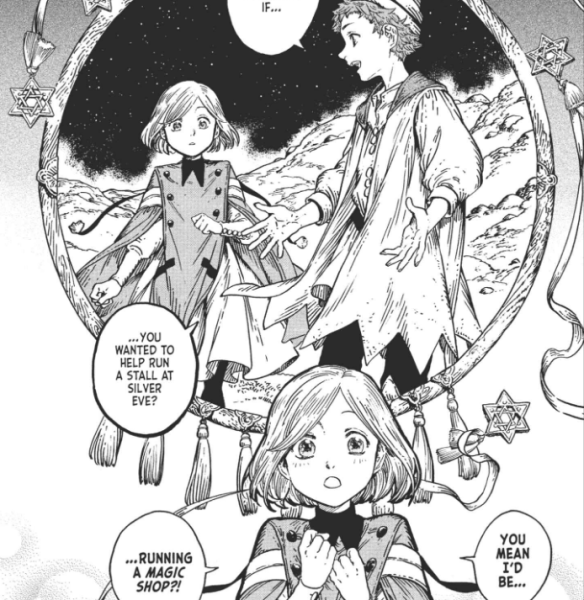
That joyful energy and playful framing is maintained in the chapter’s formal opening, as Tartah’s suggestion that Coco run a magic craft stall at the Silver Eve festival prompts an ornate mental image from Coco, the moment loosely captured within a lovingly ornamented wooden frame, with further star-shaped charms arching overhead, the trails of their ribbons echoing the shooting stars of the preceding chapter. This image inherently demonstrates Coco’s enrapturement with this possibility and creative manner of thinking, as well as her tendency to swiftly apply real-world inspiration (that star shower) to potential application within her charm work.
Meanwhile, the ornate stars themselves seem to echo Kamome Shirohama’s own visual fascinations. I would not be at all surprised to learn that Shirohama spent much of her childhood drawing and perfecting these little sigils, which would then go on to inform the craft of magical creation in Witch Hat Atelier. We do not know where our creative passions will lead us, which is precisely why we must unapologetically pursue them; just as Coco’s mastery of her mother’s fabric-oriented work informed her fundamental strengths as a mage, so too has Shirohama’s obsession with sigils and ornate heraldic framing devices elevated her professional work. In their fascination with these tiny symbols that carry so much power, Coco and Shirohama are aligned.
Another elaborate gilded frame introduces us to Ezrest, the city where the Silver Eve festival will be taking place. As ever, Shirohama’s ability to wed exposition and new revelations to creative, appropriate framing devices (as well as her gift for evocative fantasy landscapes) is put to excellent use in revealing this city. That itself is another small creative lesson – while it is important to always seek new horizons, it is also crucial to know and make use of your own specialties, the things that either inspire or come naturally to you. Shirohama’s choices here aren’t the “default” or even obvious ones – Witch Hat Atelier is distinct because her specialties are distinct, and a different artist would rightfully take a different approach to the very same narrative material. If you are striving for the perfect realization of an idea, you are barking up the wrong tree – every creative pursuit is ennobled by an embracing of your own unique talents, and if you can bring nothing else to a project or idea, you can at least bring your distinct obsessions.
A beautiful two-page spread compliments Qifrey’s explanation of the festival’s history, mixing fanciful optical illusions of smoke morphing into birds with embedded portraits that, like so much Shirohama’s embellishments, seem directly indebted to works like Mucha’s Seasons. It is not just Witch Hat Atelier’s form or execution that embodies and facilitates Shirohama’s fascinations; the very nature of the work, so preoccupied with exposition, explanation, and repetition, embodies both its fundamental prioritization of gaining knowledge and Shirohama’s own approach to storytelling. It is precisely because Shirohama delights in and dazzles with her exposition-framing embellishments that Witch Hat Atelier works so well – standing at the far end of comic storytelling from the economy of someone like Mitsuru Adachi or Naoki Urusawa, it is specifically the process of discovery that is emphasized, not that discovery’s narrative consequences.
It is our old friend Tartah who offers our call to action, explaining that due to his grandpa’s sickness, he requires assistance in running their stall of magical goods. The girls are of course happy to get this chance at a unique vacation, letting Shirohama show off another of her specialties: charming, simplified character expressions. And the next page demonstrates a recurring new fascination: dialogue that goes behind the characters in the panel, not contained within any word balloons, which therefore implies a sense of unconsidered words that even the character in question doesn’t necessarily believe in. Witch Hat Atelier is always a lesson in both its form and its content, and even this first chapter is demonstrating the simultaneous importance of embracing your strengths and always seeking to experiment with new ideas.
Agate’s moody reflections end the scene on an ambiguous note, while also revealing another of Shirohama’s quiet specialties. The fact that Agate and Olruggio are the only two cast members here with fully inked-in hair actually amplifies the emotional effect of the moment, with their three shocks of dark hair essentially precipitating the corner’s vision of the cottage in total darkness. Darkness naturally creates a sense of danger and anticipation, our ability to parse the scene undercut, our imagination free to imagine what is hiding in the darkness. By framing these characters such as to create an encroaching tide of darkness, Shirohama combines her characters’ standard designs with her understanding of visual geometry to create a stronger dramatic effect.
Of course, there are greater threats in this world than disappointed parents, as Qifrey alludes to when he says he’ll accompany Tartah home the next day. Tartah bristles at being treated like a kid, and Qifrey actually sympathizes, giving him a crucial piece of advice: “trust me when I say the adults in your life have no wish to discount you. It is the surrounding world in which they lack faith.” Qifrey knows more than most the astonishing potential of children, how their passion, curiosity, and kindness can reshape the world – in fact, he has even come to rely on Coco’s moral compass over his own. But this world does not universally cherish the potential of youth; it is a world of chaos and potential cut short, where the light of curiosity and inspiration must be carefully nurtured. The ultimate victory of compassion and curiosity over suspicion and ignorance is never certain; in fact, in our own world, suspicion and ignorance could not be more ascendant. Thus, even if the kids complain about being smothered, a certain degree of alleged overprotectiveness is needed to defend all that is good in the world.
Our next title spread demonstrates again Shirohama’s keen understanding of visual geometry as a dramatic tool, and the emotional impact of negative space. While the darkness surrounding Agate created a sense of ominous anticipation in the previous chapter, here the vast sky promises fresh opportunities, a great open canvas on which our heroes are destined to make their mark. An unbalanced composition always creates a certain emotional effect, drawing the eye this way or that, or conjuring a sense of absence that begs for completion. Here, the gradual curve of the landscape into Tartah and the crouched-over Coco acts as a visual arc, drawing the eye up through Coco and out into the inviting world beyond.
Witch Hat Atelier’s dedication to ensuring everyone is equipped to fulfill their potential is exemplified in this next exchange, where Coco remarks that “having lots of different ways to tell things apart makes life easier for lots of different people!” It’s a comment that calls back to the near-catastrophe back at the apothecary, when Tartah’s colorblindness almost made deciding on the proper remedy impossible. Whether it’s Beldaruit’s chair or simple considerations like this, Witch Hat Atelier’s celebration of our potential extends to its insistence that facilitating that potential for all should be a cause we embrace universally. There are no “chosen ones,” and no “cursed ones” either – there is only the great task of bettering and expanding ourselves, a task that those with special needs should be facilitated in pursuing however possible. After all, as both Shirohama and Coco exemplify, a unique perspective on life, and unique personal struggles, will always inform the distinct nature of our own creations.
Coco has offered Tartah a precious gift: the gift of unbounded potential, of knowing the dreams you seek only require your own steady progress to achieve. We are often stymied by either external hurdles or simply our own anxieties, the fear that we’re “not ready” to pursue that passion or creative project, the idea that we’re simply “not the sort of person” who can successfully apply themselves to such a task. Even if these shackles are psychological, they are still heavy, lasting constraints, ones which often require an external source of validation or reassurance to escape. Even in my own life, it took the firm intervention of two of my best friends to get me back into creative writing, to give myself “permission” to embrace writing novels as my life’s fundamental purpose again.
Another clear trick of paneling covers their journey from the atelier to Tartah’s home, with the unusually large panel gutters and prominent negative space both emphasizing Tartah’s ominous lingering question, and also creating a sense of significant transition. It’s like the comic storytelling equivalent of a slow match fade in cinema, evoking both the clear passage of time and the continuity of the characters present
The distinctive paneling of this chapter emphasizes how tethered we are to Tartah’s personal perspective, and by contrast how distinct Coco’s own perspective is. It is Coco who generally sees the world in terms of majestic, flowing tapestries and vivid landscapes – Tartah’s world is much more defined by doors and boundaries, by lines he fear not cross and things he dare not say, exemplified through the harsh panel bounds that he uses almost like shields to hide behind. And he has been working in his own way to overcome these boundaries; as a chance run-in with Custas demonstrates, Tartah has been engaging in a forbidden combination, studying both magic and apothecarial healing arts at the same time. His own passion is taking him in a dangerous direction, calling into question the inherent validity of any given creative or scientific pursuit. Having been presented with the same question Coco faced at the tower, Tartah’s bitterness at being restricted from learning has led him to embrace the potential of the dangerous unknown.
Tartah’s very gallantry demonstrates how easy and sympathetic it can be to stretch beyond our studied reach. Tartah is indeed pursuing these dual fields of study for the most idealistic of reasons, but it is rarely “sincerity of intent” that is lacking when humanity delves into dangerous areas of study. Having gone so far to establish the inherent worthiness and joy of personal study, Witch Hat Atelier is equally swift to establish the dangers of study unbound by moral considerations, of knowledge entirely as its own reward, with no consideration for how that knowledge would be exploited by human hands. Like the great revelation that magic is available to everyone, but too dangerous to be universally understood, Tartah’s story emphasizes how good intentions are not enough to ensure dangerous powers are used judiciously. Humility is just as important as curiosity – in fact, it is only when we engage in study or research in a spirit of humility that we can remain fully cognizant of knowledge’s unbelievable, often dangerous power.
Our return to the atelier offers a clear example of the consequences of reckless experimentation, as Qifrey continues to suffer the lingering physical effects of his own dalliances with forbidden knowledge. Again, as from the start, knowledge is presented as neither good or bad inherently – simply powerful, a key which can unlock any number of doors, some concealing great discoveries for humanity, others barring access to self-destructive potential, and still more containing tools that could be used for good or ill, depending on the humility and consideration of the wielder.
In contrast, Olruggio offers a tidy demonstration of the forethought necessary for any bold experiment. The girls are surprised to hear Olruggio is struggling and planning to abandon his current project, to which he replies “why wouldn’t I? I have failures all the time. Every day of my life.” They’re comforting, necessary words – because it is true, that every act of creation is the end result of a thousand aborted processes, a thousand false steps or failed attempts or almost-but-not-quite solutions. Just as Coco has to practice her runes time and again to achieve something that actually works, so must even the working professionals embrace the fact that most of creativity is essentially the act of failing productively, of trying and seeing a mistake and then trying again. That story you have held in your heart for years is itself only a proto-first draft; it is only through bringing these constructions into the world, and seeing them in all their half-formed, unsculpted glory, that we can hope to achieve a result that’s even half as good as what we imagined. As always, ideas are cheap – it’s the dedication to the process of continuous failure and repetition that turns one of a million errant seeds into a mighty, enduring structure
Olruggio’s invention is in truth quite useful – a heatless, non-spreading flame used for light or protection would have all manner of applications. But a world where heatless flames exist would inherently be more dangerous than our own, as many children would undoubtedly learn misleading lessons about fire safety, and suffering would inevitably result. A variation on that same refrain – creation is not value-neutral, and we must consider carefully what we choose to bring into this world. The craftsman holds a unique responsibility; they alone must choose whether the world is better for their invention, or if its potential consequences outweigh its positive applications. Considering our world is currently being transformed by artificial intelligence models with countless negative applications and virtually no positive ones, the urgency of this theme is far from theoretical. We cannot count on every human everywhere to employ new inventions judiciously; it is only at the moment of their formation that we have the potential to guide their use, or risk negatively transforming the world in the way of so many inventions we take for granted
Of course, while a philosophy like this is easy to embrace when any given invention is a mere source of diversion, the equation is far different when your ability to create useful things determines whether you eat or starve. Custas serves as the counterpoint to our secure witches with their clear career track, emphasizing that as someone who came from nothing, he doesn’t have the luxury of taking the slow, careful route for everything, and of ensuring he exhibits the greatest caution in every single step of his apprenticeship. This world is not so accommodating as to allow us to only act in the ways we consider most judicious; while comfortably established intellectuals can debate the morality of creation, those thinking about where they’re going to sleep tonight cannot afford to cast opportunities aside.
Having at last come to understand the urgency and desperation that informs Tartah’s desire to expand the intersection of magic and medicine, Coco sympathizes entirely, seeing her own desperation to save her mother in his empathy for Custas. We cannot change everything, but we can commit ourselves to embracing what we can change, and making the world a kinder place for all of us. Perhaps that is the solution – to pursue creativity and invention doggedly, but to do it always with an image in mind of the better world you are attempting to create.
The trials of Tartah and Coco’s brainstorming demonstrates the truth of Olruggio’s words, that the process of invention is mostly a procession of repeated failures. Hoping to create a superior method of transportation to Custas’ fragile chair, their hypotheses are realized through one more unique trick of paneling, where an overall landscape composition is segmented by overlaid panels, the scenery emphasizing both the broad perspective of their thoughts, as well as their focused prioritization of the differences between styles of roads, the various terrains their invention will have to account for. A clever visual realization of how wide-ranging brainstorming is condensed into clear, actionable ideas.
“There are all sorts of barriers out there that you never even notice unless they affect you personally,” Tartah muses, clearly also considering his own handicaps. Just as we must take care to consider the potential misuse of our creations, so must we consider the perspectives and needs of those unlike us, to ensure we are not creating more barriers than we are dismantling. Our power to enact change on this world is a great gift, but it must be pursued with responsibility, and consideration for how those with unique challenges of their own might engage with your creations.
A shift in paneling style serves a new purpose as we delve into Custas’ early childhood. Here, the gutters between panels are entirely black, creating a sense of unknown dangers surrounding him, rather than open, unobscured potential. Additionally, the way these panels are organized into tight vertical rows, with the first in particular surrounded by massive black voids, creates a sense of entrapment, like each panel is a cage Custas cannot venture beyond. It is only when Custas first meets his savior that this darkness begins to fade, as if light itself is emanating from his new companion. And then, through the invention of Coco and Tartah, the light expands to fill the page, and the feathers that were initially a sign of his deprivation now emphasize his freedom as a bird in flight.
As is often the case, Tartah and Coco’s solution arrived when they reframed the original problem. They thought they had to make a spell that would make all roads regular everywhere, but the problem was not “fix the roads,” it was “facilitate movement.” By detethering their conjectures from the assumption that the answer had to do with addressing roads directly, they were able to seize upon levitation as a more general-purpose solution.
However, this victory only raises further questions for Tartah. If they have the ability to help others, shouldn’t they share that power? Why should Custas be barred from the usefulness of other magic, just because he isn’t within their society’s magical lineage? And the final, painful question – “shouldn’t the people who desperately need the world to change deserve the power to actually change it?” A question with no easy solution, one that speaks to the difficult bargains and cruel compromises inherent in attempting to manage and coral the restless spark of human invention – a task that lies at the foundation of this witch society, but which may well be impossible.
The chapter’s concluding images, of Dagda being repaired as easily as a broken vial, emphasize how swiftly we can step beyond the veil of what is possible or allowed, how natural it feels to apply our tremendous powers to their most impactful possible advantage. Must we remain so desperately fearful to make use of them? For those who suffer in an unkind world, words of caution can sound more like cowardice.
This article was made possible by reader support. Thank you all for all that you do.