
Hello folks, and welcome back to Wrong Every Time. Today it is altogether too cold for me to be tramping around outside, so we’re instead going to take a vicarious walk around the neighborhood, by enjoying a fresh episode of CITY the Animation. Keiichi Arawi and Kyoto Animation’s latest collaboration has proven an absolute wonder so far, and if anything, it seems like the show’s ambition is only growing with every passing episode.
Last episode’s concluding race served as the show’s most impressive flourish so far, combining copious kinetic animation and skillfully attention-drawing boarding to involve the entire community in Niikura’s quest to retain her dignity. What made that sequence possible was not just the production’s ability to maintain dramatic momentum across half a dozen distinct sub-narratives, but also the underlying fact that the show had set up all those narratives so well, making it easy to spend just a few seconds with any given story and pick up a bonus punchline. The best sitcoms tend to culminate in sequences that weave A, B, and C plots together into something surreal yet dramatically inevitable, and if CITY continues at its current rate, we’re likely due for future climaxes that reach all the way to F, G, and even H plots. I can only be thankful Kyoto Animation is using their terrifying powers for good, as we charge forward towards another day in the city!
Episode 5
Astonishingly, we actually open with a summary detailing Nagumo’s capture while chasing Niikura’s locket. Arawi’s ideas so frequently culminate in either non-sequiturs or anticlimaxes that I sorta figured any episode-concluding sequence would be instantly forgotten by the next. Then again, this show is all about the interconnectivity of these characters’ lives, and that demands a sense of continuity
I suppose that’s just an inherent contradiction of Arawi’s work; simultaneously deeply invested in the minutiae of its characters’ daily lives, yet also incapable of taking that minutiae entirely seriously
Oh my god, they built an actual miniature mansion to have pop out of the earth at the edge of town. This show’s stop-motion ED is already a treasure, and I’m delighted to see the team embracing even more of a mixed-media approach for the show proper. As I have said time and again, the illusion of realism is a false god – embrace the disruptive, variable potential of aesthetic form!
Very charming wobbly movement for the limousine as we pan in on this actual set, which is apparently Tanabe Mansion
Apparently the two massive columns are “Mansion Tanabe’s hospitality towers.” Of course
Nagumo is taken to the top floor reception area, which also doubles as the wine cellar
“It is to ensure you cannot escape.” They’re getting solid comedic mileage out of the evocative ambiguity of this “award” conceit. It’s one of those phrases that’s so unmoored from any specific interpretation it sort of acquires its own threatening ambiguity – “I’m going to give you an award” sounds almost like a threat coming from these characters, purely because the previous episode so effectively divorced the distribution of awards from any sort of award-adjacent behavior
Nagumo shows off another of this show’s signature flourishes as she attempts to escape – not just fluid, evocative character acting, but actually a scramble of character acting on top of character acting, fifteen different weird poses in a row, as if we’re actually watching the contortions generally obscured beneath a cloud of dust as characters squabble
Ludicrous flexes of their lovingly sculpted mansion as we pan the exterior, complete with cotton ball clouds and birds flashing by to create a sense of depth. Did they acquire a mounted camera rig with an adjustable track just so they could pan around this creation? My lord, KyoAni
Oh hey, the nice old man is already here!
A little ghost creature offers our formal introduction to the Hospitality Towers, which unsurprisingly seem to be the focus of this ridiculous episode
The number of fresh compositions per minute as we scroll through the tower is preposterous. While many productions have largely given up on layouts and backgrounds, relying instead on simple character art transposed against an unconvincing CG backdrop, KyoAni appear to be fiercely competing against their own ludicrous prior achievements
And it’s very important for this production! It’s not just a flex of talent and healthy production schedules; for a story that’s all about the interconnectivity of a living society, all the background details that emphasize this is a living world, one where key things are happening even if the current focus characters aren’t part of them, are essential
This is incidentally the same mechanism that makes so much of modern cinema feel “fake” – we’ve abandoned full, deep focus compositions because they require actually shooting the material on-set and in the way it’s eventually going to be used. Modern producers do not shoot films; they shoot characters in neutral lighting in front of green screens, and then construct the film in the edit, after any chance for depth or richness of composition has been lost
Of course, these producers would argue “why does any of that matter if people are watching films on second screens or phones, wait what are you doing with that gasoline, who are you and where is my family”
Apparently you can either accept the award or escape through twelve floors of fiendish traps
“If we stay here, we will be subjected to the highest level of hospitality”
“How do you know so much?” “I’m… a regular.” Like the award concept, a gag from the previous episode has now achieved a mythic aura. To be a regular is a great power indeed
God, the gags they pass by in about half a second, like the butler here unfolding a fake sidewalk to lead the Nice Man into the limousine. Like the Naked Gun movies, one of Arawi’s signature tricks is stacking the gags so high that even if one fails, the next is already unfolding
Good lord, the tiny figure climbing the tower was actually Wako sneaking in. I sorta figured that guy was just some artistic license by the architect
And now Nagumo can’t flee back to luxury, because the Mr. Bummer duo have already been captured and subjected to the utmost hospitality
They are confronted by the most confusing magician I have ever seen, like an Uncle Sam-themed wizard or something
Some gags really just come down to the specificity of the character acting, like the fluidity of this stupid magician as he attempts to defend himself against pigeons while stumbling across the room. I also like the recurring idea that most of this world’s animals are both sentient and easily incensed by human stupidity
After the magician defeats himself, the trio journey onward to the tenth floor. I just know these cuts to the mastermind behind the scenes are going to end in the stupidest possible anticlimax, and I am here for it
Next up is the Chamber of Math Hell. It seems like this whole episode is going to be one extended adventure, which I’m all for – now that we’ve thoroughly established so many of the local players, it’s nice to see them actually spend some meaningful time together
Their challenger Mitsuami is attacked by her rival Soroban! What will happen next!?
I love how deeply into these absurd skits the Nice Man is getting. He’s a dreamer at heart
“When we were little, you couldn’t do anything without me.” Two classic Arawi tricks at once here: the Absurdist Nostalgia Grab (also employed for the takoyaki “life flashing before my eyes” gag), and the Unmissable Elephant Gag (a preposterous intrusion on an otherwise normal scene that no one seems to notice – in this case, the giant robot that apparently attended all of these tower-dwellers’ early years)
It seems that Mitsubo was actually invading from the ninth floor, meaning they get to pass through two floors without doing anything
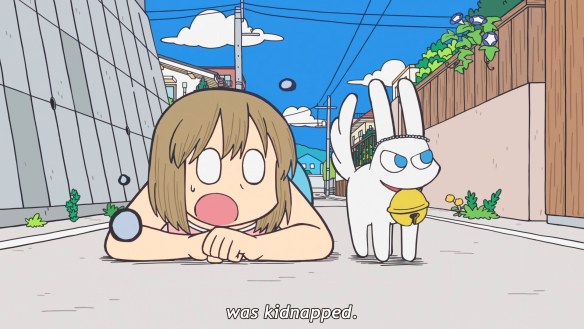
Delightful partitioned screen shenanigans as our trio proceeds through an original Final Fantasy dungeon while Niikura still hunts for her locket. Love her ruthless “fortunately Nagumo was kidnapped” reflections as she searches for the object representing her love for Nagumo
I like that they didn’t just emulate an NES aesthetic, but also the way such art would traditionally be presented on a CRT monitor. Hell, given this episode’s other extravagances, maybe they just actually played their mocked-up “game” on a CRT for real
Oh shit, they’re battling with Fighting Monkey! Beyond just “filling the screen with stuff worth absorbing,” they’re now creating episodes so dense you have to watch them twice
Nice beat in the “cameraman” for the tower descent sort of flailing to capture the animated drama in the thin vertical column he’s visually afforded
And of course, there’s a centaur with butts on both ends. Arawi truly a generational thinker
Okay, this is just absurd. Now they’re actually bouncing the partitioned screen segments around each other, taking advantage of the inherent rules of action and consequence between cuts to make for a somehow graceful procession of movement across two different scenes, both of which are constantly flipping in active perspective and even location on the screen. It’s basically an impossible guitar solo of visual drama, flexing their unimpeachable mastery of drawing the audience’s eye without confusing them
OH GOD THEY’RE UP TO FOUR PARTITIONS. I know I said the show seemed to be increasing in ambition as it went along, but I did not expect this preposterous of an escalation so quickly
And yet the sensation of fluid momentum is still preserved, as all four partitions are simultaneously panning left in pace with their focus characters’ movements
I appreciate that we can at this point just leave the high school pair’s segments silent, which still offers a strong impression of their yes-and nonsense conversations
Aaand we’re up to seven partitions. How long did this one episode take to animate?
I like how they just put Nagumo’s party in an endless optical illusion staircase while we hang out with the soccer team
And it’s just so CITY-like for them to waste this incredibly extravagant multi-partition sequence on an extended tribute to the tsuchinoko. Not that I’m complaining, the tsuchinoko is delightful, but goddamn
Meanwhile, the landlady is on a Cape Fear-style revenge quest that is only allowed to occupy about one-sixteenth of the screen
And another excellent partition-specific gag, as we “wipe cut” from the soccer team back to Nagumo, which actually just means flipping their relative panels within the overall checkerboard
Are they specifically trying to drive me insane? I can’t critique half a dozen shows at once!
This really is the fullest realization of the show’s core theme imaginable – not just implying how all of these lives are interconnected, but actually simultaneously illustrating how they all contribute to the same festive occasion here
We emerge into an even more preposterous sequence of every individual collection of characters wobbling around in their own simultaneous perception-balloon, their relative size and distance from the center reflecting Nagumo’s current awareness of their presence. KyoAni, you’re not competing against anyone anymore. No one else is achieving these heights
God, we are so lucky this show exists. It’s rare that something comes along and smacks me in the back of the head regarding the “potential of animation” these days, but this episode is an utterly singular demonstration of this medium’s distinct storytelling capabilities. What a wonder
Then at last we get the whole party at once, a Where’s Waldo-tier spread of interconnected lives
“Eat up, it’s on me.” Nagumo not one to waste free food, or the chance to exploit the existence of more free food
Plus our outro sequence is a flashback framed as a traditional watercolor-painted tapestry? WHEN IS ENOUGH ENOUGH, KYOANI!?
We learn how the very first Tanabe gained his appreciation for offering rewards to the good-hearted. A community builder from the start
Then Buddha smashed his house, a source of great distress for everyone involved
And Done
Lord, what can I even say to that? This episode was one of the most impressive feats of animated ambition I have ever witnessed, stunning with its audacity of concept, its grace of parallel drama, and of course, most importantly, its utterly astounding visual execution. I thought that big sculpted mansion was going to be the episode’s signature aesthetic trick, but the way our perspective was drawn across those partitioned scenes while maintaining total clarity… it’s just beyond comprehension, the sort of concept you’d invent just to imagine an unreachable bar of animated excellence. We are so preposterously lucky to have this production team, this crew of dreamers so dedicated to the twin causes of joyous community and aesthetic ambition.
This article was made possible by reader support. Thank you all for all that you do.