
Hello folks, and welcome back to Wrong Every Time. Today I am once again beyond up to date on my outstanding reader bounties, meaning it’s a fine time to reward myself (and you all? I hope???) with a fresh reflection on my fledgling dungeon mastering career. When last we left off, the party was approaching Castle Blackmire, and my DMing prep work was already on sounder footing relative to the initial Festival of Saint Agatha. There is simply no way to avoid the gauntlet of data and experience provided by actually running sessions; even among DMs, what amounts to “sufficient preparation” can vary wildly, depending entirely on your own comfort, knack for memorization, ability to improvise, and conception of what exactly you and your players want from your campaign.
For me personally, basically all of these factors point towards “there is no level of preparation that would feel so exhaustive as to not actually be useful.” Firstly, I was and still consider myself a pretty novice DM, and I’m frankly not much of a public speaker, so “comfort” is always a crapshoot. All I can do is set my mind at ease however possible, so I generally follow a pre-session ritual that involves eating a nice, basic meal that won’t mess with my stomach, prepping a sandwich or something so I don’t have to interrupt the session later, and trying to calm down by first reviewing my notes and then going for a brief walk. As for my knack for memorization, that’s a flat zero – my recall ability is terrible, so I have to assume that anything I don’t have written down, I won’t be able to use in-session.
My improvisation ability I consider roughly average; I can’t come up with rich characters or combat encounters on the spot, but I can at least converse comfortably as a character, and keep their voice going as I consider how the players might best be directed. And finally, there is that question of “what do you want from your campaign,” a question that will have a different answer for any given table. The play experience of DnD can range from riding along on an epic adventure with lots of pre-scripted highlights to exploring an endless sandbox, letting your immediate interest dictate wherever the journey might lead. As someone who loves epic fantasy and finds sandboxes kinda repetitive and unsatisfying, I obviously lean more towards a pre-scripted style, and thus my back-end writing needs to be robust enough to actually pay off the faith the players are placing in me.
As I said, for my DMing style and abilities, all signs pointed to “prep as much as you think possible, then take a few days away, come back, and prep some more.” I basically wanted to send my players through an epic fantasy novel, and coherent epic fantasy novels aren’t written one page at a time – they’re built off of sturdy skeletons, with early developments frequently seeding distant payoffs. The easiest way to do this in DnD seemed to be to make the land and towns the players visited both initially worthy of investment and ripe for eventual transformation, which basically set the overall structure of the campaign: I’d have my players march all across the Dalelands in a time of peace, gathering allies before they return to defend those lands in a time of conflict. This was roughly the level of definition I’d reached for my overall campaign structure as the party approached Castle Blackmire.
Continuing on, dark columns emerge in the distance, slowly clarifying into the spires of a mighty castle. Putrid swamp gives way to a blighted orchard, naked branches clawing at the cold gray sky. The castle is preceded by a stone wall and gatehouse, with one guard stationed outside the portcullis, and another patrolling the wall above. Barren, scraggly trees surround the party, the remnants of an orchard fallen to ruin. The fog has largely masked the party’s approach, but they will need to tread carefully from here, lest all of the castle be roused against them
Mission: infiltrate Castle Blackmire and assassinate Baron Tragdor
Sidequest: save the travelers who’ve been abducted by Tragdor’s raiders
Sidequest: reclaim the Crest of Mirelords (will lead to following: present it to the King of Yauhnn beseeching aid, and return the last Heir of the Mirelords)
The castle will have guards (occasional Knights and many Guards, along with Thugs, Spys, and Scouts as archers) situated all throughout, largely congregating around outposts, towers, and barracks. There will additionally be patrols running throughout the castle, as well as guards posted outside important chambers. However, the troops seem poorly trained, more bandits than soldiers, with no consistent uniforms and not much resembling a sense of order or cohesion. It would not be difficult to evade them, and perhaps even possible to fool them into considering you allies. Tragdor generally resides in the Master Study
Guard clusters can be found in the Guardhouse, Barracks, Front Hall, and Rear Station, as well as the two towers on top of the castle
Single or twin guards can be found at major doorways/entrances
Patrols run throughout the hallways and main chambers of the first floor, as well as the overhanging hall of the second floor
Significant fog and darkness make it relatively easy to isolate single guards and even small groups. Beware of runners if you get into a larger engagement (make a big funny commotion the first time, “someone has to report this!” and whatnot)
The armory contains a Greataxe for Arachne, Shurikens for Garu, and a Cloak of Mending for Jaric
Already in this sequence, you can see my writing has shifted from thinking in terms of overall quest concepts to thinking in terms of player-DM moments, how a specific sequence will be experienced or described, and how it would feel to mechanically navigate the castle grounds. The opening descriptive copy is more elaborate and specific, because I’ve already settled into the pattern of using such exposition to set a scene before pulling back and letting the players do what they will. The writing matches my assumed pacing; exposition is a little cheaper when it comes at the beginning of a session or sequence, when it’s not actively interrupting player action.
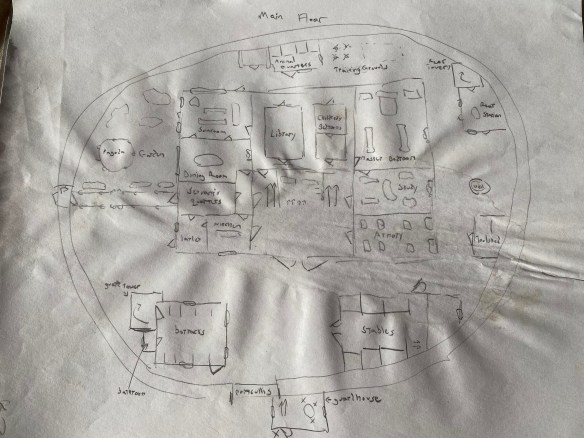
The distribution of guards and loot saw me thinking more in terms of visual and physical geometry, a trend I’d be embracing from here on out, and supplementing with player maps whenever possible (please enjoy my exceedingly rough and coffee-stained map above). I had always loved pouring over maps as a player in the previous campaign, and wanted to reward investment in such supplementary tools by making strategizing and plotting a course of physical action genuinely useful. Such an approach would hopefully emphasize player agency – rather than the castle or guard patrols simply “happening to” the players, I wanted them to feel a sense of ownership over their approach, and satisfaction in picking the precise battles they felt were necessary for victory.
In retrospect, I’m quite impressed with novice-Nick for weaving a couple bonus sidequests into the castle infiltration. I imagine the immediate blank stares upon setting my players free in Nettlebarn had a profound effect; players like agency, but they also need some direction, and thus I tried from then on never to leave them without some clear goal they could at least choose to pursue. I’d also always enjoyed World of Warcraft’s system of weaving side quests into larger dungeons to provide some direction to your exploration beyond “kill all the monsters,” and figured with an open expanse like Castle Blackmire to explore at will, having a handful of sub-objectives would provide both friction and direction. If you can organically lead your players to questions like “should we fight to clear this area or stealth our way towards that other objective,” you’re generally hitting the sweet spot of agency and direction.
Encounter:
The captured travelers are being held in the dungeon cells, beneath the rightward main hall staircase. Two Guards are playing cards at a table near the base of the stairs. When the party initiates combat, the Lurker will strike as well, awkwardly/belatedly warning the guards (“watch out, uh, guy! Oh, shoot”) before joining them in battle
The lurker is actually a ferocious yet deeply anxiety-stricken Lamia, who can actually be befriended by the party. She is accustomed to being shunned for her allegedly monstrous nature, and has thus developed a nervous disposition and eagerness to please that eventually led to her joining Tragdor’s bandits. Her name is Natalie
Gives the party her Necklace of Spider Climb when defeated (she’ll give up and ask for the party to quit it when her health drops low)
Ah, Natalie. This anxious lamia who more or less accidentally joined a bandit gang would unexpectedly prove the most consequential aspect of this whole quest line. She was actually initially conceived by Dante the Sorcerer’s player, who was basically my partner in crime for sculpting this campaign, frequently handling more mechanical aspects like designing upgrades for our rogue. But I was the one who gave her the personality and disposition of Dusa from Hades, and that was all it took for my party to fall in love with her.
“Nervous, eager-to-please lamia who talks with an adorably snake-like lisp” was an immediate hit, and thus I swiftly made plans to bring her back, first as a waitress at a Yhaunn tavern, and later as an actual hired ally of the party. Whatever the medium or format, my specialty in storytelling is characters, and thus my campaign has slowly gained a “gotta befriend ‘em all” subtheme, as my players latch on to favored NPCs and recruit them into their business operations. Natalie would eventually become the first employee of Diehard Enterprises, but that was a long way off – for now, I was just happy to have built a character my players clearly wanted to see again.
Checking the cages reveals the travelers you were searching for. The travelers will reward you with two Potion of Greater Healing, and will increase your reputation in Tasseldale as they relate word of your exploits to those they meet
Along with the travelers, one cage contains Helena Mirehand, the last steward of the Mire family
Helena Mirehand, Last Steward of Castle Blackmire
Loyal to the original family. Was doing her best to maintain their fading estate when Tragdor arrived, demanding the location of the family’s treasures. When she refused, she was consigned to the dungeons. For saving her, she will reveal to you the secret hallways and doors of the castle, as well as the location of a relic that was once borne by the head of the family, bearing drops of their blood to prove their lineage (“turn the golden candlestick in the manor’s vault chamber”)
“The last true heir of the Mire clan, the Mireheir, has been secreted away to my sister in Yhaunn. Please, you must petition the king for forces to reclaim our home! You must restore the true Mirelord!” She offers a Quest to find the last Mire heir and gain an agreement from the king to restore this land, thereby making it safe again for its homesteads and travelers
At this point I’m already starting to plot at scale, and give the party as many tethers as possible connecting them to Yhaunn, so that they’ll feel not just compelled to visit the capitol, but actually rife with quests to pursue when they get there. One of my primary objectives in writing this campaign was to make the party genuinely care about this land and its people, rather than having them simply feel like scenery for the party’s own heroics. Achieving that would demand continuity of connection and purpose, and Yhaunn would essentially serve as the first harvest of the seeds I’d planted, offering a chance to check in with the thief Charlie from Nettlebarn, hand in the quest offered by Nettlebarn’s mayor to the king, pursue the last heir of the Mire clan, and meet back up with Natalie. You only get one chance at a first impression, so I’m thankful I worked so hard to infuse the introduction of the party’s ever-since main base Yhaunn with so many points of emotional and mechanical connection.
Encounter:
When the party has progressed significantly through the castle, they will be challenged by Tragdor’s lieutenant Fukuro. This encounter will begin explosively, with Fukuro using his lightning power to carve or stab a surprise entrance through one of the castle walls. He will then summon two guard captains and commence the battle (one samurai + two spies)
Fukuro is actually a samurai from the eastern kingdoms. He will recognize Garu’s weapon and attire, calling him out as a false warrior, and pledging to strike him down with This Very Sword (an imposing, lightning-enchanted sword that carves lightning arcs across the surroundings)
When Fukuro is defeated, his sword will shatter, and its essence will be consumed by Garu’s Wakizashi
Wakizashi Upgrade: +1 to attack and damage rolls, as well as the ability to assume Lightning form. When in Lightning form, replace all slashing damage with Lightning damage. This form is embodied in a small yellow bead embedded in the sword’s hilt, and can be replaced by another (once others are found) over the course of an action
Encounter:
When the party reaches the Master Study, they will have to disarm several layers of traps to proceed forward. There is a wire trap outside the door, magical trap on the door, and pressure plate activating crossbows inside the door. Tragdor (probably a Gladiator) and two soldiers wait inside, prepared to weather a siege. I should include alternate ways to approach/disarm this encounter – it’s also possible to break in through the back window, and there’s a ventilation duct entrance that can be exploited with Helena’s information
The safe behind Tragdor isn’t locked, and contains his significant personal fortune. If the party has the knowledge gained from Helena, they can proceed further once they’ve discovered the correct golden candlestick to turn (there are dozens in the room, but only one bears the marks of consistent use as a handle). This will reveal a hidden passage that leads down to a small stone shrine, where a Bloodwell Vial stands above a pool of water, casting an eerie crimson hue on the water’s surface
Conclusion:
When Tragdor falls and his minions are silenced, the party will have a moment to explore his quarters and resolve any lingering quest objectives. When the prior door guards fail to check in, an alarm will be raised, and the party will have to swiftly escape the castle. The prisoners will have already escaped at this point, meaning the party is free to carry on towards Yhaunn
Whew, I really had no idea what was going on with Garu at this point. His player had defined him as “Sekiro combined with Cloud from FFVII,” a combination he wanted to realize in both a mechanical and narrative sense. The mechanical end was partially fulfilled through his wakizashi, which I would eventually give the proper title “Blade of the Castaway,” and which you can already see here is being fitted with the equivalent of FFVII’s Materia System. He would also eventually be fitted with an outright Limit Break system, courtesy again of Dante-player’s hard work turning entirely unrelated game systems into workable DnD copy.
I would ultimately ditch both the samurai identities and stat blocks for Garu’s signature opponents, reflavoring them as the elite “Knights of Archendale,” who were much closer to the SOLDIERs of FFVII. This would allow the initially amnesiac Garu’s true history to unfold across the course of the campaign, with the growing martial threat represented by Archendale echoed by Garu’s drawing understanding of his place in this conflict. As such, even though practically all of the defining variables introduced here would eventually be discarded, it was well worth it to introduce signature enemies for Garu so early, and thus establish a precedent to guide both future character developments and a long string of related combat encounters.
With that, my party vanquished the bandits who had so rudely claimed Castle Blackmire, and were thus once again on the road to the city that would change everything. Until next time!
This article was made possible by reader support. Thank you all for all that you do.