Hello folks, and welcome back to Wrong Every Time. Today I’m eager to check back in on the evolving drama of Trigun Stampede, after our last episode revealed the tumultuous childhood of Vash and his brother Knives. As ambiguous creations with the form of humans yet the genealogy of power-generating plants, it was the pair’s caretaker Rem who taught Vash the fundamentals of true humanity, and his companions at Home who showed him that life is a continuous cycle, and that hope can spring from even the most barren of soil.
As long-living children of the stars, Vash and Knives are destined to experience many cycles of human existence, with all the good and bad that entails. But it is up to them to decide the meaning of such an existence, whether it leads them to the megalomania of Knives, the despair of Vash’s early years, or the hope he now carries for the next turn of the wheel. Can Vash’s faith in our better nature survive the endless deprivations of No Man’s Land, wherein the fragility of life so often forces us to be our worst possible selves? More so than his physical power, it seems that faith might be his greatest strength – for just as Vash’s surrogate parents taught him to treat others with compassion and dignity, so might his own ethos foster such fragile, precious values in the world at large.
Episode 9
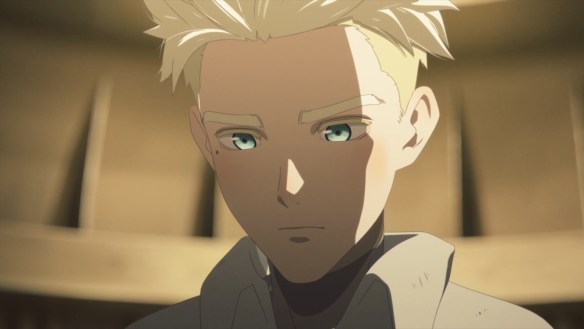
We open on teenage Knives this episode, playing an organ within a vast golden chamber that all seems to curve upwards and outwards from the piano itself, before we flash back to Knives as a child playing on a similar but much smaller piano. Both Vash and Knives seem trapped to some degree by the inherently cyclical nature of their experiences – because they live so long, they are bound to repeat the same paths over and over, particularly if they’re living alongside human beings. Knives’ attempts to reclaim the past in moments like this, or his overall violent project, feel like a rejection of that cycle, an attempt to block the gears of the eternal clock. In contrast, Vash has been forced to find some peace with nurturing those living within the cycle while accepting he will ultimately outlast them
This series in general is really effectively honing in on something the first adaptation largely ignored: the profound loneliness of being a god
Vash pops in to accompany him with a far more aggressive melody, clearly annoying Knives. The slight differences in their design emphasize their emotional distance – Vash is flush with the bright colors of humanity, while Knives is pale and faded out like a lingering ghost
And though the young Knives begrudged his brother’s company, the elder finds himself feverishly playing both parts together, unable to let his brother go. Again, Vash has come to accept time’s passage on a human scale, while Knives clings to specific moments he cannot move past
A man in a SEEDS jacket walks in, apparently one of Knives’ collaborators
Yeah, these OP lyrics just feel more on the nose with every episode, precisely conveying Vash’s attempts to maintain hope for the future when it seems like every new day is a repetition of the past
Post-OP, we cut in on Knives surveying his atrium of plants, all of which seem to have died or “failed to maintain their bodies” owing to the strain of whatever this place is producing
“One Final Harvest.” The arbiters of this process intentionally provoke the plants to self-destruction, all to power a vanishing fragment of the past
“Please forgive us humans.” Knives’ contempt for humanity isn’t really unreasonable; we are indeed a selfish, shortsighted, and wildly destructive species. In past eras, it was only our physical inability to cause irreparable harm to the planet that kept us from destroying ourselves – in this modern area, it seems only a matter of time before we finish off what is left of the natural world, a process which many millions of people will belligerently applaud. The reason “only I can effectively rule over the foolish, destructive humans” antagonists remain compelling is because their critique is actually spot-on, even if their proposed solutions are questionable
I unsurprisingly tend to fall on the pro-humanity side of “is humanity worth saving,” but I’ve also accepted that maybe a fifth of any given population is made up of cruel, willfully ignorant people, and there’s probably no real way of fixing that
“Vash, you must have heard them. Their screams. Now you know, this is the true face of humanity.” Vash’s power to communicate with plants basically echoes his general presentation as an icon of empathy – unlike humans, he can fully comprehend the pain of those who suffer from our actions
Thus we learn the meaning of Knives’ chosen name – he is the avenger for all of this planet’s plants, the focused retribution of their million knives
“Vash, let’s make a paradise. Free our brethren from the foul humans.” Honestly, it’s not a bad pitch. If he were just killing humanity because we’re sinners that’d be one thing, but he’s actually just looking to defend his people, a people who are perpetually tortured and sacrificed by humans. We’ve kinda got it coming!
“An evil weapon of the Sinners, taking lives from afar with the mere pull of a trigger.” The use of guns is like humanity’s exploitation of the plants – clinical, distant, with no thought for the moral cost of their actions. In contrast, Knives’ use of melee weapons emphasizes his moral commitment to his cause, his willingness to accept the weight of murder
Then Luida arrives to take Vash home
“I won’t let you take anyone else away from me!” Ironically, Knives’ attempt to rid Vash of his empathetic morals only serves to solidify them, to underline the fact that if he wishes the world to be a kinder place, he will have to fight to make that possible
Desperate to save Luida, Vash accidentally opens a black hole-esque gate, prompting Knives to cut off his arm to save him. Some excellent visual effects employed for this black hole’s pull; a combination of the voluminous, semitransparent effects they’ve been using for wind and sand, combined with a subtle warping effect for the orb’s event horizon
With his remaining arm, Vash steadies the gun at Knives to protect Luida. Once again, Knives has forced Vash to embrace the consequences of his convictions, serving as a living emblem of how pursuing peace demands the power to defend it
We then jump to the present, with Vash at Home and Brad complaining how Vash messed up his masterpiece. So it was Brad who made Vash’s arm – another tidy metaphor there, a testament to how Vash’s methods can actually change people’s hearts, with Brad literally lending a hand to Vash’s pilgrimage
“You never change, Brad.” A point of stability in Vash’s life, even if only briefly
Brad and Luida reveal they’ve known Vash for a hundred and fifty years, and have been using cold sleep to stay alive in order to maintain their ship. That certainly makes more sense of our overall timeline – the fall of the arc ships is thus far, far outside of any regular human’s lifespan
Luida shows Vash’s friends a verdant garden they’ve been maintaining in the ship’s glass dome
I like this beat of Luida explaining the concept of flowers to Meryl, which really hammers in how distinct and impoverished life is here. Frontier towns are a pretty familiar concept to most audiences, meaning they don’t naturally convey a strange and distant world, while a character revealing they cannot believe in the concept of an ocean tells us a great deal more
While plants are currently necessary to support this garden, Luida envisions a long-term future where greenery like this can instead support the plants. Roberto is suspicious, and rightly so – fragile, long-term plans like this can rarely stand up to the short-sighted brutality of humanity at large
“No matter how long it takes, I want to take the right path. I don’t want to justify wrongdoing just to survive.” You can see how Luida influenced Vash’s morals, but that underlying question remains – how can you maintain the morality of a superman without the attendant invulnerability? If we don’t prepare for violence, if we don’t meet the world as it is, we will surely be destroyed by those with no such compunctions
“You sound like Vash.”
Wolfwood asks the key question: “you don’t think you can make up with Million Knives, do you?” Knives is the pressure point, a man possessing so much power that Vash cannot safely disarm him, and so much malice that Vash cannot possibly reason with him. Can Vash’s morals contend with Knives’ existence?
“I’ll find a way to save them all. The humans, the plants, and Nai.” “More empty words.”
Then Zazie shows up, further emphasizing the fragility of Luida’s quest
Meryl and Roberto are captured by Zazie, who wonders whether the worms that are this world’s natural inhabitants would side with the plants or the humans. Every moral framework is relative
And as Zazie rightfully affirms, humanity doesn’t exactly have a great track record. This great arc project only came to be because humanity had already wasted earth’s resources
“Why did you bring them here?” asks the doctor, to which Zazie replies “I don’t take orders from you. Knives invited me as a guest.” Interesting – so Zazie really is an independent avatar of the planet’s natural inhabitants
And Done
Thus we race towards our conclusion, with Zazie offering a question of this planet’s “rightful” inheritors with no clear answer. If humans and plants were left to share No Man’s Land, humanity would surely destroy their plants over time, even if many among humanity’s survivors possessed only the best of intentions. If Knives were thrown into the mix, humanity would likely be wiped out, followed by a slow decay as Knives failed to maintain the fragile lives of his own people. So is there a better answer than mutual destruction, whether it is at the hands of humanity’s worst impulses or the plants’ murderous crusader? I suppose we’ll have to wait for Vash’s proposition, but as of now, I’m frankly leaning towards letting the worms inherit the earth.
This article was made possible by reader support. Thank you all for all that you do.