Hello folks, and welcome back to Wrong Every Time. Today we’re trying something a bit unusual, as we drop in right at the beginning of Jujutsu Kaisen’s third season. Though I have actually watched Jujutsu Kaisen’s first two seasons, I haven’t really written about them at length, for a pretty simple reason: I didn’t like them, and it takes a lot to motivate me to write about things I’m not enjoying. Quickly panning a movie for a Week in Review post is one thing; writing a fully negative piece on something someone cared about enough to fund is always a terrible feeling, and something I try to avoid in general these days.
Nonetheless, my patron is well aware I haven’t enjoyed Jujutsu Kaisen so far, so I’m taking a chance on this one. As for my general impression of the show so far, I’ve been quite impressed by some of the animation, but otherwise don’t feel I have anything to grab onto here. The characters feel superficial and grating, the worldbuilding feels ill-considered, the narrative lacks strong trajectory or momentum, and the combat system is essentially Calvinball – an attempt to make a Hunter x Hunter-like system without understanding the checks and balances inherent in such a system, which thus inevitably leads to contests of characters “going bigger” without any rhyme or reason. There is nothing about the source material that grabs me, and even in adaptation, it feels like the show often falls into the glossy, weightless spectacle of something like Demon Slayer. As I said, I’m not a fan, but I will do my best to address season three on its own merits, even if I lack the emotional attachment with which one should really be approaching a third season. Let’s get to it!
Episode 1
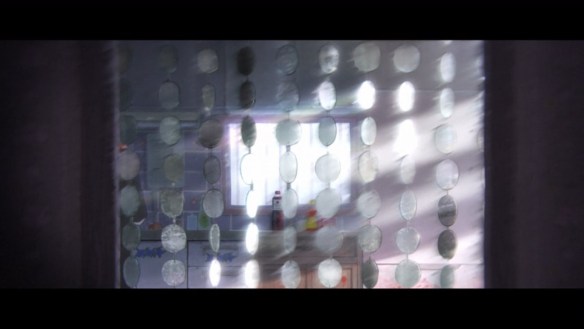
A quietly ominous opening, as we stare through hanging beads into a kitchen where the sink is running, the entire scene oddly smeared like wet chalk
It appears our boy Yuji is attempting to wash the blood off his hands, a classic metaphor for inescapable sins going all the way back to Lady Macbeth. I imagine this is a dream sequence then, with the smearing of color and persistent racking of focus intended to evoke the fog-headed unreality of walking through a dream. It’s an effective trick!
We then jump to another presumed nightmare, as Yuji wanders the ruins of Shibuya as more massive fiends stalk the city
Definitely some fun monster designs among these cursed spirits. Also evocative, clean integration of digital lighting, something this production has generally been solid about
The first season was pretty bad about integrating characters into prerendered backgrounds (the school-on-school arc was a visual nightmare), but the Shibuya arc did a solid job of creating a sense of voluminous space, particularly for standout moments like Yuji’s fight against the blood laser dude
This sequence is cool and all, but it does typify one of my issues with JJK – it’s all just empty imagery, impactful visual concepts without the dramatic heft to give them meaning. The background artists and animators do a great job, but the source material just can’t support their ambitions
That’s not to discount the imagery, though! That Shibuya arc OP was indeed cool as hell
This OP is less focused, but absolutely stuffed with cool visual flourishes, from moments portrayed as watercolor paintings to morphing sequences clearly animated by whoever handled that wild Megumi-summon sequence from Shibuya
Hah, they’ve even got a shot painted in the style of Gustav Klimt’s The Kiss. I remember when Elfen Lied pulled that trick! God I’m old
We open post-OP with the prospective new head of the Zen’in clan spewing misogynist rhetoric about Mai and Maki, as the old clan leader approaches his death. Villains in this story are not the most subtle of characters
Some nice work with the shadows and angles here; the combination of these desaturated colors, heavy shadows, and high-angle compositions successfully evokes the look of a classic samurai drama
The slight fisheye effect also emphasizes the sense of disorientation in the wake of the lord’s death, as well as the claustrophobia of this chamber, which in turn echoes the metaphorical challenge of three proud inheritors being forced to share the same space. Their egos can barely be contained by this chamber
As expected, the creep Naoya is inheriting the clan
The will features separate provisions in the case of Satoru Gojo’s death. Gojo feels like a double-edged sword for this narrative; his “coolness” seems to be a great part of the show’s appeal, but he’s just so powerful that the narrative has had to awkwardly walk around him from the beginning, and so one-note in his appeal that I can never take him seriously. He himself is one of this narrative’s biggest shortcomings, an attempt to make a Kakashi-like character that goes wholly overboard in defining his powers, a choice that in turn underlines the superficiality of this whole domain system
There are definitely ways to make an interesting narrative featuring a Superman-level hero who can technically beat everyone up, but Jujutsu Kaisen never seems to interrogate him beyond “isn’t Superman cool?”
In the event of Gojo’s death, apparently Megumi will inherit the clan. These conditions gesture towards my frustration with how small this world feels – two schools, one clan, and everybody knows each other. It seems clear Akutami didn’t consider how the world outside of greater Tokyo might be affected by the existence of cursed spirits
Naoya declares he’ll kill Megumi and Yuji both
Yuji is still haunted by Nobara’s death, which was one of the cheapest “kill the girl to raise the stakes” blunders I’ve seen. It feels like Gege Akutami never knew what to do with her character, an issue that falls into the more general category of him poaching from his influences (urban fantasy aesthetic from Bleach, Nen from HxH, the Team Seven dynamic from Naruto) without really understanding how those influences worked. The OPs and EDs ultimately featured more time of the theoretical “main trio” hanging out and building bonds than the show itself, and skipping that stuff meant their friendships never felt real
Granted, this show’s sense of humor is pretty suspect, so I’m not sure more low-key activities would actually fix things
Yuji runs into our blood laser buddy Chousou, who urges him to return to school
They then get to work killing cursed spirits, letting this production show off more lovingly animated monster designs. I particularly like how the variable line weight of these monsters lends them a greater sense of unreality, like they’ve been roughly painted on the world itself, forever warping in form
Both solid and dubious CG integration as the fight takes to the air. I can’t knock this team for their visual ambition – they’re really pushing the limits of conceptualizing traditionally animated combat in a 3D environment. Modern Dragon Ball does some of this as well, but it doesn’t throw the same wild, ambitious punches as JJK
I also like these brief moments emphasizing the texture and uniqueness of this city as a combat zone, like Yuji hopping off an exploding spirit and grabbing a nearby fire escape
Yuji attracts a whole menagerie worth of fun beasties as he races into the subway
Then Naoya arrives. Smart framing choices here, as we see him from a low-angle long shot that emphasizes his ominous presence while obscuring his face
Naoya blazes through them with ridiculous speed. Fine work conveying his speed through the shifting angles of his approaches; it reminds me of that bravura Mob Psycho sequence where the team fights a teleporter
Their sparring is stopped by the arrival of Yuuta
Ooh, love this choreography of Yuji and Yuuta fighting in an auditorium. A terrific sense of weight and consequence to their movements – you can really feel the weight of their bodies in how they spar, and how each movement carries with it the momentum of their previous movement. I always love this sort of animation in the classic Yutaka Nakamura style, the solidity and flair he brought to Spike’s movements in Cowboy Bebop
“Enough chatting.” It feels grimly appropriate that Yuuta only stops attacking to briefly ramble about how cool Gojo is
Yuji then attempts to append a bunch more specific rules about cursed energy activation, none of which will have any impact on their actual battle. As I said, it’s Calvinball – the rules are whatever the last speaker decides they are. You need a grounded template to achieve something like Nen, a frame of reference for how all these powers intersect, and JJK has nothing like that
Fun ink-blot animation for the representation of their auras, though
Yuji is ultimately restrained by a monster that seems to obey Yuuta
We conclude on Yuji getting stabbed right through
And Done
Well, that was certainly more Jujutsu Kaisen! Plenty to appreciate visually in this episode, from the warped interpretations of Yuji’s guilt to the delightful procession of cursed spirits. That fight at the end was a definite highlight; it’s a hard thing to convey superhuman battles with coherent sparring, and that sequence in the theater certainly achieved it. Nonetheless, I basically feel as I always have about this show – there’s just no strong writing to support the adaptation’s visual ambitions, and Akutami’s approach to combat systems tends to undercut the action scenes rather than elevate them. It all feels like groundless spectacle to me, and I’m just not enough of an action-first kinda guy to appreciate that without characters to care about or narrative/thematic hooks to draw me forward. Still, there’s a lot of talent on display here, so I imagine fans have a beautiful season ahead of them!
This article was made possible by reader support. Thank you all for all that you do.