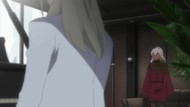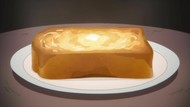
Hello folks, and welcome back to Wrong Every Time. Today we are returning to the bustling streets of CITY The Animation, after an episode that casually offered one of the defining sequences in twenty-first century animation. That’s not a claim to make likely, but it seems inevitable that episode five’s screen partition medley will be referenced and celebrated for years to come, a visual articulation of CITY’s “every community is a living organism” theme that astonishes both as a feat of sheer animated manpower, and also as a somehow cohesive, easy-to-follow master class in visual direction.
Episode five also offered the show’s first continuous narrative, taking advantage of its compelling venue to articulate a tale of hospitality deferred across a distinctive series of preposterous non-challenges. Given all that, I’m expecting we’ll be returning to the usual skit-based fare this time, if only because episodes like that last one must be a strain on even KyoAni’s incredibly healthy project scheduling. Fortunately, “a standard episode of CITY” is still one of the best things you could possibly experience, and with every episode we watch, more amusing/endearing bonds between its sprawling cast reveal themselves. Let’s see what’s going on in the city today!
Episode 6
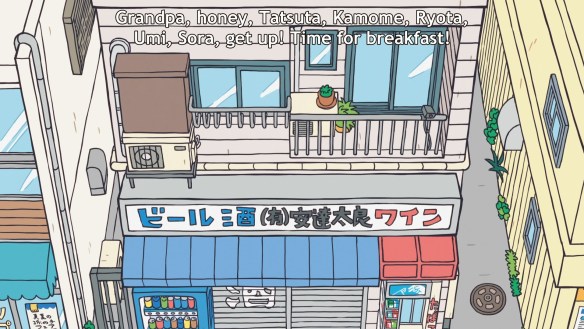
As usual, we open with an establishing shot that situates our current drama in the context of the city at large; in this case, by panning downwards across a family home while the folks inside bicker about breakfast, emphasizing the continuity between this small domestic drama and the streets and houses adjacent to it. We sort of can’t help but become a part of the lives of our neighbors; I’ve never met the guy in my neighborhood who practices his opera singing through the afternoon, but I certainly acknowledge and appreciate his presence
We’re introduced to a family of perhaps half a dozen chaotic siblings, though it seems we’ve met one before – Ryota, the second son, unmistakable in his “modern-day William Tell” pose
A fun riff on his prior joke, as he reveals how many plates he’s broken with the same confidence he applied to his paper airplane throwing, coffee brewing, and other talents. Continuity is really how sitcoms move beyond individual gags and into the sublime interplay of cultivated audience expectations; sadly, continuity is also how you eventually lose the capacity to attract new audiences. Thus every great sitcom contains within it the seeds of its own destruction, so long as it doesn’t want to take the eternally replicable yet fundamentally less engaging route of perpetual context-free surface-level gags
The younger sisters are just barely familiar, having taken part in some of the smaller panel partition dramas from the previous episode. That sequence did an impressive job of evoking the slight incidental familiarity of people you’ve only seen about town; normally every character within a given scene is placed there with intentionality, but that barbecue was conveyed at such a grand scale that even characters who starred in their own sub-screen dramas are still mostly strangers to us
Wonderfully expressive, fluid animation for the second and third daughters. It takes a strong team of animators to convey something like “the boundless energy of youth” through character acting
Also love the percussive rhythm of Ryota’s attempted exit, leading into this quick montage of shots resulting in an onigiri being thrown at his head. Something last episode also exemplified, and which KyoAni productions in general handle masterfully, is the “musicality” or fundamental rhythm of comedy. A great portion of a joke’s impact rests in its timing, and KyoAni are unique in their respect for that fact, consistently making use of shortened half-beats for anticlimaxes, extended beats for “stretching a joke until it becomes funny again,” and standard yet crisp beats for sequences like this
This sequence takes those fundamentals of rhythm even further, making an actual song of the various repeated noises around their house
Another pinpoint timing gag, as Grandpa’s outburst is prematurely silenced by his granddaughter’s glare, to the point where his apology lands exactly where the end of his original complaint would have. A beat effectively facilitated by the grace and economy of her eye just momentarily panning over the prior composition
Oh shit, no OP this episode? I’m happy to get more CITY per volume, but I do love how this show’s OP sets the mood
Niikura’s lamentations regarding her locket are interrupted by a soccer ball beaning her in the face. Again, timing is everything
Which leads into the other extreme I mentioned – comedy of absurd repetition, as she is further assaulted with an entire team’s worth of errant soccer balls
This sequence also offers a natural callback to Niikura’s suspiciously gentle harisen
“With all due respect, please remember that some of us here are passionate about chives.” Gags like this are pure Arawi, twisting conversations to internally logical yet generally inexplicable end points
We then return to Grandpa from the opening, as he drinks tea and remarks on the quiet when the family has left. A very relatable moment of pure atmosphere; the briefly silent residential streets, that mid-day hush that falls on urban communities when everyone is away at work or school
And then Grandpa FUCKING DIES!?! Oh my god, what a punchline
Ah, he’s just pretending to be dead to get back at Makabe for making fun of old people. A trick I certainly plan to exploit if I somehow make it to old age
“Everyone was thinking about me, but all I was thinking about was revenge.” The melancholy march of the backing track here really accentuates the gag nicely. This production team is so good at keeping an aesthetically straight face through the nonsense
And then we’re off to Mr. Happiness, the apparent successor to Mr. Bummer. Get this guy outta here, no one relates to this shit!
Oh no, it’s actually funny! What a challenge to the reign of Mr. Bummer!
A great gag that’s largely constructed out of the goofy, wonderfully animated wrestling of artist and editor, with Mr. Bummer’s artist determined to prevent that final, devastating “it’s been an honor working with you”
I also like the general Mr. Bummer meta-gag of Arawi treating the creation of 4koma gag strips as the most exhausting and psychologically excruciating practice any human can experience
As it turns out, the editor just wants to start a dual-manga segment. Mr. Bummer is saved!
Lovely transition as we jump from that nonsense to our main trio, with a shift to a simplified, uneven-lined art style conveyed as placing an overlay on top of the initial designs. This show naturally looks like a pop-up book, and it’s always fun when they lean into that effect for these effects gesturing towards mixed media, with paper overlays being slipped “forward” like a page being turned from the bottom, or the subsequent sideways shift from nighttime to daylight, as if the audience is pulling a paper tag to adjust the image on the page
The sequence is a brief, wordless Wako interlude, which definitely seems to fit her airheaded nature
We then jump to Riko Izumi and her perpetually accommodating classmates, as she appears to have slept through the majority of a test
Excellent gag of one classmate chastising our boy for talking in the middle of the test, only for every other classmate to then stand up and walk over to see what’s wrong, apparently utterly indifferent to the test themselves
Also appreciate how they’re all shout-whispering with the same energy as their usual outbursts
Of course, Adatara is obviously the only choice for giving Izumi the right answers
Love their subdued collective cheer as they return to their seats. This is basically just a retread of the first Izumi class gag, except with the added acknowledgment that ferocious whispering is very funny
We then jump to the newspaper office, where we learn that Wako Izumi has been delivering the Mr. Happiness comics. Of course, in typical Wako fashion, she has no interest in actually joining the paper. An avatar of whimsical, enthusiastic indifference
“So this is my opponent: a newcomer who submits a manuscript and refuses to be serialized.” A good example of two distinct monomanias making for an amusing battle: the man who sees all of life as a comic-making struggle, and Wako Who Don’t Give A Fuck
Next up are the middle schoolers, who are having far too much fun with a hollowed-out pumpkin head. This seems to also be a way for Eri to practice saying goodbye to Matsuri. And in spite of Matsuri’s constant jokes to deflate the tension, she emerges from her pumpkin head with the message clearly received. A uniquely Arawi blend of absurdism and genuine human drama
And Done
Thus life goes on for the city’s many inhabitants, as the approach of summer prompts cheers for some, tears for others, and an overarching reminder that whatever our daily foibles, the sun will rise and seasons will change with reassuring regularity. With the show’s individual dramas now fully established, this episode offered a wide array of charming narrative collisions, from Wako invading the editorial office to Niikura calling out the entire soccer team. And though that stinger was certainly melancholy, CITY’s overall ethos of enjoying the small moments and appreciating your neighbors means there is ultimately no sense of something lost; Eri and Matsuri made the absolute best of their time together, and should walk forward proudly towards whatever new adventures await them.
This article was made possible by reader support. Thank you all for all that you do.