
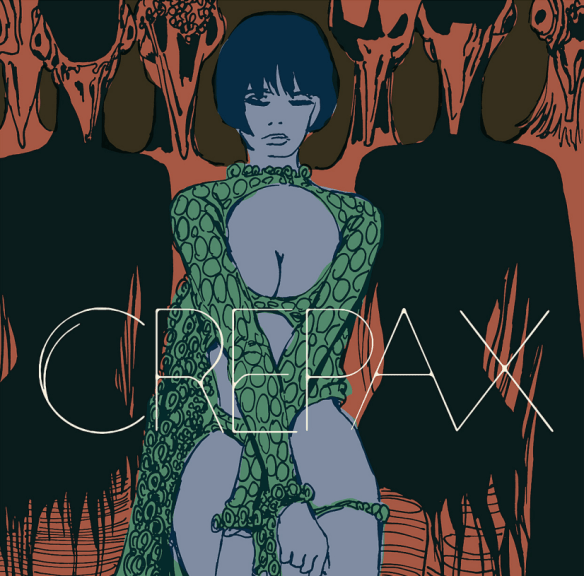
It is always a pleasure to be introduced to a vibrant, fully realized artistic voice, to learn of a wholly distinct perspective on storytelling and human psychology. I consider it something akin to a moral duty to continuously check out new artists, for the simple reason that it is only through such far-flung trawling that I can hope to better understand our capacity for self-expression, and to better express whatever humanity I might possess through the works I create. As such, I’m happy to today be sharing my own experience of the works of Guido Crepax, as contained in the first volume of his collected works.
Born in 1933, Guido Crepax cut a restless artistic path through the 20th century, with his works ranging from advertisements to album covers to long-form comics and even tabletop wargames. Alongside his award-winning advertising work, he is perhaps best known for his character Valentina Rosselli, who he cast in all manner of adventures throughout his career. Aging alongside her creator, Valentina would provide an outlet for his wide-ranging passions, her tales touching on BDSM fantasies, old-fashioned adventure serials, and Crepax’s abiding fascinations with art, fashion, and high culture.
Valentina features heavily in this first collection, serving as the protagonist of a series of subterranean adventures. These adventures demonstrate the breadth of Crepax’s interests, echoing the aesthetic concerns of ‘60s and ‘70s culture in all manner of ways. His love of the French New Wave seems to reveal itself in the staggered, dramatic paneling of Valentina’s adventures, as well as his later works adapting classic horror tales, sequences that call to mind the intimate cinematography of Jean-Luc Godard. In his ambiguous relationship with fashion photography, we see Valentina realizing the menace of Powell’s Peeping Tom (an apparent favorite); in his luxurious, sprawling portraits of hip Parisian parties, we see his intimate engagement with the gallant social spheres of mid-century bohemians.
Alongside contemporary film influences, it’s easy to see Crepax’s interest in more old-fashioned adventure models, be they the cheap adventure serials of the ‘30s and ‘40s or the classic tales of Jules Verne. His subterranean adventure series is clearly inspired by Vernes’ Journey to the Center of the Earth, but folded in with his own more contemporary interests. So removed from their status as “contemporary” sensibilities, it is a wild thing to see a story draped in the stylization and self-conscious performances of French New Wave suddenly twist in a weird horror direction, with narratorial embellishments acting like a splash of cold water upon the prior indulgence.
Crepax’s love of epistolary novels and adventure serials, as well as likely American comic books, comes through in the stylization of his prose – lots of reflections on past histories, and plenty of melodramatic exposition bringing curious turns of fate into focus. Much of these narratives is composed of characters explaining their strange fortunes to each other; a style I imagine was more popular in the early 20th century, matching the efficient brevity of tales like 20,000 Leagues Under the Sea. At one point, Valentina’s companion Neutron protests that he’s “not Flash Gordon” – true enough, but only because Crepax’s interests extend beyond Flash Gordon specifically, ranging from older tales like She: A History of Adventure to superhero comic tradition.
Beyond the clear footprints of his various influences, Crepax’s work delights in a purely formal sense, offering elegant artistry and plentiful clever variations on panel formatting. Many of these tricks coincide with his interrogation of fashion photography (Valentina herself is a photographer), or gesture towards the sequential prison of film cels. Other embellishments are more tangible than metaphorical, like Valentina’s mixed reverie of being rescued, contrasted against the tactile recognition of the cave around her.
Sequences such as that feel akin to Osamu Tezuka’s experiments in panel design; the ambiguity of form, time, and space make it all the easier to relate to Valentina’s hopes crashing against the sensations of the cave around her. Elsewhere he might use the tilting of his panels to evoke the sense of a looming danger, as when Dracula’s Jonathan finds himself trapped in a visual spiral with no hope of escape. And it’s always a pleasure when he gets tight with his rows and columns, creating a sense of panic, disorientation, or even just drifting off to sleep.
Time and again, Crepax’s flourishes echo the restless fluctuations of his career, often aesthetically echoing advertising or fashion copy. Crowd scenes flitter from art deco to art nouveau, bearing all the while that sort of flowing, pose-based mark of advertising copy. Each new scene is peppered with aesthetic critiques and celebrations of clothing, and the physical orientation of bodies in space often seems to matter less than their uses in defining a striking individual composition. Rather than motion-directed sequential action comics, his stories often feel more like a collection of illustrations, technical documents, and ornate advertisements. And always, there is that contradictory focus on physical violence and fashion photography as a route to both pleasure and exploitation, a debate lying at the heart of his work.
That perpetual argument reflects the sincerity of his storytelling, his willingness to celebrate all of his passions in tandem, and through doing so conjure an artistic voice all his own. His love of game design is frequently expressed through the incidental explanation of invented sports and games, while the ambitions of his subterranean narratives grow precipitously over time, juxtaposing the theatrics of a hollow earth narrative with the aesthetics and attitude of the swinging ‘60s – like if Blowup took place in a ‘40s serial adventure.
Other sequences mix far-flung action drama with Valentina’s BDSM preoccupations, or prominently feature wargames of his own presumed design. It’s an inspiring attitude, really – rather than contorting his own passions and fantasies to the form of the genre he’s inhabiting, he forces that genre to stretch and squirm in order to make room for anything that catches his interest. Though obviously artistic indulgence can at a certain point undercut your narrative’s breadth and truth, it is ultimately more important to ensure your passions do come through in your work – after all, it is those passions that give anyone’s artistry a distinct vitality, a personality unlike any other.
All of these interests and specialties fuse together marvelously in his horror works, which combine his love of classic storytelling modes with moments of dangerous transgression, and realize all of this through dynamic paneling, or even a movement beyond paneling. For near the end of his career, it feels like his style was actually adjusting to fit his weakening capabilities to his experiments with panel-bereft comic drama, thus facilitating the almost cubist flourishes of his late-era Frankenstein.
Given the often exposition-heavy stories of Valentina’s adventures, as well as their tendency to be revealed in retrospect, it is a natural transition to the epistolary format of Dracula. The bigger change in style is Crepax’s attention to background detail, but that too seems natural enough for his incredibly detailed, sprawling tableaus, which often flaunt the very idea of drawing the viewer’s attention to one particular point. Crepax’s works intentionally defy focus – the eye is told to wander, to stroll as it will from one strange physical formation to another.
As if in deference to the majesty of the original work, Crepax’s Dracula embraces more classic rules of comic art, demonstrating detailed draftsmanship, purposeful manipulation of negative space, and lines that guide the eye through the composition. But though the form is altered, thematic commonalities make it obvious why Crepax is attracted to this tale. The eroticism of pain, the homoerotic undertones of Mina and Lucy’s story, as each of them become an “untamable woman” in their own ways – these themes provide a direct line between Valentina and Dracula, while letting Crepax indulge in his clear obsession with dreams and nightmares.
Crepax’s work consistently engages with the link between reality and the subconscious, questioning how our impressions of the world and each other inform our trajectories and relationships. Perhaps even his fascination with subterranean worlds stems from this core passion, as he envisions a secret society where myth becomes real, and our inner fantasies are realized. Regardless, his works stand as a unique artifact in our perpetual interrogation of selfhood, horror, and desire, while demonstrating at every turn the vivid fruits of a wide-ranging aesthetic sensibility. In embracing the wild fantasies of others, we may just find ourselves.
This article was made possible by reader support. Thank you all for all that you do.