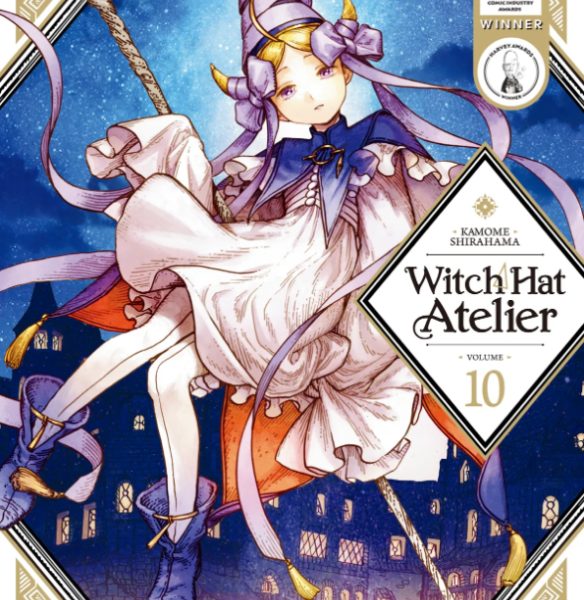
A shadow hangs over Witch Hat Atelier’s tenth volume. After a set of chapters largely preoccupied with emphasizing both the personal and political dangers of magic, wherein the Knights Moralis consistently demonstrated their cruciality for any kind of working magical society, its tenth cover is dominated by the mysterious Irinia, the Brimhat determined to manipulate both Coco and Tartah into serving her radical ends. Our young mages have been conscripted into a war beyond their understanding, as the promise of magic’s useful potential batters against the threat of its violent misuse.
But for now, Coco’s trials are unknown to her festival-minded companions. We return first to Richeh in a moment of triumph, having sold every one of her pairs of linked bangles. Though Kamome Shirohama’s artistic talents often stretch far beyond the conventional aesthetic flourishes of modern manga, she is also no slouch when it comes to the fundamentals – which is to say, her illustrations of Richeh’s victory poses and instantly billowing ambitions are extremely adorable, leaning effectively into her low-affect presentation as she contemplates her all-but-certain future fame. Of course, even this sequence demonstrates a superior eye for paneling as visual drama, as we see her imagination soar in negative space as she contemplates having her own shop, then be constrained by her own hunching body language when she recalls how far she still has to go.
In response to her musings, Olruggio offers some essential advice – that rather than continuously pursuing one path of study, Richeh should journey widely, testing both her aptitude and appetite for various disciplines, and thereby enriching her subsequent choices with all the lessons of her prior fields. It’s a lesson that Witch Hat Atelier has exemplified from the start, as Shirohama’s diverse interests have infused the manga itself with painterly illustrations, technical diagrams, lovingly rendered crafts and fabrics, and all manner of other unique embellishments beyond the standard comic purview. By reading, watching, or studying only one sort of thing, we inherently limit ourselves; it is only through broad study that we can create works of unique, personal synthesis, rather than echoes of whatever came before.
We then return to the preceding volume’s stinger, as Tetia discovers a prince on the run from his apparent handlers. Their first meeting is a classic exercise in visual drama, with Tetia descending from top right as if she were the sun itself, bringing illumination to the prince’s darkened sanctuary. It is only in the context of his royal identity that he is able to stand proud and free, unhampered by panels or shadows. It feels as if Shirohama is attempting to visually emphasize his naivete, with the lack of borders or shadows echoing his certainty that announcing his royal identity will always protect him.
Cluttered and lovingly rendered backgrounds demonstrate the festival in full swing as Prince Eoleo explains his desire to see the festival from the ground level, and perhaps even find a spell for himself. His words offer an echo of the political negotiations from the preceding volume, here compressed into a personal battle between duty and desire. Magic’s potential is infinite, but that does not mean that even a king may employ it at will; its rightful application demands prudence and forethought, alongside an understanding that magic must always be utilized for the good of all. Everywhere we look, the boundaries of magic’s application appear thin and porous – and even if a king might understand magic is not to be used for personal desires, can we expect the same standard from his bright-eyed son?
Our focus then turns to Qifrey and Agott, who is currently in the process of burning her precious runic inscription, the spellcraft she intended to display in the king’s parade. In classic Shirohama fashion, this dramatic act of destruction is not contained to the panels alone; as Qifrey approaches, the burnt edges of the panels and implication of further sheets below create a sense of the world itself catching fire, which from Agott’s perspective it essentially has. All of her practice so far has been in some way a reaction to her parents’ rejection, a method of proving to them that they were wrong for doubting her potential. And if she can’t secure that victory, then all of her work is nothing more than ash in the wind.
Qifrey is swift to deduce the object of her frustration, introducing us at last to Agott’s mother and current Head Librarian at the Tower of Tomes, the imposing Adina Arklaum. Both the panel compositions and Agott’s framing of the situation offer painful hints of context for their relationship; Adina is depicted as a figure turned away from Agott, her face unreadable, gaze focused on the tower that is her true obsession. And Agott’s ensuing statement of intent, her reasoning that this might be the one chance to actually impress Adina, underlines how her banishment from the family means she has no greater access to her own mother than anyone else in the kingdom.
Resentment, determination, and despair all animate Agott’s voice as she embraces her frustration, allowing herself the exceedingly un-witch-like solace of a classic “they’ll see, they’ll all see” as she laments her failure. In response, Qifrey is as measured as ever. He first acknowledges the truth of Agott’s feelings – that she understandably believes only a dramatic feat of magic will impress her mother, rather than the mundane, utility-oriented spellcraft that is their general stock in trade. But acts of magic do not stand alone – and as important as it is to conceal the secret of magic’s capacity to be used by everyone, it is equally important to limit the public understanding of magic’s ultimate potential, its capacity to wreak dramatic change upon the earth. We cannot unmake a technology once it is introduced to the world; we can only be prudent in our feats of engineering, and ensure we do not create a weapon we cannot contain. So it has been for great innovators throughout history – once an invention passes from thought to page to reality, its creator loses the power to limit its destructive potential.
Meanwhile, Tetia and her new friend are engaging in a very different form of magic – the transformative power of self-presentation, a tool through which we can change not only how others perceive us, but how we perceive ourselves. By disguising himself in a witch’s garb, Eoleo embraces a fragment of his greater fantasy, while also seeking to draw himself closer to Tetia’s perspective. But the boundaries between them are vast indeed; in terms of both social conditioning and their overall perspective on society, Eoleo is separated from Tetia by an incredible weight of divergent experience.
Tetia’s well-meaning counter to Eoleo’s lament, her innocent insistence that they are already true friends, emphasizes just how easy it is to disrupt this world’s fragile ecosystem. Her proud declaration of personal friendship means something very different to the prince – rather than “Tetia and I are friends,” he internalizes “witches and kings can stand as true allies.” Thus we rightly return to Qifrey’s words of caution, as he emphasizes again that magic must not be unquestioningly granted to the mundane rulers of man. Just as we cannot call back a technology that we have loosed on the world, so must we never grant a king the power to dictate what potential technologies might best serve their people. This world stands on a knife’s edge, where even an earnest yet ill-advised friendship might herald the wrong synthesis of powers, and conjure a resultant calamity.
That calamity seems almost within arm’s reach as we at last return to Coco, now insistent on showing off her own wing-cloak in the king’s procession. Qifrey offers an unsurprisingly measured response, emphasizing the inherent dangers of an untethered wing-cloak, as well as the necessity of running any potential demonstration by the ruling Wise in Friendships. But Coco remains oddly insistent on performing, even floating the idea of coming up with a new spell just to earn her place in the procession. Her passion is inexplicable because it is not her own: as we swiftly learn, this is the price that Ininia demanded for unshackling her and Tartah.
Returning to the wake of their unfortunate meeting, we find Coco and Tartah adjacent yet isolated; though they walk in the vicinity of the festival, their own forms are isolated outside of the panel, emphasizing how they can no longer partake in the carefree festivities that still surround them. The ensuing page makes this disconnect of paneling and perspective explicit – as Coco herself says, there is now a wall between themselves and the festival, the boisterous fanfare of the surrounding panel surrendering to cold white emptiness in our young mages’ periphery.
What’s more, this separation applies to more than just their enjoyment of the festival – for as Tartah points out, going to the authorities for help would surely result in a terrible outcome for Custas. Having drawn ever so slightly beyond the prescribed lines for the sake of her friend, Coco now finds herself painfully aware of how easy it is to attract this magical society’s ire, to be made an undesirable purely through unfortunate circumstances. Thus it feels all the more appropriate that their wandering might reunite them with Dagda, a man whose life directly reflects the classist cruelty of this allegedly peaceful system.
Dagda’s reflections swiftly banish any assumption that the order of this world is inherently righteous, or that the deserving will inevitably rise on the winds of their fundamental nature. Life is arbitrary and cruel, and even modern societies have only made the most tentative of gestures towards civil equality; in a medieval society like Coco’s, it is no surprise that a man with Dagda’s resources would have to steal to survive. And it was not any great act of heroism or personal reinvention on his own part that carried him out of such desperate circumstances – it was the rare and fortunate kindness of a random stranger, a person who, like Qifrey for Coco herself, saw potential rather than a threat in an ostensibly impermissible act of civil discord.
It is rarely those who hold power who suffer the violence of its misuse; that is for those who strive below, seeking only to pass on a sliver of charity or happiness to the people they love. Thus we learn that Dagda as well has been roped into the Brimmed Hats’ games, as Coco and Tartah notice a forbidden rune tattooed on his chest.
The cruelty of this society’s bargains is thrown in stark relief as Knight Moralis Galga descends, intent on “saving” Coco and Tartah from an alleged Brimmed Hat. Their clash illustrates the incompatibility of the witches’ overarching principles with the fundamentals of individual justice; as the knight speaks loftily of his order’s sacred duties, Dagda can only see a man attacking him without question or cause. It is a moral conflict without any easy answer: on the one hand, the incredible danger of magic, and the delicacy of its current place in society, demands a policy of unflinching deterrence. However, any such absolute policy will naturally lack the nuance to handle a case such as this, seeing a clear victim like Dagda as unfortunate collateral damage at best.
What’s more, since the Knights Moralis’ mission is not just to forbid, but also conceal any dangerous magic, the actual benefits of their efforts are invisible to everyone (hence their poor reputation in not just mundane, but also magical circles). The necessity of their service is invisible, while the obvious injustice of their methods is clear to all. They must serve as the hated spearpoint of witch society, challenging every hopeful young would-be witch, and punishing even innocents who get caught up in powers beyond their understanding. The justice they ostensibly embody is high-minded, distant; all we see in the moment is their unwillingness to even let a desperate boy save his father’s life.
Where, then, does true justice lie? It is easy enough to say that magic’s potential misuse is worth limiting its potential uses when you have no need for those potential uses – but for those with actual lives on the line, the idea of forbidding healing magic simply on principle seems unfathomably cruel. Must we accept sad-eyed, high-minded rhetoric about the inevitable fate of all things, when it is clear as day that magic is constantly being used for impossible, lasting wonders? What makes this act of honest charity unforgivable, when the society of witches already embraces such preposterous indulgences as their city beneath the sea?
And if it’s hard to see the justice or compassion in the Knights Moralis’ methods on a society-wide scale, it’s all the more difficult to justify them on the individual level. For as Coco is swift to note, Custas’ path is in truth no different from her own – she also grasped for magic heedless of its danger, and she also would have used the counterseal if she’d only known of its potential. In fact, Custas’ situation is all the more sympathetic, because his utilization of magic has only ever been for the most sympathetic of reasons – to repair his damaged legs, and to save his beloved father. Neither Coco nor her mentor Qifrey have actually played by these rules that are forced on others – so if even the kindest of witches don’t obey these dictates, then of what use are they in the first place?
Faced with this impossible question, Coco can only offer the tools she’s always relied on: her compassion and determination. Powerful tools, of course, but fortunately Tartah has something a little more practical in mind. If magic can’t heal Dagda, then perhaps healers can – like the Peninsular King, rumored to be the greatest doctor in all the land. His suggestion offers at least a glimmer of hope for Custas, while Galga ends up paying the full price of his order’s hypocrisy. If the Knights Moralis are unwilling to compromise, reconsider, or forgive, then why should the Brimmed Hats be any different? In the end, the Knights Moralis stand alone; bound by principles they can never fully justify, they are destined to be hated by those they ostensibly protect.
This article was made possible by reader support. Thank you all for all that you do.