
Hello folks, and welcome back to Wrong Every Time. Today we are concluding our journey through Monogatari’s Monster Season, as Araragi and company close the book on their town’s latest vampiric intrusion. Having at last learned of Deathtopia’s arrival in her own words, they’ve discovered that while Suicide-Master did commence this chain of mummifications, it was actually her first victim Sowa Kiseki who committed the rest, working out her frustrations regarding the girls’ basketball team via a series of violent reprisals.
In an arc littered with echoes of Kizumonogatari, Kiseki represents an alternative path Araragi could have taken, if his resentment towards others had outweighed his hatred of himself. Or perhaps Araragi simply got lucky, in that unlike Deathtopia’s “food poisoning,” Acerola’s survival of Araragi’s vampirization set him on the road towards Meme Oshino and a positive application of his new powers.
We cannot isolate every turning point in our life, nor guarantee we will undergo that precise, “correct” degree of transformation through our experience – as Deathtopia put it, neither so familiar we seem static, nor so different we’re unrecognizable. But we can acknowledge that everyone is bound by those same anxieties, whether allegedly ageless vampires or uncertain college freshmen. Thus after an arc spent reassessing Araragi and Shinobu’s bond, we find ourselves happily where we began: still licking each other’s wounds, still unified in mutual trust, and still ready to face whatever the future may bring as a fast-talking, quick-slicing pair of vampiric badasses. Now let’s hunt down our killer!
Episode 14
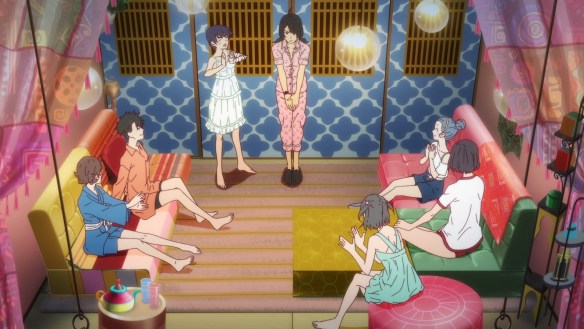
And we return with a late-Monogatari staple: Araragi dolled up in women’ s clothes, in this case one of the girls’ sets of pajamas, being graciously applauded by the whole slumber party. As I’ve said, Araragi’s uncertain relationship with gender has been a long-running theme at this point, one that definitely offers some perspective on his initial feelings of isolation and dislocation within his life, as well as the nature of the community he would eventually develop. Araragi doesn’t really relate to men; his only male relations are authority figures, while the peers he actually feels he understands are all women. And the person he’s most comfortable riffing with is Kanbaru, who has fully embraced her own queer identity, to the extent that the two of them enjoy play-acting exaggerated versions of allegedly “default” gender performance together
As someone who more or less feels like masculinity at large is a plague on human society, I appreciate how Araragi is similarly bereft of any aspirations towards machismo or “what a man’s gotta do” misogynist hangups, even if he obviously pulls some shit that would rightfully get him locked up
After introductions, Araragi asks if the five missing girls had anything in common, which apparently wasn’t the case
Araragi thus reframes the question: is there something four of them share that one of them lacks? Which is the odd one out? This apparently leads him to a revelation regarding how their information got leaked
Back at the Kanbaru estate, Kiseki confronts Deathtopia
With short yellow hair, yellow eyes, and this loosely draped dress, Kiseki actually looks much like Deathtopia herself. An echo of Kanbaru’s fan club members, who all cut their hair to better reflect their idol. Hair cuts are often associated with sequences of rebirth or general character development in Nisio Isin narratives, but these ones feel more like a regression – a denial of the self, in preference to adopting the guise and presumed greatness of another
“The hardcore, cool bloodline of mine has been walking around for a dumb reason like revenge.” The admonishment that Shinobu feared is actually landing on Kiseki. Though Shinobu has changed dramatically, she is still happily living her life for her own reasons, and so long as Araragi is worthy of her that is more than enough for Deathtopia. We should not wish for our loved ones to stay forever the same – we should only wish that whatever changes may come bring them greater happiness
Living for revenge is a fundamental denial of this arc’s core theme. It is a way of trapping yourself in the past, of refusing to move past one burning moment of hurt and disappointment, of defining yourself purely in relation to the target of your vengeance
“I have no intention of covering for you. I said that I sucked your blood because I wanted to show off to an old friend.” Deathtopia is a lot of fun
“There are things that are unexpected even if you live for a thousand years.” A charged line, emphasizing how we are always capable of growth and change
Deathtopia reflects that Araragi’s adversarial impression of “being eaten” by a vampire excludes the case where the “victim” actually wanted to be consumed
“Nowadays, she’s forgotten about her sublime idea, and lost everything. I guess she managed to accomplish it all. That makes me feel relieved from the bottom of my gut.” Though Deathtopia phrases it in her own peculiar style, she is profoundly thankful to see that Shinobu is no longer seeking that distant ideal of finding someone to save her, nor giving meaning to her destructive aura by consuming all of its victims. She is simply happy, living a precious ordinary life with treasured friends
In contrast, Kiseki has only come to understand the emptiness revenge leaves behind
Deathtopia offers an escape route, the chance to drink her blood and return to humanity. Another transaction that defies this conception of a villain and victim
In payment, Deathtopia gets to endure a cool death, rather than a boring death by starvation. Deathtopia is not seeking some new horizon; she is happy with the life she has lived, and wants to die as she lived, on her own terms
“I want you to kill me before I feel like committing suicide.” It seems most vampires eventually die of the repetition and loneliness, seeing no reason to carry on. Deathtopia would much prefer a warrior’s death, a death that offers the possibility of something new growing from it. It is only through creating new vampires that beings like her can contribute to the steady changes of the world at large
“A death with dignity. That is the death fit for a proud one such as myself.”
You can see their relative relations to their powers in their body language. Kiseki is constantly jumping around, reveling in her vampiric athleticism, while Deathtopia is an old monarch content to sit on her throne. Nothing Kiseki is doing holds any novelty or surprise for Deathtopia anymore
“I’m not hurrying to my death. I just no longer have any more regrets.” Confirming Shinobu’s happiness was her last task
Araragi arrives at the last minute, informing us this is actually Kie Harimaze, not Kiseki. Harimaze performed a body swap, fitting Kiseki in her own garments, and leaving her phone on as essentially a wiretap to keep tabs on the course of the investigation
Figuring out how Karimaze was able to keep tabs on their investigation also determined his next destination – because her information “source” was already out of batteries by the time the slumber party was planned, she would lack that information, and naturally assume her target was still at the Kanbaru estate
Araragi does his best to present a cool intro pose in these pajamas and pigtails
I like how this arc leans into the horror of vampiric forms a bit, lengthening Harimaze’s fingers as she prepares to attack in a manner that calls to mind the shadowy extending digits of Dracula’s best adaptations (Murnau, Herzog, Coppola)
“So, are you saving people like you always do? Though there are no humans here.” And Deathtopia doesn’t want to be saved. A final strange inversion of Kizumonogatari’s scenario
“Who knows about the others? Maybe things are easier for them in their current state.” In her current fatalistic state, Harimaze cannot possibly extend her perspective to the feelings of others, and instead transposes her own feelings onto them
“Maybe what I did wasn’t assaulting, but saving?” A flattering yet indefensible extension of Deathtopia’s extremely specific situation
“If you can’t tell if you’re alive or dead, isn’t that how every high school student is?” Again, the understandable, self-flattering myopia of unhappy adolescence
“Isn’t banter of this nature what you’d call adolescence? Hilarious.” Deathtopia can’t help but laugh at this long-forgotten yet apparently all-consuming perspective
Harimaze charges towards the net (Araragi), but Kagenui is a whole lot faster
Some charming banter between Kagenui and Deathtopia, who are of course professional acquaintances. Kagenui demonstrates her charity by declaring Deathtopia beneath her caliber of target, and therefore not worthy of being destroyed
Araragi sums up the fallout during a lunch date with Senjougahara
“Their goodbye was rather simple. I guess the vampiric feelings, or rather vampiric time, is something I don’t understand.” At a long enough timeframe, goodbyes start to feel less consequential. This is a bit of an extreme case, but it’s nonetheless a lesson Araragi will learn better through adulthood – that carefree “until next time,” accepting whatever twists in fortune may come, knowing our bonds will keep so long as we believe in them
Shinobu at last answers Araragi’s question of “what are humans to you,” replying with “monsters.” There is no distinction, no dividing line. We are all monstrous, and in that we are all alike
And in his enduring desire to help fix everything himself, Araragi recognizes he is still a child. But for once, that doesn’t feel like such a bad thing – he is no hurry to grow up, and happy to help where he can, so long as he makes sure to take care of himself and his future as well
And Done
Thus our mystery draws to a close, with one final last-minute reversal that ultimately just affirmed this arc’s rambling reflections on how we define ourselves, what it means to grow up, and how we come to terms with the eternal fluidity of personal identity. Through drawing on all these Kizu-recalling touchstones, this arc offered a starkly lit reflection on how much Araragi and Shinobu have changed since then; by tethering those reflections to the more world-weary perspectives of characters like Gaen, Deathtopia, and Kagenui, it offered a fond assurance that the road ahead is still full of mystery and wonder. Araragi is still a work in progress, but the crucial thing is not to find our “true selves,” but to enjoy the eternal process, to forgive ourselves for youthful transgressions, and to seek happiness in each odd, imperfect moment. So long as you continue to embrace life’s opportunities, you’ll still find things to surprise you, even after a thousand years.
This article was made possible by reader support. Thank you all for all that you do.