
After seven volumes of inexpertly dancing around each other’s true feelings, Yuri is My Job!’s seventh volume concluded on a simple, devastating truth: that Hime could not reciprocate Mitsuki’s desires, and the mismatch of their ambitions made it impossible for her to continue working at Cafe Liebe. Having rekindled their childhood friendship in spite of their profoundly differing impressions of that history, it seemed like they were on a course towards genuinely understanding each other, and perhaps forging an even stronger bond. But as this insightful manga is always willing to admit, mutual understanding does not necessarily imply reconciliation; in fact, it is sometimes our most fundamental truths that drive a wedge between us.
It’s a bitter, biting insight from a story that has often seemed to frame sincere communication as the key to unlock true companionship, the antidote to the feigned performances of intimacy that characterize employment at Cafe Liebe. But “always tell the truth” is an insight fit for a children’s fable, and the reality of socialization is much more complicated. While there are certainly points worth critiquing in Liebe’s prioritization of a scripted, audience-aware form of intimacy, the truth is that all of us necessarily put on different performances for different audiences, not because we are attempting to hide or deceive, but because that is simply the only way to maintain civility and mutual comfort across the divergent spheres of our personal lives. Scripts of conduct and kindly lies are natural tools of social interaction; to deny them is to embody the irrational antisociality of the rebellious teenager, not the considered poise of a compassionate adult.
Thus a story of finding the truth in artifice arrives at the most cruelly ironic result, reaffirming the barricades that once divided Hime and Mitsuki. Hime once believed that only her façade could protect her from the ugly consequences of honesty – and after driving Mitsuki to admit her true feelings, she may well have been proven correct. And Mitsuki believed her own true feelings were too selfish and undesirable to risk her bond with Hime over – a fear that has manifested into the worst possible reality, as Hime now seeks to distance herself entirely. The unhappy truth is that no simple rubric of honesty or deceit can wholly mitigate the distance between our feelings; we are never perfectly sculpted to match each other’s angular contours, and mutual understanding is no guarantee of mutual agreement.
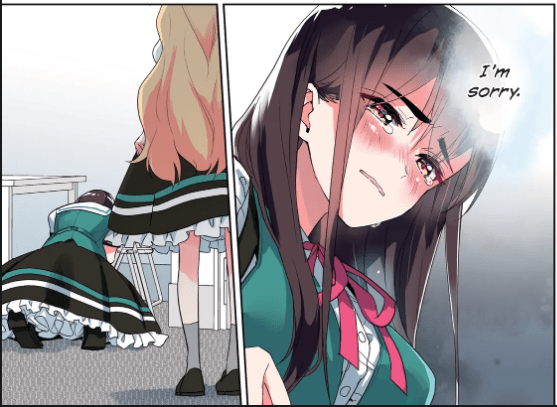
Thus we find ourselves at the beginning of Yuri is My Job’s eighth volume, with Hime on the verge of quitting and Cafe Liebe in disarray. Hime’s true feelings, or rather her lack of any romantic feelings, are like a wrecking ball crashing through her companions, first sending Mitsuki tumbling to the ground, and then filling Kanoko with doubts regarding her own hidden feelings. If the revelation of Mitsuki’s true feelings demanded a wholesale denial of their friendship, then what does Kanoko herself have to aspire to? Even if she had accepted this current degree of closeness with Hime, she still possessed a secret yearning for something more; with that hope offhandedly denied, she too flees the scene, a presence that is momentarily there and then absent, leaving Hime alone and isolated in center frame.
Thus the Cafe Liebe crew are forced to commit to their greatest act of emotional performance so far: the long-awaited double birthday, providing service with a smile as their various hearts are breaking. Just as the tragic reconciliation of Mitsuki and Hime proved the limits of their personal philosophies, so must this event demonstrate the cruel extremes of Cafe Liebe’s philosophy drawn to the breaking point, with its employees clinging to the social mannerisms of Liebe Academy like life rafts in a storm, their practiced patter the only thing keeping them from falling apart.
The shading and paneling echo Hime’s reflections on her relationship with Mitsuki, as her fond memories of their previous closeness fade into the cold certainty of their current distance, her very thoughts forming a barricade between them. And even as Mitsuki stumbles in her performance of carefree, loving gaiety, Hime can no longer reach out to her – knowing how Mitsuki interprets her affection, she fears that every act of kindness would only be a way of leading Mitsuki on. Her tools for handling confessions and general impression of romantic longing leave no room for reconciliation as friends; she has long since internalized the impossibility of post-confession friendship as a defense mechanism, and given Mitsuki’s desperate bargaining across the preceding volume, she isn’t even necessarily wrong to do so.
Fortunately, mired as she may be in anxieties regarding her fraying friendships, Hime is not truly alone. The solidarity of her peers is winningly demonstrated as the birthday party moves towards the “exchanging of letters,” with each Schwestern offering a speech for their respective birthday girl. And rather than offering advice to Kanoko herself, Sumika’s speech actually centers on Kanoko’s desire for her to give Hime some instruction, some words to navigate this moment of transition. It’s a choice that dramatically underlines the evolution of Sumika and Kanoko both – Kanoko in her growing trust and reliance on Sumika, Sumika in her acceptance of Kanoko’s feelings towards Hime, and both of them in their willingness to apply the traditions of Liebe to addressing off-stage emotions, emphasizing both Kanoko’s confidence in her emotions and Sumika’s softening of her hardline stance.
Sumika’s chosen advice is simple and clear: rather than choosing the path she believes will result in the least suffering for those around her, Hime must decide what she herself wants, and pursue it without fear or apology. Attempting to be everything to everyone has helped Hime navigate social interactions safely, but her greatest triumphs have been simple victories of deception, not actions that might guide her towards her own form of happiness. And ultimately, her defensive poise has paralyzed her, leaving her with too many conflicting obligations that can’t possibly be reconciled. The only solution is the most simple yet difficult path – accepting that you can’t please everyone all the time, and aspiring to at least follow your own heart’s desire.
Sumika’s declaration is a tremendous victory for her and Kanoko’s relationship, while unsurprisingly leaving Hime all the more distressed and uncertain. How is she supposed to trust in honesty now, after her persistent attempts to clear the air with Mitsuki only left both of them feeling depressed and dejected? And it’s not like she’s simply been treading water or avoiding a hard decision – her choice to quit was painful for her as well, and the result of a long process of considering the best possible option. So why would they now urge her to speak sincerely about her own desires, when her own desires were the very thing that brought her rekindled friendship to ruin?
With these tangled thoughts on her mind, Hime then recites her own birthday letter, a letter she thoughtfully constructed back before she realized the true nature of Mitsuki’s feelings. Thus while Sumika’s letter presents an optimistic, forward-thinking recognition of their current disorder, Hime’s letter feels more like a eulogy, a reminder of the closeness Hime once desired that she now knows is impossible. Her recitation of old hopes offers a devastating contrast of past and present, each transcribed ambition now undercut by her full knowledge of their disagreement. And through reciting these outdated calls for mutual understanding, Hime is forced to dash Mitsuki’s hopes one final time, as Hime’s prayer for their continued friendship is undercut by her whispered acknowledgment that all such prayers are now relics of the past.
With Hime refusing to heed the guidance of either her friends or even her own deepest feelings, it again falls to the increasingly confident Kanoko to actually defend the feelings of her revival, demanding Hime at least offer Mitsuki one final discussion. In a sea of mismatched feelings and unspoken desires, it’s tremendously refreshing to see the girl who was once the most soft-spoken and sheltered of Cafe Liebe’s employees state her feelings clearly, and not just because her looks of fierce determination are absurdly adorable. Unfortunately, her attempts to similarly strong-arm Mitsuki ultimately capsize on the rocks of another goddamn mismatch of understanding, borne of their distinct reactions to Hime leaving without saying a word.
To Kanoko, this is basically the expected turn of events – Hime knew that sharing another unproductive parting conversation with Mitsuki would only hurt her, and thus took the burden on herself to leave without a word, thereby sparing Mitsuki any further pain. But to Mitsuki, this sudden departure is simply another betrayal, another instance of Hime saying one thing and meaning another, proving yet again that they could never truly understand one another. This in turn prompts a painful realization from Kanoko – that Hime’s impression of Mitsuki was always incorrect, and Mitsuki was from the start unable to either understand or respect Hime’s feelings.
For a time, Kanoko took it on faith that Hime saw something special and real within Mitsuki, something that justified the pain of attempting to reconcile – but with Mitsuki failing such a simple test as understanding why Hime might choose to leave, she can no longer believe that Mitsuki could be a true friend to her precious companion. That in turn must surely stoke her own insecurities – for if Hime places more value in Mitsuki’s comfort than Kanoko’s friendship, even with Mitsuki proving so unable to reciprocate her feelings, then what is her own friendship with Hime really worth?
Fortunately, while their conversation is certainly painful for Kanoko, it may be precisely the kick in the pants Mitsuki needs. Reflecting on Kanoko’s repeated entreaties to consider how hard Hime is working towards reconciliation, Mitsuki decides to return that trust, and once more tell Hime how she really feels. Of course, she’ll have to break through a reinforced wall of Hime’s façade to reach her; for as we turn back to Hime’s side, we find her in full cheerful avoidance mode, demonstrating that bright yet superficial smile and easy way with lies, as she casually denies her earlier promise to talk with Mitsuki after their shifts. Mitsuki’s own arrival only emphasizes again how far Hime’s retreated into her defensive shell, as she immediately denies her own preceding words to keep things civil and unobjectionable, revealing how anxious and unhappy she is through her very unwillingness to let any such emotions show.
Pushing against Hime’s poise, Mitsuki challenges layer after layer of evasion, from “let’s discuss this later” to “everything has already been discussed” to “I’m leaving no matter what.” Finally, with all of her standard defenses challenged and discarded, Hime embraces the one weapon she’d never wished to deploy: her own callous, unpolished self, defined by uncharitable feelings and offhand personal judgments. No more prevarication or gentle rejection; if it requires letting the whole cafe know that she’s secretly cold-hearted to push Mitsuki away, then that’s precisely what she’s prepared to do.
So we arrive at the tragic assumption that defines Hime’s personality: her belief that her true self is fundamentally unlovable, and that only through creating a façade might she hope to gain the kinship and adoration she desires. And as the painful miscommunications and mismatches of desire that have defined Yuri is My Job! attest, Hime is not wrong to fear the consequences of her true self unleashed. Creating social harmony often demands silencing uncharitable or discordant aspects of our truest thoughts; “be honest in expressing your feelings” is a convenient moral for children, but of little help to those who know their natural instincts would isolate them, yet still seek companionship among those with kind, forgiving hearts.
Of course, we are not always the best judges of our own nature. We inflate the bad and downplay the good, shielding those we love from our true thoughts while judging ourselves for those thoughts all the same. And the very fact that we engage in such self-editing, “dishonest” as it may be, is actually the surest proof of our better nature. Though Hime has often celebrated her successes as a deceiver, it is clear from these painful discussions that she secretly hated herself for it as well – but Mitsuki understands now that Hime is not a liar out of malice, but out of kindness. She lies because she cares about those around her, and wants to preserve both their feelings and their presence in her life.
Just as “be honest with your feelings” is not necessarily a useful blanket statement, so too is “avoid telling lies” a flattening of what in truth can actually serve as compassionate, sincere consideration. For it is not the ungenerous instinctive thoughts of our temperamental minds that define us; it is what we do with those thoughts, and for Hime, the tempering of those thoughts has always been committed in pursuit of genuine companionship. Though fear of Mitsuki’s pain and rejection has solidified Hime’s determination to separate lest they be hurt again, Mitsuki herself has learned that lies are not always intended to mislead or deceive – sometimes they are a genuine form of compassion. And in response to Mitsuki offering that comforting lie, Hime at last expresses herself in Mitsuki’s language, responding with a dangerous yet dearly felt truth.
Thus our errant leads restore their friendship at last, working together to navigate the sometimes awkward hurdles of mismatched desires. It’s a refreshingly mature conclusion to a narrative draped in the embellishments of romance as theater, wherein either rapturous romantic affection or disastrous star-crossed love are often the only outcomes considered. Our relationships are more complicated than that; we can love someone dearly without feeling romantically inclined towards them, and we can desire romance with someone without ruining our friendship in its pursuit. While the scripts and Schwesterns of Cafe Liebe imply a specific order to romantic attraction, Yuri is My Job! firmly attests that feelings are messy, mutual affection is no guarantee of a positive outcome, and both lies and the truth have their place in any social interaction. It’s not a pithy theme to be wrapped up in a bow, but when are matters of the heart any simpler? We can only do the best we are able by the ones we love, seeking a common language along the way, and accepting that what we think about others and even ourselves will never be the whole truth. If there’s a final truth to the heart hidden somewhere in fiction, I think we can all agree we haven’t found it yet.
This article was made possible by reader support. Thank you all for all that you do.