
Hello folks, and welcome back to Wrong Every Time. I’m still in end-of-year catch-up mode at this point, and am currently munching through the sunshine and cicada shells of The Summer Hikaru Died. I’m also looking to devour outstanding anime films from any era in order to furnish my year in review post, having found myself in the unique situation of doing so much writing in the preceding year that I’ve actually fallen behind on my film viewing. I checked out Inu-Oh last week and will likely finally get to The Colors Within next week, but feel free to let me know what other gaps in my education could use some addressing. In the meantime, let’s burn down the Week in Review!
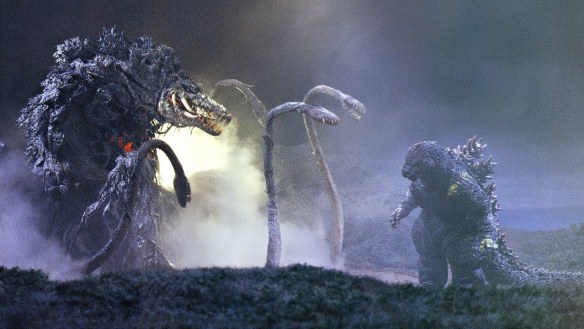
First up this week, we continued our journey through Godzilla’s Heisei era with Godzilla vs Biollante. In this one, Godzilla’s incredible regenerative tissue has caught the eye of scientists worldwide, desired for the creation of both anti-nuclear weapons and gene-spliced super plants. In the oil-rich nation of Saradia, Dr. Shiragami works on just such a project to turn deserts into jungles, until saboteurs leave his research destroyed and daughter dead. But five years later, he gets a second chance to experiment with Godzilla cells, fusing them, rose cells, and those of his own daughter into a creature beyond reckoning.
So yeah, we’re absolutely continuing with the ripped-from-the-headlines political commentary of Return of Godzilla, this time tackling Japan’s role in an increasingly fractured geopolitical landscape. With the old titans crumbling, the future is in anyone’s hands; and with even the Middle Eastern oil titans attempting to modernize and diversify their economies, the idea of Japan remaining a loyal subordinate of the United States feels less appealing by the second. Thus a new path forward must be found, which in this case comes in the dubious form of a giant many-toothed rose-Godzilla-human hybrid.
Biollante’s got things to say, but its thematic complexity never undercuts its plentiful immediate pleasures. Between Shiragami’s group and Japan’s martial heroes, Biollante offers a half-dozen or so leads with fully realized personal arcs, alongside a nefarious assassin from Saradia to keep things boiling. And Biollante is far and away one of the most gorgeous, awe-inspiring creations of the Godzilla universe, both a marvel of puppeteering and a figure of tragic beauty, a testament to our wild hopes for the future and profound love for our children alike. Godzilla vs Biollante is easily the best Godzilla feature since Hedorah, and perhaps my favorite of the franchise so far.
We then screened The Head Hunter, a 2018 dark fantasy feature starring Christopher Rygh as the titular hunter, the solemn defender of a lonely kingdom. Sent orders by arrow from an unseen king, Rygh slays beasts and pounds their gristle into healing salve, all while awaiting the return of his nemesis, the monster that killed his daughter.
The Head Hunter is a sparse, austere film, a grim seventy minutes of trudging through forbidding woods, striking viciously at creatures of cruel, dubious form, and then trudging back with fresh injuries to show, hoping the blood will hold until that vile tonic curses your skin once more. So yes, absolutely my sort of thing, and executed with focus and style in spite of the production’s clearly limited resources. Sometimes you just need a pile of mud-smeared monster masks, a gnarly backyard, and an appropriately stoic lead.
We then checked out M. Night Shyamalan’s recent feature Trap, starring Josh Hartnett as Cooper, a firefighter and loving father, currently chaperoning his daughter’s trip to a Lady Raven concert. Swiftly upon arriving, he learns that the concert is actually a sting operation, wherein the police intend to capture a serial killer known as The Butcher, who is known to be attending the concert. This comes as a source of significant consternation to Cooper, who in truth is The Butcher, and who must now find a way to evade the police while playing along with his daughter’s best day ever.
Hoo boy was this one fun. I’m always down for a former heartthrob’s dramatic reinvention, and Hartnett provides an absolutely astonishing one here, ably shifting between Cooper’s various affectations with an ease so practiced it’s unnerving. He’s such a fun character to follow that the film ably lulls you into forgetting he’s a monster, until he casually does something so unconscionable you’re reminded it’s all just a performance. Set on his shoulder, the film evolves into an improbable yet highly entertaining game of cat and mouse, with the evolving circumstances of the concert offering a steady drip feed of new dramatic variables to toy with.
The film gets a touch shakier in its second half, but nonetheless pulls off its reversal of perspective, reorienting us from Cooper’s eye to that of his victims, and thereby making absolute fullest use of Hartnett’s terrific performance. Shyamalan manages perspective well via camera trickery, but this is ultimately Hartnett’s show, and he nails it – the mixed levels of sincerity and subterfuge in his family man performance, the juxtaposition of his sunny affectation against his horrifying actions, the coldness in his eyes when he’s already decided how a scene will play out, it’s all riveting and utterly convincing stuff, keeping the film centered even when the plot threatens to spin out of focus. A delicious popcorn watch.
Last up for the week was The Flesh Eaters, a ‘64 horror feature set on a mysterious island off the coast of New England. When a sudden storm forces a seaplane’s passengers to take shelter among the dunes, they discover mysterious skeletons washed ashore, and soon learn the sea is host to a ravenous flesh-eating microbe. Abandoned in a sea of death with the tide rising, they will have to work swiftly to discover a counter to their mindless executioner.
For a horror film produced in the early ‘60s, The Flesh Eaters possesses a gruesomeness that puts it well ahead of its time. The film really doesn’t skimp on the grotesque consequences of its flesh-eating antagonists, and is generally shot with a clarity of purpose that puts its contemporaneous Hammer productions to shame. The weak link here is unfortunately the cast, who aren’t precisely convincing in their commitment to their horrifying circumstances, but The Flesh Eaters nonetheless offers a diverting procession of narrative hoops and harrowing payoffs, largely demonstrating the finer points of low-budget horror while hewing to the narrative model of mid-century adventure films like The Mysterious Island. Always interesting to see how theoretically familiar genres naturally reflect the narrative and tonal assumptions of their era.