Hello folks, and welcome back to Wrong Every Time. Today the bells are calling from the tower of Seiren Academy, where Saint Juste is presumably even now flinging daggers at the wall, lost in a reverie of abandonment and exquisite squalor. Down below, Kaoru-no-Kimi confronts the imperious Miya-sama, their forms concealed beneath the wafting bows of the sacred elm. And all along the windows and walls, voices chatter and eyes lurk, each confrontation a feast for their ravenous peers.
So, you know, classic high school stuff. Yes, we are indeed returning to Dear Brother, and at a moment of uniquely fraught drama no less. Incensed by her heartless treatment of Saint Juste, Kaoru has called Miya-sama out, and revealed at last that Saint Juste is actually Miya-sama’s younger sister. Considering this drama’s consistent focus on lineage and propriety, I imagine that their relationship in some way echoes Nanako’s fractured family life; and given Saint Juste’s current residence inside that alienating apartment, I would assume it’s not just Miya-sama who has abandoned her. Let’s see what fresh revelations await as we return to Dear Brother!
Episode 13
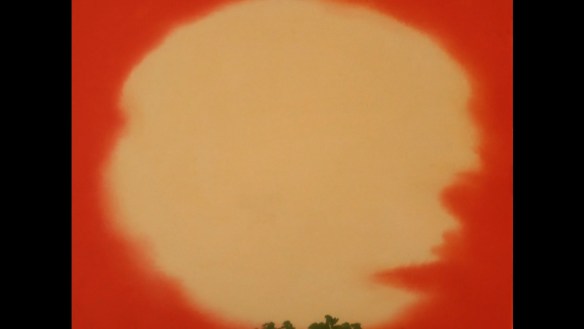
We begin as we left off, our shot holding on the shimmering yellow sun before descending to that fabled elm tree. The rippling focus of the shot creates a sense of intense heat or pressure, which aligns with the reddish sky to make the scene feel almost apocalyptic, as if the sun is a mushroom cloud rising over this confrontation
As always, Nanako arrives just in time to witness the carnage. She occupies a fascinating role in this narrative; staring out at these larger-than-life heroes, it would be easy to imagine her as standing in for the Greek chorus commenting on their drama (the role Utena’s shadow girls explicitly play). But she refuses to be a bystander – in fact, compared to the stasis and slow decay that all three titans seem trapped within, Nanako is by far the most vital and active, determined to drag them away from their assigned lines and the tragedy those roles imply
Their color choices here are interesting; Kaoru’s in a yellow shirt and green pants that actually echo the scenery, while Miya-sama is in a demure blue dress. The colors subtly emphasize how Kaoru is invested in this reality and this moment, while Miya-sama is determined to float above it, cocooned in her tiny sorority world
“A Tale of Double Suicide.” Even by Dear Brother standards, that’s quite an episode title
Nanako is juxtaposed against the shadows of birds taking flight as she leaves, making her the literal “little bird” overhearing their dark secrets
Miya-sama exits as well, saying an outsider like Kaoru has no place commenting on their situation
Nanako again reflects on the isolation of Saint-Juste’s home life, now with the harsh contrast of Miya-sama’s mansion to compare against it. The sunlight is so effectively overbearing in this episode; the characters are smothered under heavy orange light, and every shot of the sun itself seems to present it as an ominous overseer, peering down upon the drama below
The train’s crossing light serves as our segue to that evening, echoing the red light of the later afternoon, and seeming to foretell some approaching violence, some threshold that could augur good or ill
With Nanako’s window open, the rush of the train seems to call her attention outward, and she attempts to call Saint-Juste
Nanako is again compared to Saint-Juste’s beloved doll – as Nanako’s phone call fails to reach her, so is the doll constrained and isolated, hidden in the closet where its judgmental eyes cannot reach Saint-Juste
“I can’t enter your world myself. I can only hope that you will open your door of your own free will.” Nanako’s wishes obviously apply to more than Saint-Juste’s apartment – she seems now ready to take that fateful step, to embrace being a player on the same stage as the three titans
Ooh, love these compositions. After one shot framed looking from one mirror into another, with the endless copied reflections that would imply, we then switch to a series of compositions where Miya-sama and the doll are each fractured across many simultaneous panels, like when Miya-sama was previously reflected in the shattering glass. The effect naturally echoes Nanako’s sense of being trapped in a labyrinth, unable to piece together the truth behind Saint-Juste and Miya-sama’s relationship
Over at Miya-sama’s mansion, Saint-Juste stares longingly towards the window, where Miya-sama plays her piano within. Terrific use of sound design for this transition here, as the crunching of Saint-Juste’s pills literally drowns out the sound of the piano, sonically echoing how Saint-Juste muffles her pain
Saint-Juste’s apartment lies across the river from Miya-sama’s home, a clear dividing line between their worlds
Nanako’s calls are finally answered when Kaoru picks up the phone
“What sort of food does she like?” “Come to think of it… I’ve never seen her enjoy eating.” Nanako seems to bring a crucial degree of normalcy to these heightened personal worlds. While everyone else is thinking in terms of redemption and revenge, she’s the one making sure everyone’s eating healthy and getting plenty of sleep
Meanwhile, her engagement in their world draws her further from normalcy, as her lies and deceptions towards her parents stack up
The sound of Miya-sama’s piano resounds in Saint-Juste’s ears, and she rushes to drown it out with the shower. “If only I could wash it all off!” No wonder she doesn’t mind standing in the rain – it dulls the music of her despair, implies a certain type of cleansing purity, and serves as personal punishment all at once
Now that part of the truth has been revealed, Saint-Juste’s increasingly vulnerability is emphasized through her actual nudity, and sequences of the others gently dressing her
With Saint-Juste unconscious the whole time, it feels more like they’re dressing a corpse for a funeral
“I’ll be fine. I’m good at handling hardships.” Hilarious admission from Nanako. What a tragic proficiency!
Kaoru’s hopeful proclamation that Sainte-Juste will eventually ask them for help is contrasted against the bright yellow morning sun, a welcome sight after the oppressive coloration of the previous day
“Waiting this out is a test of my friendship.” A comment that naturally raises the question of how close they were before
“If that is how real friendship works, it is so different from me and Tomoko.” Goddamnit Nanako, do not take these absurd relationships as a model!
“We think of friendship as something which entitles, not something which obligates.” That at least is a sharp insight. Adolescence generally involves a sharpening of focus as we come to understand the differences between ourselves and others, and the barrier of potential misunderstanding separating us. A natural part of that process is considering not just what we want, but what we owe to others
“Unless this is a deeper bond based on some doomed emotion.” Contrasted against Kaoru and Saint-Juste naked in bed, we are again asked to consider the relationship between love and destruction. Why do all of three of these figures express their passionate feelings through violence, either towards others or towards themselves? I am reminded of the classic Kaze to Ki no Uta, which similarly conflated the embrace of forbidden love with self-annihilation
The seriousness and red colors of that first sequence are contrasted against frivolity and inviting blues and greens, as Tomoko makes a great performance of the approach of midterms
Delightful to see Shinobu treating Tomoko like a friend as well now. There is hope for at least some of these kids!
Tomoko even jokes about their Sorority status, emphasizing the lack of bad blood between them
“Now you can prove your friendship!” Her jest regarding the Sorority’s test-taking advantages touch a bit of a sore point though, echoing Nanako’s reflections from the previous day
As ever, Miya-sama is defined by the light of the stained glass windows. But she is now haunted by a ghost; she sees Saint-Juste’s form waiting beneath the elm tree, a shadow that disappears as she turns
Nanako relates a series of sudden mysteries at the school: a piano playing itself, footsteps up and down an empty stairwell, and the sound of sobbing emerging from the elm tree. Shinobu explains them away as the result of pre-exam stress, somehow now acting as the grounded, sensible member of the group. I am so proud of her
Shinobu relates last year’s ghost stories, about two alleged Showa-era student ghosts who bear a passing resemblance to Saint Juste and Miya-sama. Sturdy effects used to convey this historical tale, mixing sepia hues with heavy watercolor backgrounds that blot out most details, conveying a sense of a near-forgotten memory
“Finally, they cut their wrists with a razor together, under the elm tree in the rain.” A tale that obviously possesses all sorts of resonances with Saint Juste and Kaoru’s relationship. So that’s our double suicide
While Shinobu finds this story romantic, Nanako can only wonder if there was another way, hoping her current doomed companions don’t suffer the same end
Saint-Juste’s song calls Miya-sama and Nanako to the piano room. The pair of sisters do indeed look like the pair Shinobu described, with Saint-Juste’s masculine suit echoing the attire of the man from the legend
A rare tender moment by Miya-sama, but it seems only intended to affirm her total control over Saint-Juste
This of course only stirs Saint Juste into another suicidal frenzy. Mistaking Nanako for “Fukiko-sama,” she reiterates their pledge to die together
And Done
Well Nanako, your heart’s in the right place, but I’m not sure what you’re expecting from entangling yourself in the lives of these lovelorn, self-destructive titans. As she herself noted halfway through this episode, their relationships seem utterly alien to her own understanding of love or friendship; unfortunately, she is still young enough to credit that to her own lack of experience, rather than the genuinely unusual nature of her upperclassmen’s ordeals. In terms of craft, the use of lighting and sound design across this episode was exceptional; the sun served as an appropriately cruel arbiter of the first half’s desolation, while the use and absence of Miya-sama’s piano fully dictated the momentum of the second. At least Shinobu’s joined the psychologically stable crew now! I’m sure that won’t last, but it’s a comfort while it does.
This article was made possible by reader support. Thank you all for all that you do.