
Hello folks, and welcome back to Wrong Every Time. This week I’ve been doing my service as a tertiary member of the Straw Hat Fleet, by inducting another friend into the cult of One Piece via the astonishingly well-executed live action series. It seems almost unfair to have such an easy on-ramp for engaging with One Piece; after grappling with low points like Captain Kuro’s Long Walk or Don Krieg in general, I can’t help but feel a tinge of battle-hardened pride relative to these newcomers’ easy stroll from Windmill Village right to Alabasta. Of course, that is always an instinct to be fought; more people getting to enjoy stories I love is an unquestionably good thing, and if that means I have to explain what’s up with Garth and Coby when they jump mediums, it is a duty I will embrace gladly. In the meantime, let’s burn down the week in films!
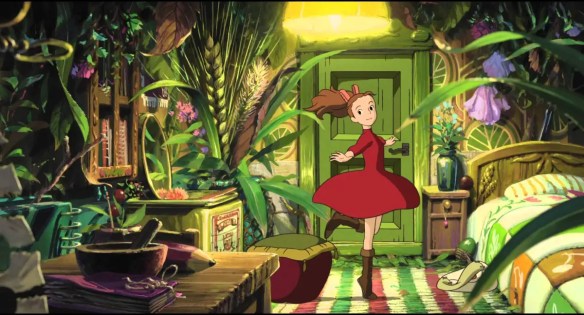
First up this week was Arrietty, one of the few Ghibli features I had yet to watch, directed by future Studio Ponoc co-founder Hiromaya Yonebayashi. Based on Mary Norton’s much-loved book The Borrowers, the film centers on our tiny titular heroine, who lives beneath the floorboards of a remote estate with her parents, and sneaks up into the world of the “human beans” to borrow what her family needs. Her life is complicated by the arrival of Sho, an ailing boy who seeks to befriend his miniscule housemates, breaking the taboo barring borrower and human interactions.
It feels like the animating motive for producing Arrietty was “wouldn’t it be nice to explore a beautiful Ghibli house from the perspective of a tiny little guy?” As it turns out, yes, yes that is exceedingly nice! From the charmingly reappropriated knickknacks of Arrietty’s home (stamps as paintings, chess pieces as statuary, etc) to the cavernous ground-eye views of Sho’s bedroom and kitchen, Arrietty offers a unique and refreshing approach to Ghibli’s consistently stellar scene-setting, calling to mind the pint-sized pleasures of roaming the neighborhood in My Neighbor Totoro.
Arrietty’s actual story is a bit less engaging, unfortunately. The film feels like it’s barely begun to stretch its wings before it’s drawing to a close; with the first third or so caught up in introducing Arrietty’s world, there is virtually no time at all to flesh out her bond with the young Sho, making the conclusion’s emphasis on how much they meant to one another ring hollow. Definitely less emotionally impactful than most Ghibli features, but still full of distinctive little pleasures; very much a “the journey is the reward” sort of film, offering an array of visual gifts before floating off down the stream.
We then continued our march through Gamera’s adventures with his fourth outing, Gamera vs Viras. This time it’s those fucking aliens again, now intent on conquering the earth in order to steal our precious nitrogen. Their malicious machinations even include stunning poor Gamera with their Super-Catcher Ray, and subsequently mind-controlling him into attacking Japan himself. Fortunately, the young boy scouts Masao and Jim are on the case, blessed with the wit and technical know-how to take down the aliens’ ship from the inside.
Gamera vs Viras essentially completes Gamera’s transformation from threatening kaiju to friend of the children, a journey affirmed by Masao literally naming him as such directly to the camera. The adventures of Masao and Jim further solidify this film’s status as a youth-centered fantastical adventure, a sort of younger viewers’ counterpoint to Godzilla’s concurrent escapades. All that is well and good (and Viras’ giant squid design is lovely), but the studio’s struggles with funding are unfortunately more than clear in this film’s heavy reliance on old footage. Essentially the whole middle act of this film is cut from Gamera’s previous three outings, as we montage through his last three battles under the dubious directive of revealing Gamera’s weakness (his love of the children, duh). This makes for a frustratingly unfocused and derivative viewing experience; there’s a reasonable two-thirds of a Gamera adventure here, but apparently the tortoise doesn’t always win the race.
Our trawling of TUBI then led us to The Dungeonmaster, an ‘80s anthology film centered on programmer Paul Bradford (Jeffrey Byron), whose attentions are divided between his girlfriend Gwen (Leslie Wing) and his apparently sentient computer X-CaliBR8. Suddenly, all three are summoned into a hell dimension by the nefarious Mestema (played with great relish by veteran character actor Richard Moll), who demands that Paul overcome his various challenges to win Gwen back. This at last leads us to our anthology premise, as Paul fights through various directors’ undercooked challenge courses.
The Dungeonmaster is novel in concept yet exceedingly ramshackle in execution; if the film didn’t so proudly tout the distinct directors of each individual sequence, I’d have hardly suspected they were different artists in the first place. Nonetheless, I appreciated the film’s snapshot of societal reflections on both D&D and the age of computers, and the script occasionally rises to some semblance of ingenuity – this is actually the origin point of that “I reject your reality and I substitute my own” line, for example. It’s nothing I’d recommend, but between the variability of the challenges and Richard Moll’s scenery-chewing presence, I can’t say I regretted the viewing.
Last up for the week was The Gate, an ‘87 supernatural horror film in the same vein as Poltergeist or Gremlins, in that it’s an ostensibly family-friendly horror film that may nonetheless scar your children for life. Stephen Dorff stars as Glen, a young boy whose parents are heading away for the weekend, leaving him and his friend Terry under the stewardship of his teenage sister Alexandra. This would all be well and good if not for the demonic portal that just opened in their backyard, which proceeds to spew demons and nightmares directly into Glen’s home.
The Gate is a relatively straightforward artifact of its time that exemplifies much that is uniquely compelling about ‘80s fantasy-horror fare. Its portrait of faceless, sterilized suburbia echoes the bleak prefabricated communities of ET or Poltergeist, and its leads have sharper angles than you’d expect, drawing the story in unexpected directions and making for protagonists that are more real than they are likable. The homes of Glen and Terry are stuffed with character-rich detail, and most importantly, the nightmares they face feel uncomfortable, unsanitized, and personal.
Though it’s clearly aimed at family audiences, The Gate doesn’t hesitate pulling Godfather-reminiscent shenanigans with the family dog, or forcing its lead to stab a demonic eye emerging on his own palm, or pursuing any other number of disquieting, body horror-adjacent larks. Additionally, its mixture of forced perspective miniaturization and genuine stop-motion beasts make for a delightfully tactile demonic invasion, complimenting the lived-in texture of the leads’ homes. While not quite on the level of its closest ‘80s compatriots, The Gate nonetheless offers a satisfying take on a distinct era in family horror.