
Hello folks, and welcome back to Wrong Every Time. Today we’re returning to an intriguing new interactive project, as we explore the second chapter of 1000xRESIST. Our first excursion provided a diverse stew of variables to chew on, setting us in an apparent post-apocalypse where variably purposed clones of an overseeing ALLMOTHER pushed back against the OCCUPANTS, spectral giants that have seemingly destroyed most of humanity. After meeting our protagonist “Watcher,” we were introduced to fellow sisters like “Healer” and “Bang Bang Fire,” as well as the apparently rebellion-fomenting “Fixer.”
Alongside this present-day narrative, we were also tasked with sifting through the memories of Mother, which took the form of an intimate story of connection and betrayal at a Canadian academy. As a teenager, our mother Iris sought to assimilate and separate from her Hong Kong heritage, a process complicated by her friendship with fellow expat Jiao. We also learned a great deal about Iris’s own domineering mother, and received a number of hints regarding the tear-prompting plague that preceded the apocalypse. It’s a credit to the game’s confidence and clarity of execution that these two spheres of drama seem so naturally linked, and I’m eager to see whatever catastrophes shaped the insecure Iris into the all-knowing Mother. Let’s get to it!
Chapter 2
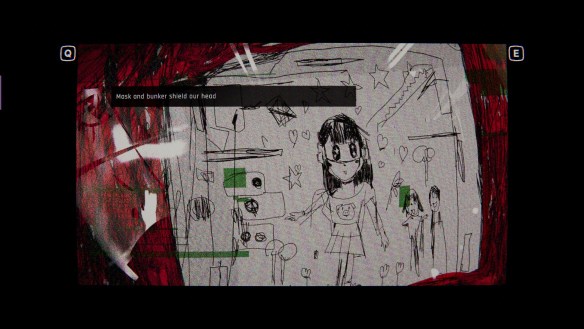
We open our second chapter on a series of children’s drawings, clearly constructed by Mother’s children within their bunker. The accompanying poems emphasize the totality of their indoctrination process, turning the rules of the bunker into nursery rhymes
The teenage Iris sought to integrate, to abandon her cocoon of tradition and become one with a greater world. Interested to see how that philosophy eventually shifts to this contrasting view of isolating within oneself and living in the past
“ALLMOTHER’s dream from red to blue. Then sisters walk the earth anew.” Red is a warning, signifying lockdown
We learn there are apparently six different functions that sisters can be assigned, all color-coded
“An ancient sister ALLMOTHER crossed. ALLMOTHER’s grace forever lost.” Are all sisters damned for the sin of Iris’s betrayal of Jiao? And interesting how we’re talking in terms of sin and punishment – I wonder what pieces Iris took from the cultures around her to inform her own religion
We awaken to a message from Principal calling us to her office. This game uses soft focus to great effect in selling these more cinematic moments, in spite of its generally humble visual design. A real lesson in how visual drama doesn’t require detailed graphics; a strong, distinctive aesthetic and understanding of cinematic language will absolutely do the job
Principal offers an apology that doubles as a quiet interrogation, as she probes at the relationship between Watcher and Fixer, as well as the strength of Watcher’s faith
The “report” of Fixer’s punishment takes the form of more children’s drawings, all projected on the sky. A choice that prompts a variety of questions – is ALLMOTHER herself suspended in a perpetual childlike state? Did all of these events happen before, predicted by these drawings, and are now just repeating? Additionally, the fact that the clear blue sky shifted to these drawings likely makes clear that that sky itself is another projection, a happy fantasy used to disguise the actual fallen state of the world. It seems we’re all in some sort of nursery here
“This is them burning for their sins.” An ominous sight, all the more so as conveyed in these childish scribbles
“It seems the sins of our ancient sister grow ever more cunning.” Another line emphasizing their Original Sin
Thus our new job is to serve as the enforcer, rooting out any other signs of rebellion. A classic method of binding subordinates to a tyrannical directive, by making them complicit in the tyranny
Watcher’s discomfort with this whole situation is expressed through her curt, defensive responses to Secretary’s comments
I like how our map display is also drawn in a child’s hand, raising a further question as to whether our doctrine as a whole was designed by a child. Always appreciate it when frequently unconsidered design choices like maps or user interfaces are employed to support a game’s aesthetic and storytelling, like with Persona’s menus or Outer Wilds’ mystery board
A conversation with Knower comes as close as it can to a eulogy; Fixer is gone, but Watcher is glad to know her deeds will be logged in the database. Some fragment of her will remain
Conversations with the less prestigious “shells” reveal a mix of ambition and fatalism. Those with hope seem to find it in crawling over their fellow sisters for validation – those without seem like prisoners in their own bodies
A trip to the healing wing seems to underline the slapdash nature of this whole project – though the library wing subordinates marveled at the perfection of ALLMOTHER’s wisdom, here it’s clear that both role assignments and biological check-ins are chosen haphazardly, at the whim of the superior. No surprise this order relies on an unquestioning faith
“I’ve tasted the glistening lips of the ancient sister!” Elsewhere, Watcher sees the tale of Fixer’s betrayal already being translated into ALLMOTHER-approved religious canon. Interestingly, Iris’s preoccupations still slip through into her descendants’ interpretation of sin – the “fall from heaven” is framed as kissing Jiao, the temptress and source of our original failure
“We must trust the audience to find the truth that exists between your version and ours.” “The truth? But I was actually there.” Watcher still not quite understanding how the truth is manufactured in her world
“Communion” with BB leads to another tense moment in Iris’s past, as we see her packing to leave her parents’ home, and “go off with strangers,” as her mother puts it. As with the first chapter, I’m quite impressed with how well this game sketches out the contours of Iris’s life with as few key memories as possible
Crucially, it’s embracing the key dramatic strengths of interactive media in particular – actually going through the process of flinging Iris’s personal items into a bag offers a tense, tangible experience of fleeing home
“You are our rock! So sturdy.” Though he’s not as overbearing as her mother, Iris’s father still clearly piles expectations upon her
“This must be the ALLMOTHER’s gestation chamber.” Their reflections on pre-fall life are always fun
“During the darkest days of the demonstrations, it was songs that got us through. And some other things… but it’s the songs that are important to remember.” Her father offers key, world-weary advice, but she is of course too caught up in her own adolescent struggles to heed his words. A failure that crosses generations – Iris modeling her children on herself has created a sense of unity, but robbed them of the understanding that can only come from engaging with the foreign experiences of others. Everything she failed to internalize has thus become a failure of her children as well
Our first touchstone memory here is shared by her parents – a moment when her father was beaten by the cops during the demonstrations, preserved as a recurring nightmare of her mother’s
Past and present converge again as we flash back to the moment of separation, throwing her things in her bag. We can flee our physical location, but we cannot escape our memories, whether they are of the parents we’ve disappointed or the home we’ve lost forever
“You don’t think I’ve dreamed every night of going back home? Haunted by a place that doesn’t exist?”
“Canadians don’t like hot soup during hot times. Don’t ask me why.” Her parents’ arguments circle the same eternal point, that feeling of disjoint
Her father makes one point explicit – he wants to provide his daughter the normal adolescence that he never got to experience
“Mui mui, sometimes there’s things that don’t need to be said.” One lesson Iris did internalize from her father, and carry on to her children
We then cut to the latest memory yet: two representatives of humanity’s defense talking with Iris’s parents, expressing the importance of her immunity as a potential weapon against the OCCUPANTS
“Iris would never leave us behind.” Oof, that one hurts. Her father is such a decent man
We then cut to an even more devastating memory, as we witness Iris failing to appreciate her parents’ birthday celebration, seeing their traditional gifts as one more “weird” thing isolating her from her peers
And yet for all her efforts, the only friend who actually shows up is Jiao
Another terrifying memory, one implying her mother’s sleepwalking eventually led to her falling off the apartment balcony
“Be water.” Whatever they must do to survive. Another lesson Iris internalized, with questionable results
Considering her yearbook, Iris thinks “I’ll probably be too busy for nostalgia.” A sharp jab of dramatic irony
Several of those surviving drawings already hang on her wall. One of the few things she preserves
An overheard discussion between Iris’s mother and Jiao reveals how her mother wishes things could be – shared nostalgia over the home they lost, shared understanding of the eccentricities of this new world. But there will always be a divide between herself and her own daughter, a gulf the size of an entire culture
“God, the smell! I can’t get it out of the microwave!” From eagerly looking forward to the “freedom” of this new life with her hamster Bobo, Iris has now reached the point of killing her pet to express her dissatisfaction with her lot
A flight of planes like terrible dragons, all leading her parents away from home
“You’ll never know what your father and I sacrificed for you.” The cycle spins back another level – Iris’s grandmother gives her mother the same speech Iris herself would modify to design her children’s cage
“You and me? We’re the same!” As we return to the finale of her packing, it’s her father who reaches out through the door, trying desperately to maintain that bridge between them. But the things that make them the same might also be the things that draw them apart
“Iris? Don’t leave us like this. Please. I won’t make it without you.” He wasn’t lying earlier – Iris is indeed the rock that keeps him going, in spite of all the disappointment and compromise and regret. His words are lent even more painful weight by that prior flash-forward, implying he actually did jump from the apartment after Iris left
Her final “escape” requires navigating through all these fractured memories in sequence. A viciously effective application of interactivity, forcing us to physically traverse every painful sequence once more
Our two explorers ultimately drown their sorrow in liquor, an entirely natural response to that deluge of sorrow. My god, what a tragic sequence
“To desert them like that.” Once again, Watcher can only marvel in regret at Iris’s choices
BB counters that “culling the weak” is precisely how Watcher handled Fixer. Is that the kind of person you want to be, Watcher?
And Done
Thus we drink and dance the night away, cushioning ourselves in liquor from the pain of grappling with Iris’s decisions. This game’s first episode was already poignant and precise, but this one was absolutely devastating, presenting an exceedingly human family’s dissolution with scientific curiosity and not a hint of mitigating sentimentality. The use of interactivity here was precise and brutally effective; forcing the player to actively pack Iris’s things made us complicit in her betrayal while offering natural commentary on the parts of herself she was leaving behind, and that final walk through her hall of memories felt like the goddamn Metal Gear Solid III river requiem, like navigating a gallery of her sins. This game only gets sharper as it goes, effectively using Iris’s experiences to shape Watcher’s own personality into something just maybe capable of breaking the cycle. But I suppose however our experiences shape us, we are ultimately still only human.
This article was made possible by reader support. Thank you all for all that you do.