Hello folks, and welcome back to Wrong Every Time. Today we’re checking out a fresh new production, as we explore the debut of last year’s The Fragrant Flower Blooms With Dignity. Based on a manga by Saka Mikami, the show centers on the romance between a girl from a fancy prep school and a boy from a school for delinquents. So we’ve clearly got some elements of class conflict to complicate our would-be romance, alongside a school rivalry that puts this drama somewhere between West Side Story and Romeo & Juliet.
Not that I’m expecting anything quite so tragic as that; by all accounts this is a charming and gentle narrative, and also a genuine hit for Netflix, where it stayed among the top rankings for a significant portion of the year. That all sounds fine by me; I’m a fan of romances of all stripes, and adaptation director Miyuki Kuroki’s work boarding and key animating for productions as visually impressive as The Idolm@ster and Fate/Grand Order, as well as animation director Kōhei Tokuoka’s prior work as AD on Josee, the Tiger and the Fish, gives me ample reason to assume we’ve got a delicate and character acting-rich drama ahead of us. Let’s meet our lovebirds!
Episode 1
Our establishing shots all focus on conveying the atmosphere of our heroine’s elite academy, starting with a deliberate low-angle shot framing the school as an imposing monolith, much in the way Dear Brother often depicts its Seiren Academy
The sound design further emphasizes this sense of high-class propriety, with a piano-led chorus group presenting her classmates as aligned in appreciation of the finer things
Detail-rich character designs as I expected, and also some strong flourishes of incidental character acting as we briefly spy a soccer match being held beside the school
A cut of the boy’s school gives us a better look at the show’s character design principles: sturdy, even lines that match the background objects, thus letting the characters feel that much more embedded in the scenery, alongside a clear emphasis on how clothing hangs over the body, and lots of distinctive haircuts setting all these presumed delinquents apart
Our lead sits in the traditional Protagonist Seat at the back right of the classroom, bearing a couple standard signifiers of “anime delinquency” – earrings, yellow hair, and a clear appreciation for hair gel
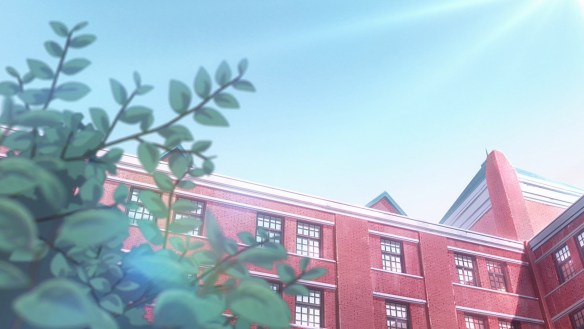
A smart riff on the usual “staring towards the open sky” beat so many shows use, with this window instead aiming directly at the brick walls of the neighboring school, emphasizing the cultural limits on his ambitions
Some nice uses of altered photography in the OP, facilitating the classic visual contrast of this girl’s bright yellows and pinks invading the somber blues and greens of our male protagonist
Also more wonderfully fluid, effectively weighted character animation, with the expected focus on the movement of clothes and hair
And then some classic visual motifs regarding coming to a happier self-image and emerging successfully from adolescence – the rain coming to an end, the plane in flight
Post-OP, we cut down in what appears to be greater Tokyo somewhere, as some punks perform that classic “you pushed me” “no you pushed me” ritual. Always wild to me to recall that Tokyo is large enough to contain at least a dozen sub-cities
Our lead is apparently Rintaro, whose tall, menacing appearance swiftly scares off the punks
Some fun long shot animation of the boys from fully across the street. I often find long shots where the characters are distant enough to be reduced to their fundamental profiles is where some of the most fun character animation sneaks in – Sailor Moon is absolutely full of this
Much like Toradora’s Ryuji, Rintaro gets misjudged easily due to his menacing appearance
He does seem to have a solid group of friends though, which will definitely help facilitate the culture clash element of this narrative. Already clear these boys aren’t actually delinquents, even if their scholastic neighbors view them with disdain
“When it comes to us, they don’t act like ladies at all.” An early prelude to a likely theme – that true nobility is determined by what you do, not who you are
Our two schools are the private academy Kikyo and the low-ranking Chidori
Interesting how Japan’s system of applying to high schools prematurely filters and stratifies the population like this – if you don’t do well in middle school, you’re likely to fall into a high school where it’s impossible to do much better. Though I suppose the United States just accomplishes this with private schools and housing laws
After school, Rintaro rushes to his job at a local bakery. Again like Ryuji, Rintaro’s harmless passions swiftly defuse his bad-boy image
Apparently it’s his family’s business, and something he keeps secret from his schoolmates. So this is his sanctuary, the hiding place for this softer side of him; additionally, this reveals he’s not actually close enough to his friends to have ever brought them home
Our heroine is as small as Rintaro is tall, and apparently a big cake fan. She scampers off the moment Rintaro notices her
“If she stops coming here, it’s my fault.” “Why would that be your fault?” Rintaro seems to have internalized the implications presented by the dichotomy of these two schools, seeing his very existence as an imposition on others
“You always blame yourself for everything. It’s a bad habit.” At least his family seems to value him
This production is running into one issue that often plagues manga adaptations – adapting small single-panel gags into full-screen extended sequences, thus making the joke more aggravating than endearing. Timing is everything in comedy, and overplaying a quick manga gag is a comedic death knell
Oh my god, now Rintaro’s fretting over potentially traumatizing her and wondering how he might apologize. You’re too kind, Rintaro!
Even Rintaro’s friends at school recognize his strategy of keeping people at a distance, presumably because he’s scared he’ll otherwise hurt or offend people
Later, our heroine returns to the bakery and asks to speak with Rintaro. Dramatic focus on her startling blue eyes, which feel all the more large and imposing given her otherwise diminutive stature
No surprise this production focuses on layers of clothes and hair, given our heroine has such elaborate hair and frill-bedecked outfits. She looks like a porcelain doll
“Allow me to treat you!” Damn, asking him out halfway through the first episode. I’m impressed!
Some excellent faces for our heroine indulging her love of sweets
She reveals she was embarrassed yesterday because he saw her eating so much. An immediate charming parallel between the two of them – each felt embarrassed for the other’s sake, assuming their actions were inherently offensive. He, an imposing young ruffian interrupting a maiden in a place of rest, and her, a maiden indulging in the unladylike practice of binge eating – both of them are bound by social conventions that don’t suit their personalities, but nonetheless inform their sense of shame and displacement
Our heroine is Kaoruko Waguri, and Rintaro’s family name is Tsumugi
Interestingly, she jumps directly to calling him “Rintaro-kun,” again pushing their familiarity ahead at top speed
“Now I finally know.” Her phrasing implies a past connection Rintaro doesn’t know about
Apparently she’s seen him around the shop before, and was simply scared the previous day because that was the first time a boy stared at her. Ah, the social deprivations of single-gender schools
Rather than being scared by his attention, she was actually flustered. I appreciate how she keeps making the first moves here, in spite of her seemingly dainty, defensive affect
“I’ve never once thought of you as scary.” A very kind final gesture
Ooh, I love these smoking, ashen silhouettes of Rintaro’s middle school classmates, the ones who presumably gave him such a complex about his appearance. With no discernible faces, they eventually just became the “common consensus” in his mind, the obvious response to his looks and situation
He then heads out to return her cake, and finds her being harassed by a couple of the neighborhood predators. I used to think this archetype was a cheap, unrealistic way to draw characters together, but after Trump’s second election, I’ve become frustratingly aware I’m surrounded by genuinely dangerous people
Once again, Kaoruko demonstrates her brave and proactive personality by standing up for Rintaro
While Rintaro in turn demonstrates his automatic desperation to please others, even apologizing for bleeding after defending Kauroko
“Next time, let’s have cake together, okay?” And unsurprisingly, it’s Kaoruko who immediately sets up a second date
Our stinger sees them recognizing each other through the windows of their schools, with Rintaro of course immediately getting embarrassed and closing the curtain
And Done
That was thoroughly charming! I’ve seen a fair number of high school anime romances, and while there were obviously shades of Toradora reflected in this misunderstood pair, they definitely established a charming dynamic all their own. It was quite endearing to see Rintaro constantly apologizing for his own presence, trauma aside, and equally fun to see the diminutive Kaoruko doing all the work of setting up dates, reassuring Rintaro regarding his anxieties, and generally pursuing a cute, kind boy with all the resources at her disposal. Add in the production’s intricate art design and regular character acting flourishes, and you end up with a premiere that has me eagerly awaiting the next episode. A cute couple goes a very long way!
This article was made possible by reader support. Thank you all for all that you do.