Hello folks, and welcome back to Wrong Every Time. Today we’re continuing our journey through the blood-soaked Chainsaw Man, as Denji and his public safety companions continue to fend off an army of international assassins. Well, “fend off” might be too strong a phrase for their current situation; perhaps “contend with” is better, considering those assassins have already broken through the gates. Driven by the promise of human rights for her family of fiends, the elite killer Quanxi has pierced through Japan’s defenses, and rejected Kishibe’s offer of challenging Makima at his side.
When the conditions of your life are this tenuous, solidarity can indeed seem like a naive luxury. While Kishibe is theoretically pursuing a better future for everyone, Quanxi has no reason to trust in his alliance, nor to believe he is truly capable of toppling Makima. A recurring tragedy of social oppression is that it denies us the very solidarity that might lead to material changes, out of fear that the first to rise up will simply be battered down, rather than serve as any meaningful catalyst. Few want to die for someone else’s liberation, and the mechanics of capitalism further incentivize us towards selfish individualism, or at least no further solidarity than towards the people we can touch and feel. Thus we arrive at situations like this current bloodbath, with the war dogs of numerous countries begging for scraps while fearing the lash, cutting down the fellow killers who know them best. Let’s get to it!
Chapter 62
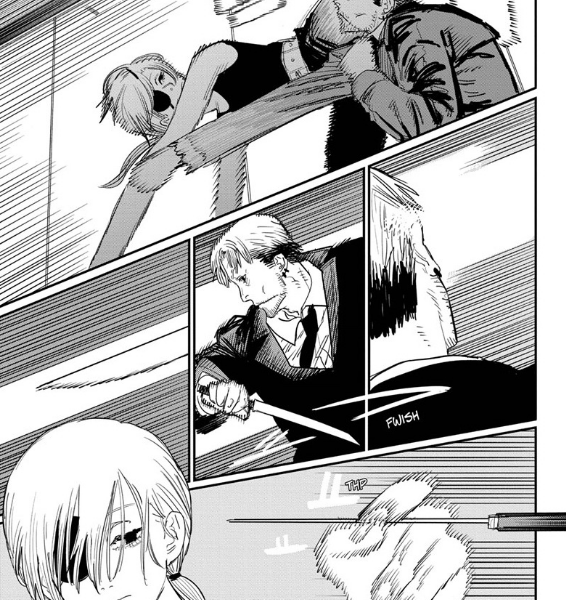
Our first page demonstrates both action fundamentals and Fujimoto’s signature tricks. The whole composition is built around pointing us towards Quanxi’s effortless parry in the last panel, an effect evoked through a combination of speed lines, diagonal character blocking, and the fact that the very lines of the earlier panels all converge aiming towards Quanxi’s face rather than maintaining parallel directions. Then there’s that blade coming in from outside the panel entirely, a meta-paneling trick that Fujimoto often employs to create a sense of tremendous speed or disruption, like something is moving too quickly for the panels to contain it
I quite like this single panel of Quanxi’s fiend inflating her chest cavity to fire a blast of flame at the public safety workers. It’s a moment that combines two things I like about Chainsaw Man – the incidental body horror inherent in so many of these abilities, and also Fujimoto’s cavalier approach to defining and revealing powers, which we often get no more context for but one single, incidental usage. That makes these powers feel a lot more unpredictable and dangerous than if everyone was carefully explaining their functionality and limitations – far too many mangaka who are not Togashi believe they can pull off Togashi’s tricks
The posing as this fiend and Power face off is also quite lively and dynamic. The slipping of Power’s jacket, the surprised, almost cat-like twisting of the fiend’s form as she looks towards Power while maintaining her chokehold – Fujimoto is quite good at capturing the incidental quirks of human posture and body language, something which tends to imbue his still panels with an inherent sense of movement and consequence
Also quite a nice flurry of blows here, ably evoking a storm of punches through the precision of limb placement. Many mangaka are able to make fights look awesome, but Fujimoto revels in how fights look messy, with bodies scrambling over and past each other, and everyone desperate to avoid that final killing stroke
And the chapter concludes on another grotesque, inexplicable image, as Denji is drawn into a crucifix pose and nearly torn apart. Fujimoto’s wild, uncontained approach to devil powers is one of Chainsaw Man’s most obvious strengths; the world feels far vaster for the inexplicable particulars of these abilities, and frankly, panels like this are the easiest way to convince newcomers that there’s some real shit going on with that Chainsaw Man comic
Chapter 63
This chapter opens with an extended celebration of another of Fujimoto’s best tricks: his ability to gesture towards full personal histories or life stories with only the barest of reference points, like this collection of memories emphasizing how Tolka was molded into the ritual position necessary for his master to cast this bizarre spell
Fujimoto excels at both sides of this process – the crafting of tangible living memories to swiftly create a sense of individual personhood (as demonstrated through the doppelganger’s visit to his target’s home a couple volumes back), and the designing of occult rituals such that their logic and consequences feel impactful yet entirely foreign to us, a monstrous chemistry built on an arithmetic of violence. Makima’s sacrificing of those condemned criminals in order to kill off Chainsaw Man’s first abductors was a terrific example, and this union between grandfather and granddaughter works similarly, with the grandfather’s statement of “offering my heart and my beloved children” ringing with the same nightmare logic as an old-fashioned fairy tale
The ritual concluding with an evocative reveal of just what happened to Santa Claus’ children is a wonderfully chilling punchline, a stark visual evocation of a witch sacrificing children to feed their own endless hunger. You can technically take certain mechanical lessons from this (like how it visually mirrors Aki’s ‘kon’ power, whose visual impact is borne through superimposing a hand over the internal “reality” of a panel, thus conveying this “magic” as something existing beyond reality itself), but the deeper lesson here is “read broadly, such that you can draw on a diverse web of creative influences, and hopefully come up with something so singular and terrifying as this”
Surrealism meets taoism as the ritual works its magic, framing this disruption of reality as merely an expansion of the natural processes embodied by Tolka’s master, as one more body returning to nourish the soil. Again, ideas like this don’t really come from mastering the fundamentals of narrative form; you have to find your own distinct influences, the things that inspire you and spark new creative connections amongst themselves. The reason Chainsaw Man feels so singular is the same reason One Piece has lasted this long – their authors are ravenous consumers of a broad swathe of films and literature, which makes their works feel more distinctive and fully realized than creators who just consume the genre they’re working in
Chapter 64
Fujimoto’s hell is an inexplicable array of signifiers – an overturned bathtub in an open field, a crop of severed fingers, a sky of infinite closed doors. It’s a funny thing that Chainsaw Man broke out in this era of global appreciation for shonen anime, as it really doesn’t offer the same sort of validating, action-focused experience as its contemporaries. Fujimoto’s main interest is clearly not fight scenes; even in this ostensibly fight-centered arc, he’s swiftly moved us towards a surreal puzzle to solve, much like in the prior hotel arc
Quanxi’s subordinate tells us that “far beyond here, the devils with the names of the primal fears are watching us.” A visual representation of existential fear, or perhaps even beyond that – the fears so profound that they can’t even recognize our existence, that are so powerful and beyond our comprehension that merely their noticing us would obliterate our existence. Fujimoto is successfully traveling in the realm of cosmic horror here, and that is an extremely difficult thing to do, because the fundamental nature of cosmic horror is that it can’t be recognized, that it exists beyond our comprehension. Thus this field of signifiers, interpretations we can recognize, but which do not convey the full scale of what is approaching
Using the fiends for this is also an excellent choice. They are attuned to something the human travelers cannot comprehend, and can feel the weight of those primal fears like a sickness inside them. They straddle the line between reality and our collective fear-based unconscious, making them painfully aware of the presence of these Great Old Ones
Thus we finally arrive at that iconic full-page image of the dead astronauts, the apostles of darkness, of a fear beyond our comprehension. I was wondering what could possibly offer context to that image, and am delighted to be so rewarded by this revelation. They are the closest worshippers of darkness itself, the few humans who have grasped the scale of our insignificance within the cosmos. Normal humans fear the threats they can see and define, but astronauts have seen how very small we are in the dark, and they know to fear things it is dangerous even to name
The following spread, this macabre dance with their arms all arrayed like banners heralding this devil’s arrival, is just as good as the first. Fujimoto is channeling the essence of weird horror across the ages here, a power that drives us to madness, rapturous worship, or both, a merging of occult narrative tradition and surrealist visual tradition. His imagery successfully evokes a power we cannot hope to fight, the darkness behind the veil, the origins of fear. Our bodies are not sacred, they are simply material, whether used for the fanfare of these arms raised in worship, or the emaciated full forms of the unfortunates that form this avatar’s own legs
In classic Fujimoto fashion, those stolen arms construct the barricades of the next page’s panels, his love of challenging the base assumptions of comic space now wickedly employed to demonstrate how powerless our characters are against this force, how effortlessly it bends our muscles and bones to its will
Given how Makima has been portrayed thus far, it seems only right that it would require such a ritual to acquire the means for her destruction. Thus Santa Claus’ granddaughter receives a precious gift
Chapter 65
Our next chapter is as grim as it is straightforward, documenting the total destruction of our aligned teams in the face of such a monumental, fundamental fear. The ease with which the Darkness Devil disposes of these warriors feels like a key point in itself, emphasizing how meaningless our individual struggles are in the face of the powers that truly command this world. Compared to this force, our squabbles are mere self-indulgence; we strike back at the forces we can name and harm to avoid considering those which are beyond our grasp
There are plenty of nice individual tricks here used to convey the overwhelming presence of this nightmare god. I like how Chainsaw Man tearing at him produces “sparks” in the form of the countless souls trapped within his shadow, and also like how everything but his front side is conveyed as pure black, that absolute darkness that we all fear conceals a lurking threat. This devil is that threat, that collective threat of whatever hears you when you call out into the dark
We also get more evocative, inexplicable gestures towards these monsters’ ritual powers, like this chiming blade that so swiftly demolishes Kobeni’s partner
Chapter 66
After all that utterly one-sided violence, the reappearance of Makima feels almost like a relief; at least here we have a monster who wears human skin, who can congratulate her subordinates and even enjoy a good movie. Of course, that’s precisely what makes her so dangerous; though she is just as indifferent to human suffering as the darkness devil, she understands humans as useful, and thus contorts herself to be the cage we can come to love
The portrayal of their collective violence further emphasizes the uselessness of physical strength. There is no tactical trickery here, no clever exchange of blows – they simply fling destruction at each other, with Makima trading every thrust of impossible destruction for another crippled, stolen limb. Violence is senseless and grotesque, and in its purest form it becomes nothing more than the annihilation of life itself
And once again, for the moments of greatest intrusion upon conventional reality, Fujimoto exploits the handy trick of having characters exist outside of the manga frame that is the “reality” as conceived of in a comic book. Makima’s escape from hell is framed like a literal wiping of the screen, an open palm either smearing this vision of hell into memory, or perhaps actually turning the physical page
Back at home, the true Santa Claus reveals herself as an amalgam of the dolls she has collected, which frankly can only do so much to match the visceral horror of hell. Nonetheless, we end on another sad stinger – after all of this, Denji still relishes the chance to be Makima’s loyal dog
Chapter 67
Having escaped from hell itself, we immediately return to the grimy politics of the real world, as this operation’s two experienced devil hunters reflect that this entire mission was likely a setup by Makima – presumably a way of baiting these assassins into revealing themselves, and also a path towards achieving some unknown secondary goal. Not a single fight can go by where the value of such battles isn’t questioned, and even those like Aki, who fight for the most ostensibly noble of reasons, must acknowledge that their sacrifices are for the most part aiding an organization that couldn’t care less about them. This is basically the main thing that frustrated me about Reze Arc’s film adaptation, and I suppose Chainsaw Man’s adaptation more generally; it is a narrative that is largely about the futility of fighting, but its adaptations tend to mostly say “isn’t fighting awesome?” Adaptation tends to blunt its thematics, moving it closer to the story general audiences want it to be
Even the big battle spreads like the one above tend to hinge more on body horror or emotional beats (or both) than the action itself. The reveal of the zombie follower’s many-bladed form feels like the debut of an avenging angel, here to pay back the love Quanxi shared with her companions
Quanxi’s overall brief appearance in this manga also falls in line with one of Fujimoto’s great narrative strengths – not just alluding to full lives that we haven’t witnessed, but setting out the path forward for those lives, only to have their journeys abruptly severed by senseless violence. Himeno was one of the greatest examples of this – it was easy to see how her and Aki’s story might proceed if this were a conventional narrative, and even how Aki, Himeno, Power, and Denji might settle into an overall narrative paradigm akin to most popular shonen. But those paths are denied to us, and the skill with which Fujimoto illustrates these “expected” paths only makes their ultimate denial all the more tragic
That in turn furthers his overall point about violence. Might doesn’t make right, it just destroys things; our attempts to align power with virtue is merely a coping mechanism, a way we seek to deal with the fact that those who reshape the world with violence tend to be as cruel as they are effective. Whether we paint the other as inhuman, make paeans to the conqueror’s spirit, or find whatever other justification we can for violence as a tool for conflict resolution, we are only lying to ourselves and doing the oppressor’s work for them
So it goes for the appearance of the “first devil hunter,” whose power is as inscrutable as it is destructive
Chapter 68
In contrast with these cheerful butchers, Denji defines himself by his unwillingness to become a murderer. It’s a thin shield, considering he’s consistently acting as an agent of Makima, but the methods by which we preserve our humanity are often so fragile as this. Denji believes in his innocence, and so it is real to him
However, his companion has little respect for such self-delusion, telling him to imagine his enemies as dolls if it makes them easier to kill. It is indeed true that our personal visions of morality often blind us to moral questions on a larger scale – it is easier to hold onto a partial truth like “I didn’t personally hurt anyone” than to grapple with one’s complicity in a system that gleefully consumes innocents. Often, the “more moral” choice on a larger scale involves abandoning the comforting morality of the local scale – Denji killing Makima would be committing murder, but that murder would undoubtedly make the world a safer place for millions. Our overseers are quite happy to see us bind ourselves into knots with provincial morality, rather than embracing the larger-scale morality of challenging and destroying those who wield power unjustly
And in the end, all of us have our own pressure points where provincial morality outweighs collective morality. For all of Quanxi’s pragmatic bluster, she is just as easily tricked when it comes to the people she loves
Chapter 69
Denji eventually gets one over on Santa Claus by exploiting a power she couldn’t predict – his utter willingness to destroy himself for the sake of his objective. While his opponents concoct clever schemes to protect themselves while ensuring their opponents’ demise, Denji lives every day in just the way he declared on this manga’s first page, bargaining and sacrificing and throwing his entire body into the blender such that he might live another day. While Makima dangles threads like love, safety, and a happy future for her subordinates, Denji knows our world too well to believe in such things. His willingness to be the first sacrifice, brought about by his hard-earned understanding that we are all sacrifices anyway, might well be the weapon that saves him
Denji indeed gets the upper hand by embracing this power, and inviting his opponent to share the agony he experiences every day. Denji cannot win by physical strength or superior wits, but his capacity to endure the suffering of modern living is second to none
And he’s still so simple! He’s still driven by these dangled carrots even as he sacrifices himself, accepting that catching on fire and fighting the avatar of darkness itself is reasonable payment for the chance to go on a trip with Makima. Denji is both inspiring and tragic, simply too hard-headed to be crushed beneath the wheels of his station
Their battle ends with a wonderful final panel, with his rough effects sketching clearly evoking the heat and momentum of this explosion. As Goodbye, Eri well demonstrated, Fujimoto has a clear knack for explosions
Chapter 70
Santa Claus’ attempts to inspire fear in Denji only earn mockery. As she says, “it isn’t that you’re fearless, it’s that you’re too dumb to understand the implications.” She’s not wrong, but that doesn’t mean her attack will be made any more effective – Denji’s inability to consider implications or consequences is actually one of his greatest weapons. In a world where we are all bound by our fear of how our actions might invite punishment, Denji can stride forward without limitation, doing whatever he feels like because he simply doesn’t consider that such behavior might be wrong
Another fantastic use of high-concept monstrosity as the Cosmos Fiend forces Santa Claus to comprehend all of reality. It’s basically another variation on cosmic horror, except using knowledge instead of space – there is so much to know, so much to be conscious of, that anyone who is forced to comprehend its scale would instantly lose themselves. Our individual consciousnesses are tiny specks relative to the scale of what can be known, and to look upon the face of creation is to be eradicated by its heartless, endless scale
Powers like these feel like another reflection of Fujimoto’s singular perspective within his genre space. There are things much scarier than a fist punching you in the face, and Chainsaw Man is in part about coming to comprehend the truth of such things, and the ways violence is often used as a placeholder to stand in for either justice or subjugation, a physical deferral of our world’s true, horrible face
As if to punctuate that very point, our last image of the volume is Kishibe leaving his blindfold on, determined to “not see a thing.” In the face of this world’s true terrors, only idiocy or ignorance might save us; Kishibe would recognize what he sees too well to act like Denji, so he keeps his eyes blinded through the end
And Done
Whew, what a delightfully horrible volume! Though there’s obviously less to philosophize about in the midst of such an action-packed sequence, the team’s journey to hell nonetheless proved one of the most enthralling sequences of the manga so far. Tatsuki Fujimoto understands cosmic horror better than any mangaka I’ve seen, and in this volume was somehow able to visualize the unseeable, to craft a coherent language of articulating horrors beyond human imagination. That combined with the contrast of Kishibe, Quanxi, and Denji’s perspectives made for a chilling and ferocious volume, demonstrating an artist determined to breach the confines of his own medium, to offer something harrowing, fundamental, and painfully true. What a ride.
This article was made possible by reader support. Thank you all for all that you do.