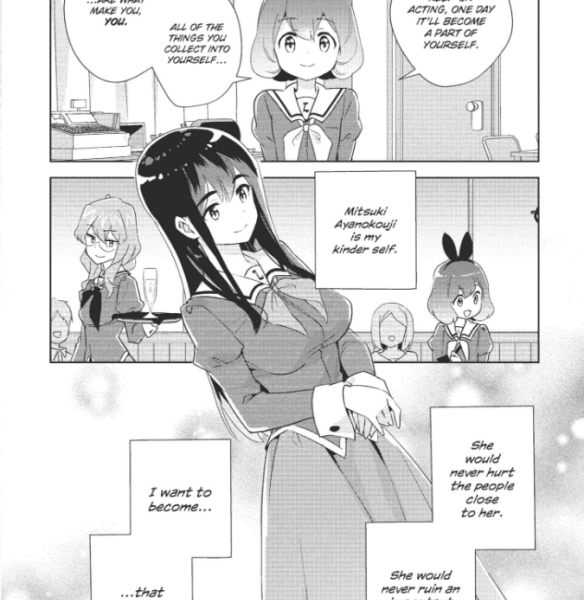
Yuri is My Job!’s fifth volume concluded with a long-awaited emotional revelation. Having found herself distanced and disoriented by Mitsuki’s seemingly contradictory behavior, Hime vented her feelings to Sumika, and thus learned the messy truth: for Mitsuki, the cafe performances are not an assumed, alternate self, but an aspirational one. Mitsuki isn’t just acting nice because that’s what the patrons demand; she is performing kindness and grace and social acumen because she wishes to genuinely embody those qualities, whether on or off the stage. The Mitsuki who exists backstage is actually her private shame; in truth, Mitsuki Ayanokouji is the person she wants to be.
It’s certainly an interesting new wrinkle in this interrogation of sincere versus “artificial” social presentation, one that leans on a truth we all must come to learn in our own ways: that self-improvement is not a single decision, but a practice we commit to. We can actively train ourselves to be kinder, more thoughtful, more productive, or whatever else we want to become – and in embracing that process, we really do have to push back against our natural instincts, discarding “authenticity” in favor of purposeful, habit-forming new scripts.
After five volumes of essentially framing the obfuscation of social performance as a cruel, misleading lie, Sumika’s words complicate the picture, offering a sharp counterpoint to Hime’s gleeful deception. While Hime takes both pride and pleasure in her mastery of social dynamics, Mitsuki wishes only to be understood, and is willing to abandon her own personality if it means she might communicate with the ease others take for granted. “Embrace your honest self” is advice so routine it’s become cliche, but what is authenticity worth if it isolates you from anyone? And indeed, many ferociously antisocial characters will define their cruelty as “honesty” – so where does insincere social convention end, and genuine self-improvement begin?
It’s a nest of questions with no clear answers, demanding a personal approach that takes account of each unique personality, each particular life circumstance, and each aspirational performance. As such, it’s precisely the sort of life-defining quest that can propel a multilayered psychological drama, as in the case of our poor crew at Cafe Liebe.
Our sixth volume’s cover again demonstrates Hime and Mitsuki’s shared intent, each wishing to be close to the other, yet neither willing to meet the other’s eye. How can it be this difficult to communicate their desires, particularly when both of them seem to want precisely the same thing? As each new chapter of this damnable manga demonstrates, we are remarkably good at cloaking what we wish to convey, at misinterpreting what others express, and at wounding each other through the messy interplay of our relative insecurities. Little wonder that people like Mitsuki would rather establish the terms of engagement beforehand, through a clear set of shared assumptions, a cheat sheet for human interaction.
That cover is then complimented by another precious Yano memory, as she recalls Hime saying that she “doesn’t get crushes,” and “has the most fun with you.” A conversation that gestures towards their principle disconnect – how Hime will so frequently offer careless, enthusiastic expressions of intimacy, all of which Mitsuki interpreted as special and meaningful, words whose weight must imply they are intended only for her. Of course, further complicating this situation is the fact that Hime actually does feel that strongly about Mitsuki – but given her history of nurturing the facade, she is now like the boy who cried wolf, unable to convince Mitsuki her words are deeply felt.
We then open the chapter with Sumika reaffirming Mitsuki’s goal, her desire to be a “kinder” self through this performance. It feels somewhat heartbreaking that Mitsuki’s fundamental aspiration for this performance is “kindness” – for she is in truth a very sensitive person, she just often fumbles in her understanding of others’ unspoken desires. Kindness is more about intent than result, but Mitsuki’s results are so frequently negative that she can’t believe in her own desire to be kind.
Fortunately, this conversation at least seems to get it through Hime’s thick skull that Mitsuki wasn’t just playing pretend in her displays of affection at the cafe. She wasn’t trying to fool anyone – she just needed a permission structure for that sort of closeness, a script that allowed her to express the feelings she’d be too nervous or ashamed or afraid of rejection to express back-stage. To those who lack fluency in social engagement, narratives can become a shared language; it’s no surprise that passionate fandom frequently coincides with social awkwardness, because fiction (and the community it provokes in particular) is often a way such people seek to be understood. A certain genre or narrative resonates with their own unspoken feelings – and then, by interacting with fellow enthusiasts of that media, they are inducted into a community that shares an inherent mutual understanding, a combination of shared, intimate passion (this media understands me) and a shared language for expressing it. This is part of why Mitsuki is so frustrated about Hime’s approach to Cafe Liebe – Hime is succeeding in these performances without possessing either that passion for genre or understanding of its unique language, bringing the confusing, alienating world of actual socialization into Mitsuki’s scripted, orderly sanctuary.
Unfortunately, Mitsuki’s defiant outbursts of genuine feeling, bereft of the context of her underlying desperate desire to be close with Hime, tend to sound a whole lot like outright rejection. Between her intentional denial of being close to Hime purely in the context of their cafe performance (an honest yet poorly expressed thought) and her instinctive rejection of affirming her genuine love for Hime (a lie born in fear of being rebuffed), you can’t really blame Hime for being confused by Mitsuki’s behavior. Mitsuki’s desires are in their essence contradictory – she wants a genuine, unmediated closeness with Hime, but she can only express her desire for that closeness through the mediating factor of the stage.
Witnessing all this hushed longing and mutual misunderstanding from the sidelines, Mai decides that enough is enough, and that the unexpected complication of Mitsuki coming down with a cold is actually a perfect opportunity for her “little sister” to check in on her. In this request, she intentionally bleeds together their public and private relationships, hoping to fuse what is earnest and productive about their on-stage personas (like Hime’s eagerness to please) with the genuine emotional weight of their private feelings (expressed through Hime’s willingness to go check on her). Mitsuki’s home is thus framed as both a physical and emotional sanctuary; if Hime can extend their productive performed selves to such a private stage, actually discarding the performance might become all the easier.
The gambit is immediately effective, forcing Hime to both admit to her own feelings (that she genuinely wants to check in on Mitsuki) and consider the fundamentals of what she knows about her friend. Additionally, it also plays into her lofty self-image, reassuring her with the comforting assumption that no one could actually dislike her. Thus, with Kanoko clutching her own totem of their private, personal relationship, Hime heads off to console the beleaguered Mitsuki, still operating under her own warped assumptions regarding the supremacy of her self-image. It sure is easy to justify your feelings when you assume they are a fixed, neutral point, from which any deviation on the part of others is simply a mistake on their part!
As usual, their first exchange is a bit of a disaster. On top of generally seeing herself as a burden, Mitsuki is now contending with the possibility that she might actually get Hime sick, an outcome she’d do anything to prevent. Between that and her general nervousness around Hime, her initial response unsurprisingly comes off as brusque and defensive, as she demands Hime go away in that angry, confused tone she defaults to when stressed. Of course, Hime has no way of knowing that’s what Mitsuki is thinking, and thus she sees this as one more senseless rejection of her earnest feelings. It is only when Mitsuki is finally able to stammer out her concern regarding catching a cold that their perspectives align – a result that requires a great deal of friction and talking at cross purposes, the sort of messy yet vital clarification that Cafe Liebe’s graceful exchanges and implied affection could never articulate
With Mitsuki’s defenses thus lowered, Hime is at last able to recognize her behavior, and frame it in the context of how her friend has always acted. Hime describes Mitsuki as “always saying what’s on her mind, but never saying enough, and not knowing what more she should say” – a fine enough analysis, echoing Mitsuki’s own reflections on a “hidden code” that seems to make someone’s honest feelings more palatable to others. Tragically, the route towards a shared, positive understanding rarely passes through an unvarnished articulation of our private thoughts; our minds are often less generous or harmony-focused than our external personas, and we frankly need that level of conscious mediation to avoid stepping on each other’s toes. With no fluency in that mediation to speak of, Mitsuki must rely on the cafe’s exhortation to smile and act politely in order to cover the gap.
Mitsuki’s fatalism, her inability to believe there is a happy future for her, seems clear in the way she frames their prior friendship. She speaks as if she’s calling back to a distant, unreachable era, an island of comfort that is now forever outside her reach. Of course, her recent experience has given her plenty of valid reasons to believe there is no recovering their prior closeness. Even when Hime agrees with her about valuing their prior closeness, she fires back with an immediate “but you forgot all about those times,” blaming Hime once again for not recognizing her at the salon. Mitsuki immediately recognizes her mistake and apologizes, but sees no way to avoid continuously making such errors, and thus once again attempts to push Hime away rather than risk angering her further. Her greatest hope seems to be “if we don’t interact, at least you won’t dislike me more than you do now” – a severely impoverished wish.
Thankfully, Hime now has enough of a grasp on what Mitsuki wants, what she doesn’t want, and how she tends to falter in conversations to push the point further, abandoning her own façade in pursuit of something real, something genuine. The paneling ably supports her ambitions, presenting the two of them as trapped within separate panels, unable to see each other’s faces until Hime bluntly declares her desire to understand Mitsuki. Not just enough common language to “get along,” not the niceties and cliches that tend to fill the air between our separate realities – she wants an actual bridge, a way to understand and empathize with just what Mitsuki is feeling. Thus at last, Mitsuki arrives at the blunt truth: they’re not kids playing princess games and the piano, and Mitsuki simply doesn’t understand how to connect with her anymore.
Hime’s reply is some classic Hime nonsense, once again framing Mitsuki in her own perspective and assumption of normalcy. She tells Mitsuki first to “just be yourself,” and then to “just be normal,” two things Mitsuki can’t possibly provide. It is easy for those to whom social grace and nicety comes naturally to tell others that the secret is “being yourself” – after all, their version of “themselves” is someone who is liked by everyone. But what do you do if your earnest “self” tends to push people away, and if the idea of “acting normal” requires a script you were never provided? Isn’t it better to say nothing then, rather than risk being known for your strange, antisocial personality? What good is sincerity to those whose sincere feelings would only hurt others?
The alternative Mitsuki chose was to embrace her Cafe Liebe persona all the more fiercely, acting out the “kindly older sister” role as the only way she knew to keep Hime happy – but of course, this only led to more misunderstandings, and ultimately to the rift they are now facing. There’s a real sincere power in Mitsuki’s declaration that “what’s on my mind is even worse. I’ve worked hard all this time so it won’t ruin everything.” Hime claims to want Mitsuki to “be herself,” but she doesn’t really mean that – she just means “why won’t you act nice to me, why aren’t you the person I remember from grade school.” Time has sharpened Mitsuki, and the last thing she’d want is for those sharper edges to hurt Hime again. For the inherently sociable and kind, sincerity is a virtue – for everyone else, it is a tool that must be employed with care, lest you harm those closest to you.
Hime does her best to be accommodating, sympathetically laying out the reasoning for their mutual misunderstandings, as well as her acceptance of what Cafe Liebe’s performance means to Mitsuki. But her ultimate question is just too large and potentially disastrous for Mitsuki to respond to, and so she hedges again, saying she’s “not sure of how to respond” to what from Hime’s perspective seems like a very simple question. Once again, they lack a common language – the simple phrase “do you like me” means profoundly different things to each of them, prompting confusion and fear on Mitsuki’s part, and frustration with Mitsuki’s apparent evasiveness on Hime’s.
Thus Mitsuki at last lets her hidden, ungenerous feelings be articulated. She doesn’t like Kanoko – doesn’t like her closeness to Hime, doesn’t like how Hime relies on her, and especially doesn’t like being compared to her as some kind of compatriot or equal. And she knows those feelings are unfair to Kanoko, and she knows Kanoko is a better person than she gives her credit for, but none of that will change the taste of bile in her throat, the way she feels like choking when Kanoko is close to Hime. We are not saints, not perfect beings with unblemished, stainless desires. We get jealous and bitter and angry, and oftentimes those feelings aren’t a rational, justifiable response to any sort of external stimuli. We are flawed and often hurtful creatures, and in attempting to get close to each other, our hedgehog quills will always pierce each other’s skin.
The fallout is messy, as all true matters of the heart tend to be. Hime obviously can’t relate to Mitsuki’s dislike of Kanoko, and is bitterly unhappy about her feelings of jealousy, but nonetheless does appreciate knowing Mitsuki’s true feelings. The sad fact of it is that misunderstandings alone cannot account for our social disagreements; we all want different things out of life, and many of those things will prove incompatible with the desires of others. So long as we retain our vital, brilliant individuality, we will forever be at odds with even the people we love, flying our own strange flag and hoping we can compromise our way towards something resembling coexistence. Just as no happy ending can outlast a book’s final page, so can no mutual agreement survive full knowledge of each other’s motivations. We are never perfectly fitted to each other, yet we must learn to align whatever pieces we can.
Given the muted response that even this gesture of honesty receives, it’s little surprise that Mitsuki retreats afterwards, certain that she is still destined to hurt Hime. It is still simply easier for Hime to say that honesty is the best policy, because even Hime’s darkest thoughts get no darker than “haha, I’m fooling them all with my charming façade.” Hime is actually proud of her subterfuge, to the point where it directly informed her friendship with Kanoko. In contrast, even Mitsuki’s efforts to be kinder ended up hurting Hime – if that’s the best she can do, then she is right to ask Hime what there is to possibly have faith in.
Fortunately, Hime has one final trump card – her underlying, insistent belief that trying to be kind is the inherent mark of a kind person. We will not always embody our most laudable instincts, and we will often harbor less charitable thoughts than we would like. Nonetheless, it is not strictly our feelings that define us – it is how we choose to execute on them, be that earnest or otherwise. Honesty is great for mutual understanding, but it is not a total, inherent virtue, just as “pretending to be a false self” isn’t an inherent vice. And while some people might find kindness to come naturally to them, one should never be ashamed of trying to be kinder than you’d naturally feel – for just as courage might be considered persistence in the presence of fear, so can kindness be considered charity we impress on ourselves, even as our first instincts urge us to be cruel.
And so Mitsuki, convinced at last by Hime’s intimate reflections on their salon sisterhood, allows herself to feel safe in Hime’s arms. And with a final push by the ever-taunting Hime, she takes a chance on one further indulgence – drawing Hime towards her, she offers a kiss demonstrating the true depth of her “like,” regardless of the consequences.
Whatever the eventual fallout may be, Mitsuki’s brave expression of her true feelings at least lets her briefly do something she hasn’t once managed over this story’s run: just fucking relax for a second. There is a palpable sense of relief in her giggling to herself about her crush, as if it’s a precious secret she’s only just shared with herself. And in truth, that is often how it goes; when it comes to big, consequential matters of identity like this, we often compartmentalize the truth rather than addressing it, setting a mental guardian over our private truth rather than actively living with the cover-up. This tactic can work for a while, but it always creates a strain – and ultimately, there is nothing more fulfilling than setting that truth free, whether it concerns our sexual identity, our romantic feelings, or whatever else we have self-censored into repression.
Mitsuki’s reflections on her feelings for Hime eventually lead her back to her pre-Hime life, when her lack of any clear crush served as yet another form of isolation, another assumed default separating her from the thoughts and feelings of her classmates. It was actually through fairy tale dramas of princes rescuing princesses that she first came to find the idea of romance appealing; as with Cafe Liebe and socialization, it was the fantasy and clarity of fiction that offered her a coherent framework for articulating her feelings. Within these stories, she could cast herself in the role of the princess, certain that she was only waiting for the right prince to arrive.
Ironically, just like with Cafe Liebe, it was also Hime’s introduction to Mitsuki’s class that shattered this fantasy. Just as Hime’s natural charisma allowed her to bypass the strict models of behavior expected of Cafe Liebe, so did her shimmering, buoyant personality put the lie to Mitsuki’s dreams of being a princess. Confronted by this obvious avatar of princess-like virtue, Mitsuki could no longer pretend she herself was a princess waiting to be set free; once again she was merely a gloomy loner, constructing fantastical versions of herself that would never be realized.
Through their friendship, Mitsuki soon came to understand Hime’s many un-princess-like qualities, as well as how her social performance was rooted in her own fear of rejection. Together, the two were each able to enjoy a friendship without reservation, or fear of the crowd’s approval. However, even these early memories offer demonstrations of how their feelings might become misunderstood – as in Mitsuki’s proud declaration of her love for Hime, a statement that clearly meant something different to each of them. That moment serves as an ominous parallel of Mitsuki’s kiss, wherein Mitsuki’s passionate feelings might once again be overstepping Hime’s view of the situation.
Unsurprisingly, Kanoko is the first one to notice Hime’s discomfort the next day, though as usual she avoids prying into Hime’s business. And Hime maintains her usual façade even through the reveal that Mai has actually been healed for some time, brightly agreeing to maintain her role at the salon. The ensuing pages are rife with chipper, superficial smiles, as Miman consistently demonstrates the clear distance between Hime’s practiced affectation and the genuine warmth she once expressed towards her “big sister.” Tensions rise behind false cheer, as increasingly crowded panels present a sense of the cast collapsing in on each other, no longer able to comfortably share the salon floor.
Panel by panel, the disconnect between their feelings grows all the more apparent. As Mitsuki happily reflects on how she can now say she “likes” Hime without prevarication, Hime herself questions her feelings, testing degrees of intimacy as if she were seeking a perfectly sized slipper. But ultimately, the shoe simply cannot fit; however their relationship has changed, it is now incompatible with her carefree performance of a private school princess. With the rest of the staff gathered before her, she smiles and states her case – she is quitting Cafe Liebe.
This article was made possible by reader support. Thank you all for all that you do.