
Hello folks, and welcome back to Wrong Every Time. Today we’re winding towards the conclusion of Monogatari’s Monster Season, as our elite team of investigators work to hunt down the life-draining killer stalking their town. With four exsanguinated basketball players in the hospital, a similarly drained Deathtopia at Mayoi’s shrine, and one body still unaccounted for, the race is on to crack this case before Kagenui arrives and just punches everything to pieces.
While our killer remains elusive, the journey so far has offered plenty of thematically resonant touchstones to sift through, presenting echoes of both Acerola and Araragi’s passage into vampirism. Acerola believed becoming a vampire was the only way she could take account for the lives she stole, pledging that each life taken would be as precious to her as her own flesh was to the gourmet Deathtopia. But in meeting and transforming Araragi, she actually fulfilled her previous wish: to discover someone she could truly save, and thereby redeem her own existence. Each found a vessel for their self-sacrificing instincts in the other, and with the validity of their existence affirmed, they were each able to grow beyond those instincts, and discover the ordinary, fundamental truth that if you keep living, good things will eventually happen.
“Happiness isn’t a race,” Araragi once said, and the wandering passage of himself and Shinobu speak to the truth of those words. Though the journey has been arduous, this arc’s glance back towards their origins demonstrates just how far they’ve come, all the great strides towards happiness they have taken. Whatever mysteries remain, the emotional growth of Araragi and Shinobu has never been more certain. Now let’s get to work!
Episode 12
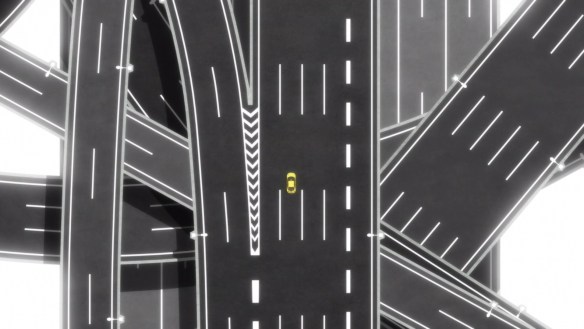
We open with Araragi on the highway again in his goofy little Volkswagen. These forever intersecting roads have essentially become the replacement for the town’s diverse, inscrutable sidewalk signage; either serve perfectly well as a symbol of confusion and uncertain direction, a series of strict, orderly directives that offer no genuine guidance for the characters’ personal journeys
Araragi hesitantly offers a difficult question, asking Shinobu if she actually means to be eaten by Deathtopia
“You’re the one who’s having strange thoughts.” A reflection of their trust that they can so easily discuss such weighty personal considerations
Deathtopia’s “Suicide-Master” title is certainly a charged phrase in this franchise. While Deathtopia seems to have adopted it as a cheeky reference to their ability to survive after death, Monogatari is brimming with characters who’ve had to honestly grapple with the idea that their life is too painful to be worth continuing, or that the world would be better off without their presence. Monogatari treats suicide with the seriousness it often assumes to those with suicidal tendencies: as a specter that is always lurking, a consideration that can become genuinely familiar, even comforting in its day-to-day presence. If you can’t banish your suicidal thoughts, you find a way to live with them, and can even address them with a casualness that would seem exceedingly strange to those who don’t live with similar ghosts
“An acknowledgment that you’re harmless is nothing but an insult to a true vampire.” Deathtopia’s pride seems a common trait of original vampires
Shinobu has one request: that Araragi play the part of servant tonight, so that Shinobu can impress her old friend. She is not unhappy with who she is right now, but she’d still like to be regarded as a gallant vampire by Deathtopia – a funny thing, how we take pride in and seek to preserve old versions of ourselves. We are mutable, and it is healthy to embrace that mutability, to love ourselves for every step in the process of self-definition – pretty much the exact point of Nadeko’s last arc
“Kanbaru, I’m sorry, but can you be my slave for a bit? And lend me your house for the night.” “Got it.” Goddamnit Araragi, goddamnit Kanbaru
Monogatari depicts a wide variety of distinct relationship types, and I’d say Araragi and Kanbaru have the distinction of being the series’ quintessential “bros”
Araragi’s decoder translates our second clue to “F/C”
Apparently the key to deciphering this one was realizing the “0” at the end of each number was actually referring to the degree symbol used for temperatures, thus resolving the puzzle to Celsius and Fahrenheit. Again, I will have to take Isin’s word for it that this was a theoretically coherent, solvable puzzle, as that insight still feels like a leap in logic too groundless for me to possibly have confidence in. I feel like generally, puzzles have to exist within more clearly defined rule sets to have single definite answers – but as I’ll readily admit, my brain simply does not work in whatever way is necessary to see any of these deductions as logical rather than convenient yet improbable
For instance, why does the puzzle end there? Why is it clear the final result is those two letters representing fahrenheit and celsius, rather than some secondary process you must apply to the numbers once you recognize they represent temperatures? And why would you reduce those two words to “F” and “C” in the first place, if you have no reason to suspect the solution will take any specific given shape? Such riddles always feel to me like test questions where the phrasing is unclear, such that any number of solutions technically meet the question’s requirements
“After seeing such a murky set of relationships, I’m not scared of vampires at all.” Gaen has discovered another subtle Monogatari theme: monsters aren’t nearly as scary as high school girls
Another fun use of live action photography here, projecting shadowy outlines of outstretched arms to represent the basketball team
Gaen posits that Deathtopia might have collapsed while attempting to reach Mayoi. But if so, who buried her?
Nonetheless, the strongest possibility remains that Deathtopia is responsible
And apparently Kagenui has a bit of a history with Deathtopia besides. Though she was initially characterized by her stubborn, unwavering dedication to the official rules regarding oddities, it turns out she too will pick a desired outcome and then massage the rules to support it
Araragi wonders if “F/C” refers to Kanbaru’s prior Fan Club, a theory supported by the similarly Kanbaru-style haircuts of all the victims so far. Feel like there’s an odd parallel forming here between Kanbaru and Acerola; both of them shine too brightly, sapping the vitality from everything around them
We thus meet up with Karen, our resident Kanbaru Fan Club expert
“Fans easily fall in and out of love.” The adoration of the crowd is fierce but superficial
Apparently Tsukihi is carrying on the Fire Sisters legacy as “Moonfire,” an almost too-obvious alias given her actual name
Araragi’s main question is basically “how did your own community adjust when its centerpiece departed,” again echoing the positions of Kanbaru and Acerola
He reflects again on how Kanbaru’s attitude makes sense for her, but can turn toxic when applied to the overall basketball club. She worked hard in spite of limited natural talent, making her assume that “anyone can do what I can do if they put in the work” – a reasonable philosophy as a humble individual, but a smothering expectation to assign to the whole team. Again, as with how Acerola’s beauty robbed others of meaning in their life, so did Kanbaru’s excellence undercut the pride others could take in their athletic efforts. Seemingly effortless greatness is a curse to those who are not similarly blessed
Gaen’s investigations clear all the basketball students of suspicion of vampirism, meaning Deathtopia is once again their only suspect
Nice shift in color design once they move to Kanbaru’s house. With Kanbaru herself absent, the house is captured in sterile white and blue, the austerity of the house’s garden only clear once the girl who considers it familiar and reassuring isn’t present
Gaen taking the stage is accompanied by a flood of multicolored stagelights, her rainbow clouds accompanying her wherever she goes
Charmed by Araragi immediately leaning into Shinobu’s request, unhesitatingly referring to her as “Master” even though she actually forgot about that conversation
“Speak normally. I have no idea what you’re talking about.” Unsurprisingly, Shinobu immediately tires of this laborious bit
Reflecting on how much he has changed over the past year, Araragi wonders what it could possibly be like to live for six hundred years. Even at this point, the Araragi that earnestly stated he had no desire to make friends feels like a stranger to him
“I’ve severed one past after another if I couldn’t remember it.” Araragi’s question makes sense for his position, because he is at a uniquely tumultuous point in his life. Adolescents moving beyond high school naturally undergo dramatic personal transformations, as their preexisting identities are basically masks of social performance papered over the remaining instincts of their unreflective childhood selves. Araragi’s current perspective is heavily colored by this process – rather than believing he will always feel as he currently does, he believes he might always be changing with similar rapidity, because change itself has defined his recent experience. But for better or for worse, this process doesn’t really replicate with anywhere near the same speed or significance throughout stable adulthood; we can and should make efforts to adjust and improve ourselves throughout our lives, but we will rarely experience a “second adolescence” as tumultuous as that first transition period. Araragi is too young to grasp a truth Shinobu has long come to peace with: that adulthood is marked by long periods of personal psychological stability, and that we at a certain point must seek peace with ourselves
Shinobu frames this stability as a natural quality of apparitions, but we know well that apparitions aren’t truly much different from human beings. Shinobu, Mayoi, Yotsugi, and Ougi have all changed significantly over the course of this narrative
“Shinobu… what are humans to you?” Of course, Shinobu’s answer naturally raises an awkward question, as to whether Araragi himself is another eventual past to be severed
In her previous incarnation, the answer was simply “food.” Even if the answer is something different now, if we are all this changeable, can he really trust in the endurance of their bond?
And Shinobu rightfully scowls at this, at being distrusted after all this time
Deathtopia awakens, and immediately commences a haughty Laugh Off with Shinobu
And Done
Whew, we’re really at the boiling point now! With this icon of Acerola’s past self reincarnated before him, Araragi seemingly can’t help but tease at the foundations of their relationship, wondering how significant their year of cohabitation could truly feel to a being who’s lived for six hundred years. For Araragi, the journey of Monogatari has essentially been the story of his self-awakening, a tumultuous sequence of personal discoveries that have instilled in him a belief that change is the only constant in life. But has Shinobu actually been accompanying him on that journey, or was she merely a passenger, briefly sharing his trials before flitting off into the night, incapable of truly relating to a human’s struggles? These are uncharitable doubts, but natural ones – and through addressing them at last, I have no doubt they will emerge stronger for it.
This article was made possible by reader support. Thank you all for all that you do.