Hello folks, and welcome the fuck back to Wrong Every Time. Today we’re returning to Rock is a Lady’s Modesty in the wake of our group’s first full band performance, wherein they rocked the faces off Bitter Ganache at an unsuspecting local club. Though the performance started out rocky for both Tina and Lilisa, Otoha’s support was able to drive both of them to glory, as she first threw a lifeline to Tina, and then aggravated Lilisa into her triumphantly selfish true form.
Their performance proved one of the show’s most compelling visual spectacles so far, drawing on the charged imagery of imprisonment, flowers, and leather-bound combat to illustrate our leads rising above their anxieties, and demonstrating their urge for both undiluted self-expression and earnest personal connection through their sound. Their band is not a happy family; they are a vicious nest of rivals, all intent on outshining each other while glorifying their own sound. Also, Tina is there.
Considering my misgivings regarding this show’s characterization of musical rebellion, I suppose it’s no surprise that Tina’s arrival has been a great relief to me. Tina’s lack of technical expertise forces the other band members to play at her pace, to moderate, to share; her inability to keep up demands solidarity from the others, and I was delighted to see Otoha taking the lead in doing so. Now let’s rub this win in Bitter Ganache’s stupid faces!
Episode 10
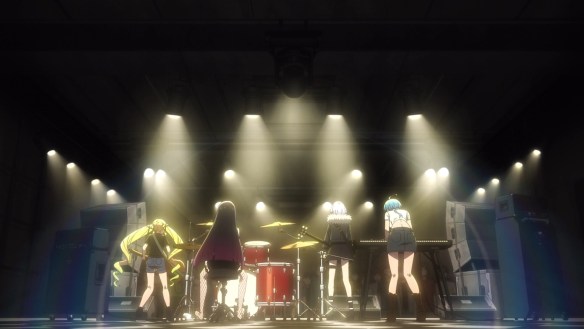
We return just where we left off, panning down on the back of our band as they hunch, exhausted, over their instruments. The framing of a stage performance can considerably affect its impact; shots from far out in the audience emphasize the response of the crowd, shots from overhead or close up tend to prioritize the bond between the musicians themselves, and a shot like this, from far behind with the crowd indistinct and stage lights blinding, really hammers in the physical exertion of performance, the isolation and heat under those heavy lights
Two guys by the bar notice the apparent revival of the dancing flower. Feels like an odd amount of emphasis to put on this gag, which makes me think it was actually a panel-corner aside in the manga. One of manga’s unique structural faculties as an art form is its ability to essentially make in-manga “footnotes,” like reactions from secondary characters in the corner of an unrelated panel
The audience don’t really know how to react to this onslaught of instrumental sound; they’re awed, but they’re not necessarily moved, at least in a way they’re accustomed to. The consequences of not playing to your audience
But Bitter Ganache’s leader is impressed. This is the tradeoff you have to make – do you design your sound for greatest mass appeal, or do you embrace only appealing to the scattered weirdos who resonate with the true sound of your heart?
Personally, it never felt like a particularly tough question to me; achieving genuine financial stability through music is basically an impossibility, so you might as well play music that makes you happy
Tina unsurprisingly blames herself for the lack of audience response. But the truth of it is, Bitter Ganache is right; most people who are at a club casually are there to hear one kind of music, and are not going to suddenly have their tastes rewired by an exceptional rendition of a style they’re simply not into. And that’s not anyone’s fault! Musical taste is highly personal, and expanding your sonic palette tends to be a gradual process
Meanwhile, Shiro has to admit that she enjoyed being caught up in Lilisa’s sound – though of course, she keeps this revelation to herself
Bitter Ganache’s leader offers some appropriately bitter-tasting advice: “if you wanna hack it as a band, you gotta cater to the audience more”
But of course, Lilisa and Otoha are already verbally hate-fucking about their performance, without a care for what the audience thinks. Quite a pair, those two
“They butt heads with each other so intensely, both on and off the stage…” Shiro realizes she can’t really match what Lilisa means to Otoha. For once, I’m with Shiro; I simply cannot relate to the desire for an adversarial partnership whatsoever. Someone who pushes you to be better, yes, but someone who does it largely through insulting rants? That just sounds toxic as hell
I suppose that’s one manifestation of a larger disconnect between me and the author; they’re clearly seeking to express a need for authenticity and individuality in a constrained, propriety-obsessed social climate, but their desired result seems to go no further than “the right to do and say whatever I want”
Our leads then “invite” Shiro into the discussion, by ranting about the deficiencies of her bass playing. Stuff like this wouldn’t provoke me to play better; it would just convince me the speakers aren’t worth my time or attention
“You want her so bad you’d stop her from playing the instrument she wants to play?” Bitter Ganache’s bassist demonstrates her own form of musician’s honor; they may be cutthroat in their determination to break big, but they’re still not going to force a fellow musician to deny their passion
They ultimately resolve to find a guitarist who resonates with their own style of rock. I’m glad they’re not defining Bitter Ganache as inherently inauthentic or “compromised” in some way, just incompatible with Shiro’s goals. Anyone who’s been touring local clubs for years has clearly put in their dues
Otoha responds to Shiro’s “you knew how this would end” with a soft smile. It really does seem that, at least in this show’s perception, even their ranting is a form of bonding. Otoha transitioning so seamlessly between her two affectations seems to imply they are equally true and sincere to her
Shiro acknowledging Lilisa is unsurprisingly captured in reflection, through a pair of mirrors centered on herself and Otoha. A seemingly deliberate choice; their true selves are communicating, but still separated, still at a safe distance
“You want a partner you can truly go all-out with, even to the point of trading insults.” I suppose there is something to be said for that. Even with the people we’re closest to, we moderate our statements, speaking kindly rather than speaking with absolute frankness. For her partner, Otoha wants to discard even that level of dishonesty, to truly bare her feelings in all their jagged ugliness. I can respect that!
Shiro admits she is an actual masochist, to which Otoha appears genuinely stunned for the first time in the series
Alice yanks Lilisa aside the next morning, chastising her for not being invited to what was clearly some rock-related business
“Just remembering it pisses me off.” I frankly appreciate that their first live show wasn’t actually successful. There is little reason to expect any given audience to immediately fall in love with a new, unknown band; even openers for touring groups, who are generally chosen specifically because they have a complimentary sound, expect to be largely ignored by audiences checking their phones or talking with their friends. You really need to be self-motivated to keep playing music, to play for your own sake even without hope of an external reward, and exploring the distance between your expectations and the audience’s reaction is a meaty, true-to-life vein of drama
Lilisa is encouraged to hear Otoha was dozing off as well. This feels like a productive vein as well: Otoha slowly revealing to Lilisa how there is still room for authentic self-expression within the confines of proper ladydom. After all, the ultimate goal here is presumably some synthesis of her contrasting selves
Tina is of course in the equestrian club, as befitting a noble prince
Lilisa’s clubmates gossip about their imminent shared ceremony with the Kuroyuri girls, whose president will undoubtedly be Shiro herself
With her white hair and light blue kimono, Shiro looks much like the classic Yuki-onna, an ambiguous yokai spirit
Very much appreciate getting some texture for Shiro here, as she laments laying her soul bare in front of Otoha, and reflects on a lifetime of being treasured as a precious doll. For her, being earnestly challenged by a like-minded soul is the rarest and most precious thing
“Both of them are rich girls, but…” Another crack in the wall separating her two identities
As Lilisa reflects on the fun she had playing with Tina and Shiro, we see her captured through first the water of the fountain, and then the glass of the greenhouse. The visual vocabulary of revealing the “true self,” here used to emphasize how Lilisa is coming to understand herself better
“Our band really makes no sense.” A definitive phrasing underlining how she has already accepted them as members of her band
And Done
Thus our band is officially established! There’s really no substitute for testing your on-stage chemistry, and it’s clear that all of them were profoundly inspired by their collective performance. This episode did a solid job of addressing two points of friction I’ve felt in the show so far: Shiro’s one-note antagonism and the dubious “authenticity” of Otoha and Lilisa’s screaming matches. We got some crucial insight into Shiro’s feelings that clarified both her general emotional distance and her particular attachment to Otoha, while her reflections on the Otoha-Lilisa bond went some distance to framing their antagonism as a genuine form of emotional sincerity, an invitation to share your raw, ungenerous thoughts with someone you know is willing to fire back with their own. I’ll probably never fully understand it, but I’m glad the two of them have found each other!
This article was made possible by reader support. Thank you all for all that you do.