
Hello folks, and welcome back to Wrong Every Time. Summer’s passing us by with alarming speed, but I’m doing my best to make the most of it, having recently discovered some excellent new jogging routes around my neighborhood. It’s been a bitter pill to swallow that diet and exercise are indeed the truest routes to physical and mental health, but I’m at least working to complement such disappointingly mature revelations with plenty of cartoons and videogames. As far as that goes, I recently screened the excellent Gunsmith Cats OVA series, and have also been bashing my head against Mina the Hollower for a couple of weeks now. The game is clearly made with love, but it often feels like the developers take their love of “old-school design sensibilities” to a self-defeating extreme; I like many hard games, but I have no patience for obtuse design as a shortcut to difficulty, and I feel like Mina too often strays over that line. And of course, there have been plenty of our regular movie screenings, so let’s get started on the week in review!
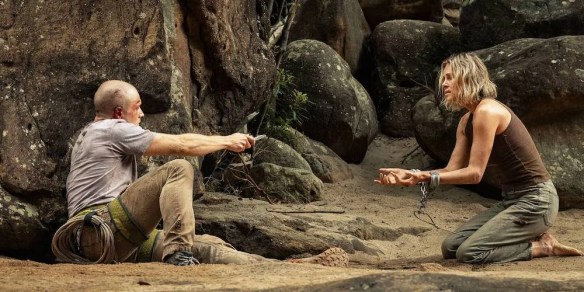
First up this week was the recent Netflix thriller Apex, starring Charlize Theron as a thrill-seeking mountain climber grieving the loss of her husband, who died during a treacherous climb five months back. Heading out to the wilds of Australia, she attempts to find closure via kayaking, only to find herself hunted by a local with a penchant for Most Dangerous Game-style diversion.
Apex is undoubtedly a lesser entry in Theron’s impressive action renaissance, finding moderate diversion in her faceoff with a crossbow-wielding lunatic. The film is a fairly paint-by-numbers articulation of its classic thriller premise, to the point where you can easily identify which aspects of the opening’s tragedy will be revisited for its dramatic conclusion. That said, a strong contrast of leads can get you pretty far in a cat-and-mouse narrative, and Apex varies up its style of challenge and manner of intellectual contest between its leads to keep things from ever getting boring, while Taron Egerton holds up his end of the drama as a fraying yet compelling creature of the wilds. CG is also overused to the point of undercutting any threat or friction within the more Charlize-versus-nature segments of the film, but our lead herself proves capable once again of finding a human being within a genre shell. Nothing spectacular, but an easy afternoon movie.
I then headed out to the theater to see Christopher Nolan’s take on The Odyssey. Combining Homer’s ancient story with portions of The Iliad and other related tales, the film charts Ithacan king Odysseus’ voyage from the Trojan war back home, as he encounters all manner of hostile forces and faces off against the gods themselves. Meanwhile, his wife Penelope and son Telemachus manage the tempestuous home front, as hungry suitors vie for Odysseus’ empty throne.
Expectations were certainly high for Nolan’s post-Oppenheimer debut as a simultaneously crowd-pleasing and Oscar-winning director, so I suppose it was only right that he tackle one of the greatest literary tales lacking an exemplary film adaptation (no, I’m not counting the Kirk Douglas one). And I suppose we really shouldn’t have worried; in The Odyssey, our boy accomplishes the impressive feat of making one of humanity’s oldest tales feel new again, through a combination of tuning its emotional shifts towards a consistently elegiac, overwhelming register and restructuring its narrative to accommodate his own persistent fascinations.
The film’s aesthetic merits are diverse and numerous; though there are no direct appearances by the gods beyond Athena’s accusatory vigil, their presence is felt at practically all times, clear in the wind and rain and foul fortune layered upon Odysseus and his men. In Nolan’s hands, what previous directors have framed as a heroic struggle or thrilling adventure is recast as a hard-earned journey into hell, with each island sighted promising inexplicable new terrors.
This is absolutely the closest Nolan has come to directing an outright horror film; sequences like the cyclops’ cave or Cerse’s house are lent fresh vitality through their focus on scale, darkness, and body horror, offering that same sense of restored wonder implied by the original Superman’s “you will believe a man can fly” tagline. His adjustments to the material, even on the micro level, are exceedingly well-chosen – we’re all fans of Odysseus tricking the cyclops into believing “Nobody” pierced his eye, but reframing the cyclops as an almost unknowable terror murmuring about the wrath of Poseidon does far more to support this version’s core thrust, further emphasizing Odysseus as a man out of his depth, driven by petty grievances for which his men must pay the price.
Such shifts are of a piece with this film’s most critical revision: sapping Odysseus of any heroic vitality or whimsy, and emphasizing his journey as a trial for the sin of corrupting civilization, of breaking the fundamental pact of mankind, and returning us to an era of distrust and terror. The film’s application of the Trojan horse and death of Sinon to this effort is masterful; just like Oppenheimer’s bomb or Bruce Wayne’s surveillance network, Odysseus’ “clever trick” is framed as the choice that casts him beyond the pale, that sacrifices an entire civilization for the sake of one hollow victory.
Nolan has been revisiting and revising his position on the “great men” of history all through his career; it’s his core, abiding obsession, and in The Odyssey, he at last reaches the point of fully condemning such men for their hideous greatness, seeing madness in their ambition and tragedy in those cast to the wayside on their climb. Agamemnon is a monster who earns his rightful fate, and Odysseus only achieves a fragment of solace by letting go, by accepting he is not the master of the universe, and acknowledging there are forces beyond his control. Thus, while the film does include that brutal battle against the suitors of Penelope, its true climax comes just before, when Odysseus at last rises from his lotus-borne stupor and acknowledges his culpability as the architect of Troy’s ruin – a plan that should have never come to fruition, an idea too poisonous to be let out into the world. After a career spent making hit after crowd-pleasing hit, it feels odd to consider Nolan a director who’s still “on the rise” in any significant way. But The Odyssey does indeed feel like the answer to a question he’s always been asking – and perhaps a sign that, more than ever before, he has truly arrived.
Our next screening was The Killer Shrews, a ‘59 scifi horror film set in a remote island compound. Captain Sherman (James Best) arrives at the compound bearing its regular supplies, and learns from scientist Marlowe Craigis (Baruch Lumet) that the island has become a testing ground for his experiments with shrews. Furthermore, it turns out some of those shrews have escaped, grown gigantic, and are now threatening all life on the island – as such, island tours are cancelled effective immediately, and anyone who survives the night is instructed to leave at first opportunity.
The Killer Shrews locks half a dozen victims in an adobe cabin, surrounds them with an army of feral monsters, and lets nature take its course. The real stars here are the charmingly designed puppet shrews (alongside the squadron of dogs the team outfitted with scraggly shrew costumes), but The Killer Shrews offers an effective potboiler in all regards, playing out much like your classic zombie holdout feature. A reasonable cast of characters, a coherently gamified horror challenge, and some endearing practical monsters; as far as drive-in theater ephemera goes, you could do a heck of a lot worse.
As mentioned at the top, I also supplemented this week’s film screenings with the three-part Gunsmith Cats OVA, which follows the gunseller-slash-mercenary pair of Rally and May as they are both harassed and conscripted by the ATF over the course of a rambling gun-running investigation. The quasi-film (it’s composed of three twenty-five minute episodes that add up to one roughly film-length narrative) is blessed with punchy, inviting art design and copious animation of both the mechanical and character-focused varieties, rambling from shootout to car chase to explosions and back again, while letting off the gas just enough to let the relationships between our leads Rally, May, and their ATF contact Bill shine.
The OVA’s attention to detail is greatly appreciated; details of gun and car design, along with the many flourishes of Chicago scene-setting, make for a production that feels grounded in its distinctive yet nostalgic world, carrying on the legacy of features like Bullitt and The French Connection while adding its own irreverent, more Hong Kong action-reminiscent spice. Exceedingly likable characters, beautiful art design, and a pulse-pounding story dotted with bombastic action highlights – Gunsmith Cats is pretty much a gem in all regards, a perfect realization of exactly the crowd-pleasing kind of story it wants to be.