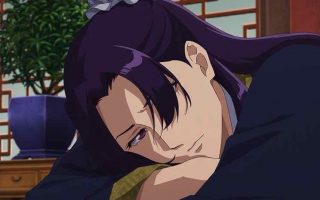
Hello folks, and welcome back to Wrong Every Time. Today I think I’m feeling emotionally secure enough to weather another stab directly in the heart, meaning it’s obviously time to revisit the sumptuous melancholy of Journal With Witch. Asa’s journey through grief has so far been articulated with precision and compassion, as her reflections on surviving the intolerable are balanced against Makio’s struggles with merely surviving. You never really “figure it out” as a human being, never get handed a rulebook that makes sense of our unfulfilled longings and daily tragedies. You just keep living, one day after another, while making sure to offer whatever kindness you can spare to the companions who make that march tolerable.
Our last episode offered a fine contrast of two such companions, as Asa’s feelings of betrayal towards her friend Emiri were assuaged through Makio’s reflections on her long-time friend Daigo. Makio’s assertion that “fighting is reserved for outgoing people” could be taken in two equally appropriate ways – either emphasizing how Makio lacks the social batteries to engage in such exhausting theater, or how the solitude of the introvert means that every single relationship is that much more precious, and worth more than the fleeting vindication of indulging your anger. The future seems endless from a teenager’s eyes, but in truth, we don’t actually get that many second chances in this life – and for particularly precious treasures like “friends who knew you before you were you,” one chance is often all you have. It’s a tough world out there; we must do all we can to make sure we face it together.
Episode 4
“Cower.” Our episode titles are rarely gentle, more often as precise and unsparing as Makio’s words
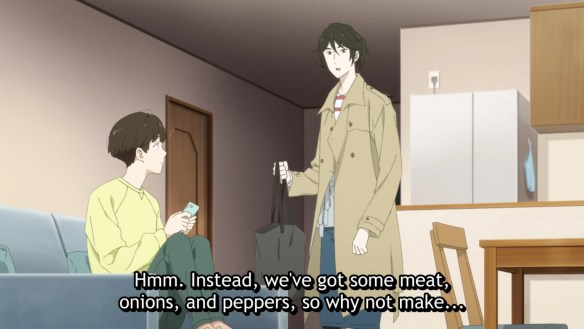
“I’ll message you the recipe!” Makio has clearly settled into the habit of having her own personal chef. A funny, sorta sideways form of growth – she’s starting to appreciate eating better, but only because she’s managed to sidestep the need to actually cook for herself
It seems that Makio is heading out to get drinks with Daigo and two other friends, making good on her advice regarding maintaining the friendships you treasure. It becomes more and more of an intentional practice as the years pass by; I remember being in pretty much constant contact with my social circle from adolescence through my early twenties, but since then it’s been a perpetual job of negotiating schedules and making sure to catch people when they pass through town
The psychology of it has changed as well, for whatever reason. I used to be the one who actually organized get-togethers, but these days I have to be dragged out to events, and actively think about maintaining friendships in terms of Persona “gotta maintain your social links” terminology
Makio’s friends maintain this production’s understated yet excellent approach to character designs, each with distinct degrees of angularity and softness in their unique features
“Having someone around constantly is enough to wear me out.” Stop skewering me like this, Makio
Makio says she and Asa are “barely related,” an odd phrasing given they’re actually quite closely related, but perfectly understandable considering how Makio sees her sister as an implacable barricade. Anyone separated from her by her sister’s presence will inherently feel like a distant relative
“I cower at the thought of her being that woman’s child.” “You mean you can’t love her?” Always thrilled by this show’s willingness to dive into the unpleasant messiness of our genuine feelings. It is in no way Asa’s fault that Makio sees her own sister when looking at her, but that doesn’t make the pain and frustration of being constantly reminded of your failings any less acute
“Can you believe we even made it to adulthood?” So apparently all four of them were high school friends
Makio’s words about long-term friendships resonate again as we flip between their current and adolescent visages. It’s nice to have companions with whom you can say “my god, we made it”
Asa then meets Shingo Kasamachi. I like the little detail of his carelessly unbuttoned sweater
Asa immediately clocks Kasamachi as more mature than Makio, and then assumes they must be dating. An assumption that emphasizes how almost everything is still in the present for her; “past lovers” is a less immediate consideration than this guess. Also reflects how little Makio has apparently shared about herself with Asa
While Makio immediately flees this awkward social encounter by going to get milk, Asa jumps to her first question without hesitation
“We were friends before that and have been since. But who knows? Our feelings may change tomorrow.” On a long enough timeframe, the idea of “true” or “destined” love proves itself an empty fantasy. We don’t find love – we build it, constructing it from shared experiences and compromises and moments of honest trust. And it can ebb and rise, but no such changes make it any less real
Their breakup is clearly a sore spot for Kasamachi, who seems to still hold out for reconciliation. “Adults are much more sensitive than you youngsters might think”
Kasamachi plays the classic adult trick of endearing a child to you by “letting them in on a secret.” And it works perfectly, all the more convincing Asa of how adult he is. I presume Makio engages in no such flattering tricks, given how she tends to always speak her mind
“What are you supposed to put in bento boxes, anyway?” They’re pricey and generally intended for adolescents, putting them well outside Makio’s recent experience
“Raising a kid and loving them were two separate concepts, in my parents’ case.” We do the best we can to rise above the mistakes that made us, and carry on whatever useful lessons we might draw from our own parents’ failures
Oof, tough moment. Kasamachi calls out Asa for calling Makio “Makio-chan,” which seems like a particularly soft term of endearment for the icy Makio. But then Asa reveals that this nickname isn’t her own fond invention, but actually inherited from her mother, who Makio would naturally assume chose it to belittle her, to frame her as a perpetual child. Just another way her sister’s presence is poisoning her relationship with Asa
We again flash back to that scene where Makio’s sister laughed at her ambitions. Moments like that never leave you; I certainly bear my own collection of bitter crystalized moments, and carry on one of my father’s that he once shared with me. Sometimes spite really is the fuel you need
And once again, Asa swiftly makes friends with one of Makio’s few treasured companions
Thus the days pass swiftly by, until Asa at last reaches her first day of high school
Makio still can’t understand how Asa is so cavalier about leaving her journal open. Makio projecting, of course – she is full of so many uncharitable private thoughts that she can’t imagine not caring if others read them
Emiri’s mother is surprised that Makio isn’t at Asa’s entrance ceremony. As close as she presumably is to her own daughter, she can’t imagine the comfortable independence Asa is developing
Odd rituals of meeting and parting, as Asa runs into an old middle school acquaintance, someone who presumably is only connected to her because they attended the same school. Is that itself worth something?
She then meets two new faces, Asuka Sone and Yumi Kanda, along with a huge boy named Yuto Togo
Their class rep is Chiyo Morimoto, a girl who bears a powerful resemblance to Makio
Incredibly smooth introduction by Asa into this group of classmates, as she lightly mentions her parents’ death before framing her current circumstances as a quiet victory of independence. It would be easy for her situation to distance her from her peers as it did in middle school, so she’s presumably trying to get ahead of the issue by presenting a collected, entirely non-tragic front
And yet, the very fact that the conversation moves on so smoothly only makes her feel all the more isolated. She wanted to act like she’s past her grief, but that only brought it back to the front of her mind
As a result, when Makio lacks much of a reaction to her story, she immediately superimposes the “motherly” responses she would have expected from her own mother. Washing her hands in the bathroom, the running water takes the role of the tears that won’t come
“Standing out for real takes a lot of work.” Makio doesn’t make immediate gut responses – she listens, considers, and then eventually says her piece
“I didn’t expect you to like people who stand out.” “Are you kidding? I’m a novelist! I make my living writing out my fantasies and publishing them to the world.” You definitely need a certain kind of ego to believe your thoughts are worth paying money for. I don’t really see any point in insincerely apologizing for that at this point!
Makio suggests joining a band, to which Asa replies that her mother never liked them. Makio’s challenge of “but she’s not here anymore” once again sends Asa to the desert – her mother remains an implacable wall between them, Makio shutting down her inquiries about their falling out with a firm “I’ll never tell you that”
Putting aside Makio’s still-burning insecurity regarding her sister’s judgment, it still seems like an impossible conversation – how can you tell your sister’s daughter why you despised her mother?
We then jump to Emiri’s unexpected arrival at Makio’s apartment. An invader!
The girls’ mocking renditions of their own parents’ reactions to guests only further needle Makio’s anxieties regarding being a “failed adult”
Makio stands dissociating by the kettle, suddenly a stranger in her own noisy, unwelcoming home
She firmly denies Emiri’s question of a favorite snack to tell her mother about. Alongside her general antisocial tendencies, this also feels like a rejection of the idea that the two of them are equivalent – or more fundamentally, that Makio is now Asa’s parent. The idea of being a “guardian” seems less threatening, less life-changing, less permanent
And so she reestablishes her separate world, closing the door on her study, and once more using the general boundaries of this apartment as a partition between their lives
Emiri at last leaves when presented with a new, unfamiliar facet of Asa – her post-crash tendency to fall into deep sleep, a quality that’s quite familiar to Makio. One of the few things that connects them specifically
Once again, the layouts emphasize the distance between them, whether through this profile panning shot highlighting the wall between them, or the subsequent racking focus shot that presents Makio as enshrined in darkness, cut off from the light of Asa’s meal
Having both weirded out her friend with her new behavior and scared off Makio as well, Asa likely feels more alone than ever. She curls up and sobs on the couch
And Makio attempts to connect, in her own blunt Makio way. The truth of it is that being around people exhausts her, and she knows that will make her insensitive at times. “Just like you can’t understand the suffocation I feel, I can’t understand your loneliness.”
God, this continues to be the most “I am in this picture and don’t like it” show imaginable. As I said, I often have to push myself to maintain personal bonds – I am generally perfectly fine being alone, and find being around others exhausting, even if they’re people I deeply care about. And that of course leads to misunderstandings and painful misinterpretations, as people assume I am reacting out of dislike or malice instead of simply being hamstrung by my own bad brain
“If I made you feel neglected, I apologize.” All you can do is work to make your intentions clear, and emphasize that you truly do care, even if your actions don’t seem coded to imply that
“If you ever want to talk, we’ll talk then and there.” “Are you sure? Even though you’re not my parent? Even though you don’t love me?” “My hope is that you live a healthy life free of despair. I feel that way because I think fondly of you.” Makio won’t lie, but she’ll use the tools she has to make Asa’s life as comfortable as possible
They cannot truly share their feelings, but they can at least offer the comfort of their shared presence. “Water from an oasis may sooth, but it will not become one with the body”
And Done
Whew, what a relentlessly scouring show this is! Like Makio herself, Journal with Witch pulls no punches in its interrogation of our human foibles, presenting both Asa’s loneliness and Makio’s inability to relate to it with such unflinching clarity that it seems to become its own form of sympathy, a dedication to honoring the truth of our fractious human interactions and inevitable points of misunderstanding. This was clearly an exhausting episode for Asa in particular, who was forced through both the gauntlet of her entrance ceremony and the awkwardness of Emiri’s visit to confront the ways she is now irreparably separated from her peers, yet also not truly integrated into Makio’s life. That of course made the loneliness of her absent parents strike all the more acutely, leaving Makio ill-equipped to handle this more frank, immediate demonstration of longing for the sister she hated. And god, Makio! Her description of how she relates to others pretty much skewered me entirely, articulating not just that initial sense of discomfort in the presence of others, but also how such a psychology ends up warping and withering even treasured relationships. It’s all a struggle, but if we can’t be there for each other, then the desert will take us all. Keep fighting, you two.
This article was made possible by reader support. Thank you all for all that you do.