
Hello folks, and welcome back to Wrong Every Time. We have sadly reached the end of the summer months, which in New England terms means I’m now in for two months of damp leaves followed by six months of merciless winter chill. Still, I’m determined to keep my heroic, eminently praise-worthy jogging routine going, so I’m currently in the process of mustering up the energy to A: find a local gym, B: acquire membership to said gym, and C: actually make use of aforementioned membership. I generally stall out somewhere between steps A and B, but I’m feeling good about this year, and will at the very least keep jogging outside so long as the frosts permit.
In other news, I’m now three quarters of the way through Galaxy Express 999, and have also munched through the majority of the recent Critical Role-associated superhero game Dispatch. Aside from sometimes falling into that unfortunate “Mom’s not home, we can say swears” tone common to too-online narratives, the game’s proven a charming found family story, stapled to a mechanical system that calls to mind Yakuza’s cabaret minigames. I frankly would have picked up the game much earlier if it was pitched with the cabaret stuff; hearing some familiar voices is nice, but man, that minigame is a top-notch time waster. And of course, there were also film screenings aplenty, so let’s get on with the Week in Review!
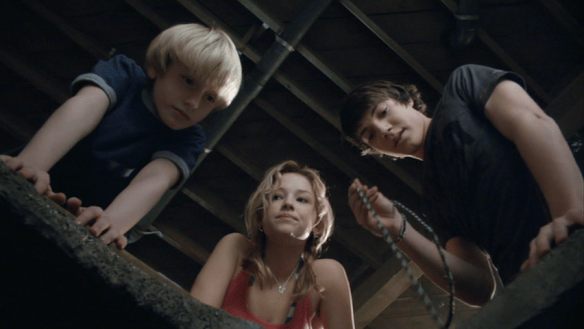
First up this week was The Hole, an ‘09 fantasy-horror feature by Joe Dante. Upon moving into a mysterious new home, two brothers discover a trap door in the basement that opens onto an apparently bottomless hole. After rigorous experimentation reveals there’s no safe way in, strange appearances around their home prove there is definitely a way out, as creatures from the brothers’ darkest nightmares begin to creep into their lives, eager to draw the boys back into their private darkness.
The first two-thirds of The Hole offer little indication that it comes from the director of Gremlins and The Howling, providing a reasonably diverting but punishingly PG-13 quasi-horror experience. The film’s biggest weakness is its leads; while the threats represented by the hole itself are reasonably conceived and constructed, the two brothers facing them are simply incapable of emoting, responding to every single experience with the same stoic expression. Fortunately, the film’s last act offers the full Dante experience, as the boys’ journey into the hole itself rewards our patience with a carnival of warped scenery, like an extension of Dante’s It’s A Good Life from the Twilight Zone film. Better child leads would have made this a genuinely excellent horror film for the younger set, but as is, it still offers enough hostile architecture to keep me satisfied.
We then checked out Roland Emmerich’s 2019 take on Midway, featuring a broad ensemble cast and following World War II’s Pacific Theater from the bombing of Pearl Harbor through the decisive titular battle. A rogue’s gallery of notable figures fill out the officers, fighter pilots, and intelligence agents involved in the conflict, ranging from Patrick Wilson and Dennis Quaid to Ed Skrein and Nick friggin’ Jonas, as Emmerich offers a long view of the strategic gambits, evolving conflicts, and improbable turns of fortune that decided America’s war in the Pacific.
As you might guess from a broad ensemble attempt to turn one of the most tumultuous years in military history into a coherent narrative, Midway has some serious trouble constructing a dramatic throughline between such diffuse events as the bombing of Pearl Harbor, Doolittle’s raid on Tokyo, and the ultimate trap at Midway. Additionally, the film lacks much of a human element, feeling more like a patriotic newsreel than a personal story. It seems almost like Emmerich was too respectful of the historical record to make a story out of it; the intimacy counterbalancing his apocalyptic dramas is generally provided by comic relief characters or families attempting to reconnect amidst crisis, and Midway provides no such balance.
Still, the man’s obviously accomplished at realizing mayhem, and the strong cast assure Midway is at least thoroughly watchable, if not exactly propulsive. Nick Jonas actually fits in a “hey, there’s Elvis manning a warplane” mid-century Hollywood sort of way, I’m always happy to see more of Jun Kunimura (and also happy for more opportunities to promote The Wailing), and am growing increasingly fond of Alexander Ludwig, who is perhaps best known as The Hunger Games’ Cato, and who also stole my heart in Operation Christmas Drop (I know, we watch a lot of bad Christmas movies). Perfectly watchable, frequently bombastic, entirely skippable.
Intrigued to compare it to Roland Emmerich’s version, we then checked out the 1976 adaptation of the battle of Midway, starring Charlton Heston at the top of a truly preposterous array of era legends. The film features Henry Fonda, James Coburn, Toshiro Mifune, Robert Mitchum… it’s a ridiculous lineup of stars, all doing their best to construct a coherent film narrative out of the leadup to the strange and consequential battle.
That might be this version of Midway’s problem, actually. While Emmerich accepted that realizing a more-or-less accurate account of the battle would involve a whole lot of plot and a lot less story, this version’s screenwriter Donald Sanford constructs drama out of sand and air, introducing an ill-fitting and fundamentally misguided love story involving Heston’s son and a young Japanese woman. Heston flits this way and that throughout the plot, seemingly occupying the roles of at least three different soldiers, all to give the film some semblance of continuity, a “great man” narrative applied to a historical event that in no way validates such a view of history.
What accidentally emerges, both from this film and Emmerich’s version, is a tale that combines individual acts of cunning or heroism with an overwhelming background static of bad luck and improbable fortune, with victory or defeat often less coming down to intentional warfare than to the vagaries of combat at sea. If this radio hadn’t been on the fritz, if that pilot hadn’t been laid up in bed, if, if, if – the Americans did an excellent job springing a trap on Japan, but the success of that trap involved half a dozen lucky turns by their men, and at least as many improbable mishaps by the Japanese. Two films that each attempted to impress upon me the heroic inevitability of American victory instead demonstrated quite the opposite: war is won by luck, and the making sense of it only comes after.
Last up for the week was Jack the Giant Killer, a ‘62 adventure feature starring Kerwin Mathews as the titular toppler of titans. Living a quiet life in the Duchy of Cornwall, his profile is raised significantly when he saves the Princess Elaine from a giant kidnapper, who was working at the behest of the evil sorcerer Pendragon. Tasked by Elaine’s father with keeping her safe as she is transported to a secure convent, Jack braves witches, dragons, and other terrors over the course of his journey, before finally facing off with the wicked Pendragon in his badass island fortress.
Jack offers a tantalizingly technicolored mid-century adventure, constructed very much in the model of Sinbad’s temporally adjacent heroics (in fact, Sinbad’s producers actually threatened to sue, forcing Jack to be temporarily re-edited as a musical). Kerwin Mathews cuts a properly heroic form, confronting beasties ranging from giants to golems to lovingly costumed witches as he seeks to save his dear princess. There are plenty of fun action highlights, and the costuming is delightful, though the film’s script could definitely use some work. Pendragon’s schemes only work because everyone else’s intelligence stat is set to zero, and the final act contains some leaps between scenes that makes one wonder if crucial connective sequences were left on the cutting room floor. Nonetheless, if you’re looking for adventure in that particular grandiose mid-century register, Jack offers a reasonable alternative to the exemplary Sinbad features.