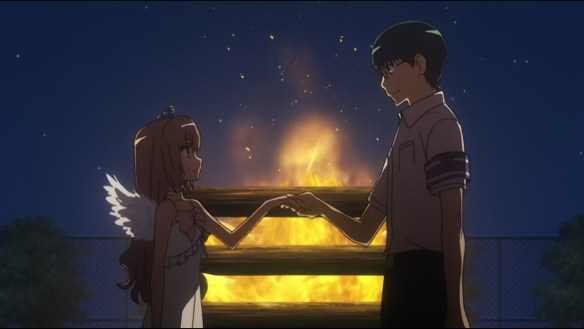
Toradora!’s thirteenth episode brought us the terrible culmination of Taiga’s attempted reconciliation with her father, leaving Ryuji and Minori to help her pick up the pieces. And yet, for all this ultimate fallout was both calamitous and predictable, and for how deeply Ryuji misunderstood both Taiga and her father’s intentions, their ultimate reconciliation came swiftly, the two rekindling their friendship alongside the festival’s roaring bonfire. That’s kinda the thing about youth; we bruise easily, but we also bounce back, so long as we are given the room and support necessary to regain our footing.
The episode’s last sequence in particular, as the fire dimmed and the festival drew to a close, felt like it was drawing on something fundamental and ineffable – that sense of vital, floating ephemerality that attends monumental adolescent thresholds. It is a strange thing to be observing your own life like a bystander as it passes by, but in moments of such clear temporal passage as that, it comes naturally to see your life through an outsider’s eyes.
The passage from childhood to adolescence involves gaining a sense of self-consciousness, an awareness of how you relate to and differ from others, and a corresponding anxiety regarding whether your presentation is effective or acceptable. The journey from adolescence to young adulthood involves developing a second kind of self-awareness – an awareness of yourself as a mutable, ever-shifting organism, which corresponds with your growing understanding of the world around you as a similarly shifting stage. The eternity, the constancy of childhood is behind you – looking forward, a whole new world awaits. And here beside you, your fellow travelers stand on similarly unstable earth, grasping for recognition from their peers, desperate to keep recognizing themselves.
We return to Toradora! with a seemingly inexplicable anecdote, as a young couple thank Taiga for apparently blessing their union in some way. Once again, Taiga is being treated as a sort of mascot, a class icon without any agency or humanity of her own. Even if conceived with no malicious intent, such gimmicks demonstrate the inherent cruelty of adolescence, wherein we are all desperate to find a happy self-definition, and all at the mercy of our peers’ tendency to find solace in collective social agreements. When we are uncertain of our own social standing, we become all the more eager to embrace any attitude or behavior pattern that might mark us as equivalent to our peers, or at least sharing the same mindset. Thus our quest for belonging can easily become a campaign of rooting out those who don’t belong, as we ironically find community in the very act of defining that community’s borderlines.
So it goes with even Taiga’s own classmates, who are swift to embrace the new identity that her cross-class festival debut has earned her. For those close at hand, such an adornment can add a humorous wrinkle to their understanding of their classmate; to those further afield, that gimmick can become their identity altogether.
As usual, Ami is the first to suss out the truth of this odd social development, and thus immediately sets to work deflating it. Though she claims indifference or outright hostility towards Taiga, it is abundantly clear at this point that she has chosen both Taiga and Ryuji as personal projects, feeling too annoyed by their perpetual circling to leave them to their own faulty devices. Thus she expresses her concern and kinship through aggression – never admitting to her fondness for her companions, but through even her provocations offering assistance to Taiga, and attempting to make their classmates recognize the human being behind all these gimmicky titles.
With Ami having momentarily fended off the hordes, Ryuji’s buddies explain the situation. Apparently, everyone who was smacked by Taiga during their wrestling performances was subsequently blessed by good fortune, be it romantic, financial, or whatever else they might desire. Thus she is now the “Palmtop Tiger of Happiness,” who may bestow blessings on whoever earns her favor (or violent disdain).
For his part, Ryuji is at least socially aware enough to now understand the cruel irony of this situation. While all of their classmates revel in this ostensibly lighthearted social game, Ryuji can only think of how Taiga’s blessings stemmed from a day that was pretty much universally terrible for Taiga herself. Their games only emphasize how little Taiga’s classmates actually understand her, as they unwittingly poke at a sequence of terrible memories, oblivious to what that day meant to Taiga. Of course, Taiga as always refuses to be an object of pity, and thus remains her defiant self as she… demands Ryuji produce her lunch. Alright, perhaps not entirely self-sufficient, but certainly defiant at least.
The ensuing compositions emphasize the cruel, alienating gaze of the crowd, as we hear whispers of gossip regarding Taiga’s new reputation, as well as Ryuji’s ostensible relationship with her. Layouts avoid the humanizing effect of their classmates’ eyes, instead hanging low, presenting their peers as mouths without a face, or a series of conspiring skirts with no human specificity. It’s a classic visual shorthand that represents a universal sensation: the realization that gossip has a life of its own, like a virus that can transfer itself via any willing vector, and which thrives on the insecurity and desire for novelty that naturally attends adolescent socialization.
Granted, Taiga herself isn’t exactly against any flattering rumors that present her as being “stolen” from Ryuji by a gallant Kitamura-kun. We can’t always choose our reputation, but we can do our best to deflect the bad and be flattered by the good, understanding our personal truth will never be fully acknowledged or understood by those around us. Getting along with our peers involves accepting a wide array of social compromises, and it is to Taiga’s credit that she’s becoming increasingly capable of shrugging off or finding flattery in the misconceptions of others.
That sense of surveillance by their classmates continues through lunch, with compositions emphasizing the lurking eyes surrounding them as Minori attempts to keep the conversation light. Another strange irony in this dynamic; in order to avoid playing the part your classmates have assigned you, you have to provide some other performance, a heightened demonstration of disinterest that hopefully allows the expectations of your peers to diminish over time. You can’t outright challenge their perspective – that comes across as protesting too much, and will only exacerbate the spread of your unwanted social contagion.
Kitamura is the next to offer support, in characteristically straightforward fashion – rather than challenging the rumor like Ami or defusing its power like Minori, he simply acknowledges it outright, offering his direct condolences that Taiga has to deal with this crap. Though the circumstances aren’t ideal, their shared meal nonetheless embodies a welcome return to normalcy, a regression to the mean that even Ryuji is quick to acknowledge.
Ryuji then runs into Ami in the hall, who punishes his indifference to her mysterious phone call by pressing the wrong vending machine button. As usual, Ami tends to express her true feelings through hostility – if Ryuji’s not willing to invest in learning about her problems, then she will strike back by challenging his subservient loyalty to Taiga. As is often the case with both Ami and Minori, Ryuji lacks the emotional intelligence to see beyond their performances; all he sees from Ami is hostility, and thus he returns that hostility in kind.
The reveal of the festival’s official photos offers plenty more tiny opportunities to affirm or progress our leads’ various dynamics. Taiga receives some much-needed reassurance from Ryuji regarding her romantic bonfire dance with Kitamura, while Minori makes a somewhat desperate joke of her own developing feelings, drawing attention to Ami’s figure in a very ha ha isn’t this so funny but-what-if sort of way. As the series’ two most emotionally intelligent leads, and also the two least comfortable exposing their true feelings, the development of Ami and Minori’s relationship is essentially a series of conspicuous asides and absences, as in this moment, when Minori rushes to change the topic through one of her exaggerated play-acting bits.
The two share a rare face-to-face conversation back in class, as Ami reflects with a hint of bitterness how her photos are sold all over Japan, and thus she doesn’t really care about who values them. Though it sounds like bragging, it’s closer to the opposite; because Ami is known to everyone, she feels she is special to no-one, or at least not appreciated for the person behind the façade. These festival photos symbolize precious, personal memories – but to her, photos are just another form of personal sentiment that has been abstracted away from her, a form of intimacy she has been forced to turn into a product. And though this is a source of some sadness for Ami, she relates it to Minori as a sort of comfort – even if others (like Ryuji) are interpreting these pictures as a reflection of some deeper emotional truth, in the end, they are only pictures. Thus our two introspective loners find at least a fragment of solidarity in each other.
The sun hangs low as our first day back at school draws to a close, a reliable echo of the comforting routines Taiga and Ryuji happily reassert. Palm Top Tiger of Happiness or no, the storms of parental disturbance have at least momentarily passed, and our leads revel in their unblemished intimacy – ribbing each other about their crushes, idly considering dinner preparations. As Toradora! so consistently demonstrates, the essence of romance is not contained in grand, singular declarations of feeling – those are fun, but the more important part is the day-to-day experience of enjoying each other’s company, and feeling comfortable being unapologetically yourself in another’s presence.
Of course, with their hearts set on those big romantic confessions, Taiga and Ryuji still don’t quite understand the value of what they already have. Ryuji’s obliviousness comes through clearly in his ensuing conversation with Ami, where he reverses the concept of the Palm Top Tiger of Happiness to ask what he might do to grant Taiga herself happiness. The fact that this is his first instinct proves the nature of his feelings – thus Ami responds with the barely-cryptic “I’d say Taiga’s already pretty lucky,” quietly envying the concern that comes so naturally to Ryuji.
Leaving the grocery store, Ryuji sends one more unintended mixed message to Ami, offering her the surplus food and chiding her for her presumed fast food diet. His words resonate with Ami’s feelings of isolation from her peers, offering an echo of her conversation with Minori. While Ami often feels separated emotionally from her classmates due to her professional experience making her more mature, Ryuji actually thinks the opposite way about her – because so much of her life has been spent away from home, she’s quite like a kid when it comes to fundamentals like cooking for herself. Thus the frustration she expressed back at the vending machines is answered in a novel form – Ryuji might not be invested in the specifics of her professional life, but he notices when his friend looks pale, and makes a mental note to ensure they’re eating properly. Maturity comes in many forms, and though Ryuji is certainly not Ami’s match when it comes to matters of self-awareness, he is quite the collected young man in his own ways.
The sun continues to set as Toradora!’s stars make their variable way homes, each considering what form their own luck or happiness might take. Some wish for a clear love, some wish for a feeling that can’t be defined, and some hope only to continue their journey with the companions they’ve met along the way. Ultimately, it is Ryuji’s mother who offers the most convincing interpretation of Taiga’s magic; hugging the Palmtop Tiger close, she states that “the fact that I’m able to hug you like this, to have meals with my family… this all makes me the happiest person in the world.” In seeking to validate a false family, Ryuji formed a rift in his real one – but so long as we keep walking together, all such rifts can be mended. There is indeed a certain magic in making such intimate contact, but it has nothing to do with the supernatural; it simply means that if you have someone to share such closeness with, you are already truly blessed.
This article was made possible by reader support. Thank you all for all that you do.