
Hello folks, and welcome back to Wrong Every Time. This week has seen us continuing our march through the Dirty Pair canon, as we finished the original series, screened their Project Eden film, and then continued onward into the tragically brief second season. It’s going to be tough to say goodbye to Kei and Yuri, but I’m also excited to embark on a new project, and am currently juggling a handful of outstanding anime possibilities. In other news, Critical Role’s fourth season has reached the convergence point of its three wayward tables, and proven anew that Brennan Lee Mulligan is some kind of genetically modified DnD machine. His ability to jump between tables, tones, and even genres is spectacular; it’s frankly hard at times to even draw lessons from his performance, since the prevailing takeaway seems to be “just be a genius, the rest will come naturally.” I’m nonetheless greatly enjoying the ride, and am awaiting the rest of this preposterously ambitious project with great anticipation. In the meantime, let’s run down some films!
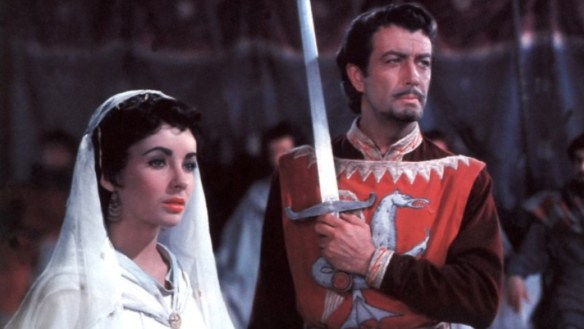
First up this week was Ivanhoe, a ‘52 historical epic based on Sir Walter Scott’s foundational novel. Robert Taylor stars as Wilfred of Ivanhoe, a knight who joined Richard the Lionheart on his crusades, and who has subsequently dedicated himself to finding the mysteriously vanished king. Traveling from castle to castle across Europe, he will eventually discover both his king and a nefarious conspiracy, and be forced to assemble an unlikely collection of allies to return the true king to his throne.
Ivanhoe is an exceedingly generous mid-century swashbuckler, featuring basically everything you’d want from a Robin Hood-adjacent tale of intrigue and chivalry. There’s duels and betrayals, steamy love triangles, castle sieges, knightly tourneys, Elizabeth Taylor is there… it’s really everything you could ask for from an adventure film, all captured in sumptuous color by the steady eye of director Richard Thorpe.
I’d never actually read Walter Scott’s original, so Ivanhoe also proved an interesting alternative to Robin Hood’s take on this period (and Robin of Locksley himself even shows up from time to time). While Robin abandons his lordly position in his rebellion against John, Ivanhoe remains within the courtly order, allowing this film to explore the distinct tensions between England’s old Saxon families and new Norman overlords. I can only hope these anxieties were captured more faithfully than its depiction of King Richard, who is as usual depicted as the perfect king in spite of his historical record of relentless crusading and repeatedly bankrupting the kingdom.
This was also my first Elizabeth Taylor feature, and yeah, I get it. She lights up the screen in her every appearance here, appearing so at home on screen and conveying such passion that you can see why stardom is considered an almost supernatural power, why some people are just meant for the camera’s adoration. Her doomed love lends a welcome sense of tragedy to an otherwise rip-roaring feature, and is ably complemented by the performance of her unwanted suitor George Sanders, whose role lends the film just a dash of emotional complexity. If you’re looking for a classic swashbuckler, Ivanhoe is an altogether superior feature.
We then checked out Edge of the Axe, a little-known slasher from the tail end of their ‘80s heyday. The film centers on a remote California town haunted by a series of mysterious murders. While the police and locals struggle to make sense of the killings, a young couple hope to use a novel tool to assist their investigations: the personal computer, marvel of modern technology.
Edge of the Axe’s ‘88 portrait of high-tech ingenuity is adorable, and likely would have prompted eye rolls even from more technologically fluent audiences of its own era. Sadly, there’s not much else to enjoy here, with even the film’s very title limiting the ingenuity of its kill scenes. And the axe in question isn’t even a good axe! It lands with all the thunderous impact of a squeaky hammer, making every ostensibly spine-tingling moment feel more like farce. Combine that with a generally unwieldy narrative and a twist ending that directly contradicts prior information, and you end up with a weak performance even by also-ran slasher standards. Surprising your audience is not more important than offering them a coherent story!
Next up was Deep Rising, a ‘98 creature feature written and directed by Stephen Sommers, who is undoubtedly best-known for spearheading The Mummy. Treat Williams leads a crew of salvagers and the mercenaries who hired them to the Argonautica, a luxury cruise ship they’re planning to plunder. However, when they hop aboard, they soon discover they’re a bit late to the party, as a many-tentacled monster has already arrived for the feast.
Though Deep Rising was a flop and The Mummy a hit, the films share a significant degree of DNA, riding on that horror-adventure line exemplified by features like Indiana Jones and the Temple of Doom. The film is largely an exercise in letting excellent character actors get increasingly frustrated with each other, as they bumble through flooding corridors and get occasionally picked off by wandering tentacles. And fortunately, Deep Rising’s stock of character actors is rich indeed, with the lack of any significant leading figures belying a deep bench featuring Wes Studi, Jason Flemyng, Djimon Hounsou, Cliff Curtis, and of course Kevin O’Connor (The Mummy’s Beni), who’s as scene-stealing here as in his most famous role.
Deep Rising’s biggest weakness is undoubtedly its reliance on unconvincing CG tentacles, but even in that, it’s not terribly far off from The Mummy’s ill-aged effects spectacles. And Sommers isn’t afraid to get loud with it; I initially feared the film would rely solely on bumps in the night and off-screen monsters, but it soon enough starts embracing big action setpieces, and even concludes on a bonafide kaiju battle. Ultimately, the film is good enough that I’m left mostly just marveling about the vagaries of fate, that The Mummy is beloved as perhaps the last great action-adventure while Deep Rising is largely forgotten.
As an accompaniment to our journey through the delightful Dirty Pair TV series, we then screened the series’ film adaptation Dirty Pair: Project Eden. For this adventure, Kei and Yuri are tasked with journeying to the planet Agerna, and investigating a series of attacks on sites mining the planet’s precious Vizorium. They soon discover these attacks are far more than simple corporate sabotage, and must eventually face off with a mad scientist to prevent him from perfecting a race of ancient super-monsters.
Project Eden is a beautifully animated adventure with spindly, near-abstract background design and stark colors that often call to mind something like Adolescence of Utena. It’s visually enthralling and action-packed, but also sadly not a very good Dirty Pair movie.
The duo are at their best performing actual investigations, playing their irreverent attitude against genre staples like the Orient Express or Yojimbo template. The action generally works as seasoning, but here it’s the whole meal – and worse, they’re accompanied by a male accomplice who does far too much of the actual work, undercutting the competency that generally counterbalances their childish flailing. The film actually has fewer twists than a standard twenty minute episode, and fails to take advantage of its leads’ personal or narrative strengths, making it best enjoyed as a Dirty Pair-themed sequence of delirious, action-packed music videos.