Hello folks, and welcome back to Wrong Every Time. Today I figured we’d take a walk through the ruins of Tokyo, and stop by the prestigious Gingarou Hotel. In spite of humanity’s apparent decline, Yachiyo and her fellow robotic staff members have been doing a fine job of keeping the beds made, cupboards dusted, and shampoo hats in proper working order. And lately, their diligent efforts have actually been paying some dividends, as they’ve entertained both plant-based lifeforms and alien tanukis in a mere fifty-year operating span.
Though it’s been a fine show from the start, it felt like Apocalypse Hotel really hit its rhythm with the introduction of Ponko and her tanuki family. With Ponko on the staff, Yachiyo now has a sounding board for her philosophy, one of those classic guileless characters who through their sincere ignorance can often arrive at unexpected wisdom. And with the cast now fully furnished, I’m hoping the show will return to some of the vivid melancholy of its premise, that poignant search for meaning in a world with no apparent future. Are they just rearranging deck chairs on the Titanic, or is there something vital and worthwhile in this staff’s struggles, even if just for their own sake? Let’s see what guidance their hotel directives can offer as we check back on Apocalypse Hotel!
Episode 4
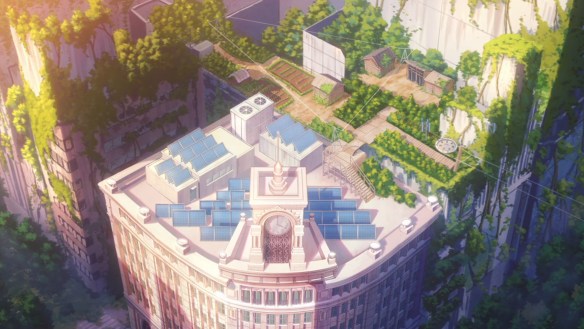
We open with an overhead shot looking down at the hotel, which provides at least some indication of how the hotel has been maintaining itself. The hotel roof is covered in solar energy panels, and abutted by a garden that presumably provides the chef’s fresh fruit and vegetables. Granted, this garden is clearly far too small to facilitate the daily and season-appropriate delicacies being offered by the restaurant, but that’s a load-bearing concession we’re always willing to grant to post-apocalyptic media, largely because the alternative is “without our globalized supply chains we’ll all starve,” which doesn’t tend to lend itself to interesting narratives
Different narrative genres all possess their own load-bearing concessions, from “true love is real” to “huge humanoid machines are efficient weapons.” The trick is not embracing realism (an anti-narrative fool’s errand), but understanding what concessions deal no damage to the fabric of the particular narrative you’re constructing
Ponko is currently attending to her duties by feeding the chickens
The names she has assigned the chickens speak to both time’s apparent passage and her happy integration into hotel life
“I guess they don’t really need names. They’re just gonna be food, after all.” Yet giving them names lends a certain meaning to the time spent with them. Her “pointless” sympathy for them is much like the hotel’s mission in general – though this post-apocalyptic setting makes the point cut the harsher, it is a general truth that we must find ways to assign meaning to our days, for the world will not inherently offer them
We cut back to the tanuki family at dinner, as Fuguri declares he’s sick of eating the same meal they’ve eaten for every meal so far. A natural quirk of robotic thinking: if it is true that “this is a delicious meal” the first time they eat it, it stands to reason that will remain true for all subsequent meals. Robots do not necessarily understand the necessity of novelty in a mortal life
Mami offers a searing speech on how Yachiyo is in fact intentionally debasing herself as a representative of the hotel in order to provide them the same meal every day. The script is hitting a nice balance of quasi-intentional rudeness from these tanukis
Yachiyo stays up all night brainstorming new dishes, and thus looks exhausted at the morning meeting. Most stories about robots aren’t really willing to commit fully to their characters being robots; they’re generally just low-affect humans with robotic physical features. Once again, realism tends to be kind of boring
Yachiyo and Ponko head off in search of fresh fish
Lovely little montage accompanied by flute and guitar strings as they wander through the city. Quite nice to finally get a glimpse beyond the hotel’s immediate vicinity
“The desertification has encroached this far? I should update my map data.” It seems even this post-human world is decaying over time. Desertification is generally a result of human exploitation and overall climate change, so I wonder if the world was in a much more desperate position than we’ve learned so far, and that the plague was only one reason for humanity’s exodus
Ponko accidentally drops the first guest’s “gift” in a pond. Terrific expression for her reaction, once again taking advantage of the inherent humor in a low-resolution closeup
Another cheery montage as the two fish together. As I expected, adding Ponko to the mix is really solidifying this show’s slice of life appeal
“Anything to put smiles on our guests’ faces.” Yachiyo is clearly much more hopeful now that she actually has guests to furnish with smiles. No matter one’s dedication, it is difficult to commit oneself to any goal without hope of some form of external validation
Unexpectedly grim gag as our camel buddy apparently gets devoured by some kind of sandworm. Feels almost like a Humanity Has Declined-esque flourish of bloody absurdism
Yep, it is indeed a massive sandworm. Yachiyo fortunately has her eye on the prize, and manages to hold onto their precious new ingredients
The creature proves utterly impervious to the environmental bot’s ray cannon. An excellent “oh shit” from Miki as his attacks prove ineffective
Ponko states the creature is a Nudel Merissa Scolopendra, an apparent interplanetary predator. I suppose it stands to reason that the earth would find new inhabitants beyond those of a size and temperament appropriate for a stay at the Gingarou
Gotta say, was not expecting this episode to transition from a slice of life afternoon walk to a battle against a giant worm for the fate of the planet
Yachiyo elects to use a giant crane as a fishing rod to catch the creature. Well, they’ll certainly have no shortage of exotic cuisine if this works out
Excellent cut and sound effect for the environmental bot slapping Yachiyo’s power cord out of this crane. In spite of him being a nearly featureless obelisk, these animators have done an excellent job of imbuing him with personality via the squash-and-stretch and follow through momentum of his movements
“We have to go home together.” Ponko makes a key statement, emphasizing both Yachiyo’s importance as an individual in her own right, and also the Gingarou’s status as a home, not just a hotel. She’s essentially serving as a conduit, translating Yachiyo’s vocabulary of hotel service into the intimate terms of friends and family
After Yachiyo volunteers herself as bait, she immediately falls into power-save mode. Thus Ponko volunteers, determined to protect her new family
Yachiyo’s heartfelt “you must come back to us alive” is somewhat undercut by her following “extraterrestrial injuries aren’t covered by worker’s comp.” But hey, she’s starting to get the spirit of genuine friendship
Some excellent SNES-vintage visual flourishes for conveying their plan of action
Ooh, excellent multiplanar compositions and movement into depth as Ponko begins her sprint. The sturdy maintenance of both creatures’ relative distance from the camera really emphasizes the absurd scale of this worm, and how swiftly Ponko must travel to try and cross the same terrain
Also plenty of great Ponko noises as she flees from this ridiculous creature
“We all have to hunt to survive.” Ponko finds strength by realizing this creature is no different from herself, or any other predator seeking its prey. She cannot fear it; she must become the predator
Thus she rises holding a GOD DAMN CHAINSAW. This episode is so much
Oh hey, she actually stated the point out loud
We are of course treated to an Obari pose of Ponko with her chainsaw
And after Yachiyo saves her, the reassessment of their relationship is completed with the requisite “welcome home” exchange. No longer just coworkers
As in the previous episode, Ponko is the first to take a new lesson of human society to heart, informing her family of the tradition of offering thanks for their meal (of chainsaw-fileted space worm)
And Done
Jeez, what a ridiculous episode! Apocalypse Hotel is still stretching its legs and finding new ways to impress, while continuing to hone in on the philosophical opportunities provided by the unique relationship between Ponko and Yachiyo. This episode basically reframed Ponko as the actual protagonist, a newcomer to earth who is learning about human customs third-hand, by way of Yachiyo’s interpretation of humanity’s values. Between Ponko’s curious energy and Yachiyo’s reverent determination, the two are essentially recreating all that was noble about human coexistence from first principles, and learning the rewards of being human along the way. Nice fishing, team!
This article was made possible by reader support. Thank you all for all that you do.