
Hello folks, and welcome back to Wrong Every Time. This week I’ve been keeping busy with all my various obsessions, munching through a pile of Galaxy Express episodes while also plugging away at that dang novel. I think I’m nearly out of the hole I dug myself some thirty-odd pages ago, but also feeling increasing trepidation at just how heavily I’ll have to rewrite this beast now that I know more about its final destination. “Just write whatever comes to mind, you can edit later” was undeniably good advice eighteen months ago, back when I was just trying to shake off the rust and write anything unrelated to art criticism, but at this point I can only gaze with envy and resentment back towards those first pages, which will now surely have to be tossed in order to ensure a dramatically and tonally cohesive whole. That inevitability of editing is also making me feel all the more impressed by mangaka who publish their work on a weekly basis, and thus must live forever with whatever choices they made however many years ago. Anyway, the movie screenings have continued as per usual, so let’s run down the Week in Review!
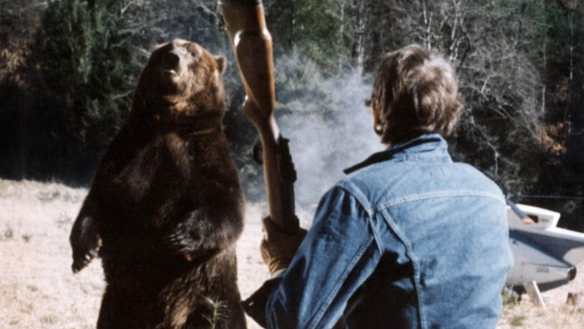
First up this week was Grizzly, a ‘76 creature feature and shameless riff on the Jaws formula. Christopher George stars as the head ranger of a sprawling national park, where a massive grizzly bear has begun making a buffet of the local campers. Bodies stack up as George clashes with the park’s defiant manager, until he eventually takes the fight to the high country, enlisting a naturalist (Arthur Scott) and combat veteran helicopter pilot (Andrew Prine) to take down the maneater once and for all.
As I said, this film is another Piranha-style riff on the preceding year’s Jaws, to the point where you can pretty much directly map various sequences from this film to their Jaws-borne inspirations (the clash with the profit-minded park manager, the grisly campfire story from our veteran warrior, etcetera). Fortunately, also like Piranha, it’s a perfectly fine film in its own right. I quite enjoyed the film’s unsettling alpine photography, and was particularly impressed by the characterization and performances of our three leads, who develop a compelling and understandably contentious bond over the course of these grizzly killings.
As is generally true of the best creature features, the grizzly bear represents something beyond just one violent animal; to the naturalist it offers either affirmation or rejection of his own status as a welcome element of the forest, while to the Vietnam veteran it serves as a chance at redemption, or perhaps the punishment he’s been secretly seeking. Prine’s reflection that “we called them names to keep it from getting personal, but it got personal anyways” succinctly evokes a world-weariness that saturates the entire production; though it’s a film of relatively scrappy means, it nonetheless achieves its goal of setting demon-haunted humans against an old god of the mountain.
We next checked out Cyber City Oedo 808, another luscious OVA trilogy from the tail end of the bounteous bubble era. This one centers on three cybercriminals serving multiple life sentences for their devious cybercrimes, who are given the chance to lop some years off their sentences by participating in life-threatening detective work. Thus we join Shunsuke, Goggle, and Benten on a trio of adventures, as each of them grapple with their past while pursuing a brighter future.
The first thing that stuck out to me about this OVA was the delightfully crass dub, which really overlabors the shit-dick fuck-ass parlance of our pottymouthed heroes. But that charmingly abrasive first impression was soon burnished by the series’ plentiful exemplary features, from the sharp direction and distinctive character design of the legendary Yoshiaki Kawajiri, to the gorgeous neon-soaked depictions of Oedo itself, to the fundamental genre-savvy sturdiness of its individual narratives. In spite of its bombastic presentation, there’s a real poignancy here; each episode combines sturdy, traditional action-adventure thrills with a certain fatigued solemnity regarding the hopeless journeys of both our leads and the unfortunates with whom they share this melancholy city. Oedo hits hard from the start, and ultimately exemplifies the tragic, relatable fatalism that defines cyberpunk’s appeal. An essential artifact of both the cyberpunk genre and the peak OVA era.
We then returned to the march of the great turtle with Gamera: Revenge of Iris. Taking place three years after the big guy’s victory over Legion, Revenge of Iris centers on a teenage girl named Ayana (Ai Maeda), whose parents were killed when Gamera inadvertently stomped on her family home. Discovering a strange egg in an ancient temple, Ayana names it after her also-stomped cat Iris, and nurtures it with her undying hatred for Gamera. Soon enough baby Iris grows to a titanic size, forcing Gamera to take decisive, destructive action.
I feel sorely conflicted about Revenge of Iris. On the one hand, it does offer much of what you want from a proper kaiju feature: a fine human-side personal narrative, a pleasingly distinctive new foe, disaster movie-esque clashes of kaijus and hapless humans, and a final supersized wrestling match. On the other hand, why is this a Gamera movie? Gamera is a friend to the children, beloved by all younglings since his very first appearance! “What if Gamera didn’t care about us” feels like a “what if Superman was evil”-tier hypothetical – sure, you can explore that concept, but is there any meat to it beyond the basic rejection of the character’s fundamental themes? As far as Revenge of Iris goes, no, there really isn’t, and the film feels far poorer for its mismatch of character and concept. It is Zack Snyder’s Gamera, and no, I will not take that back.
Last up for the week was the ‘53 adaptation of The War of the Worlds, directed by Byron Haskin and produced by mid-century master of adventure George Pal. Largely set outside the town of Linda Rosa, California, the film concerns humanity’s investigations of a strange meteor, which swiftly reveals itself to be the first of countless Martian invaders. With humanity’s weapons seemingly powerless against the Martian crafts, nuclear physicist Clayton Forrester (Gene Barry) and his companions will have to race against time to protect our fragile species.
The War of the Worlds is one of those exceptional ‘50s scifi films that feels genuinely timeless, demanding little allowances for the technical limitations of the period, and rocketing through a series of tense faceoffs with a compelling cast of characters, unobtrusive romance, and vivid sense of horror and despair. The sequence of two survivors attempting to hide from alien probes within a farmhouse feels nearly as nail-biting as it must have on release, and segments depicting the utter destruction wrought by the martians’ cold machines, or detailing the inexorable shuttering of one outpost after another, feel like the heavens’ judgment upon our damned race.
Given that, it only makes sense that the film concludes on a desperate, hopeless dash for shelter from apocalypse, whether in the grace of god or the arms of the one person you want to be with when the end arrives. The whole calamitous ending sequence had me humming “8 1/2 Minutes” to myself as the city collapsed, and if your film has me reminiscing on Dismemberment Plan songs, that’s probably a good sign.