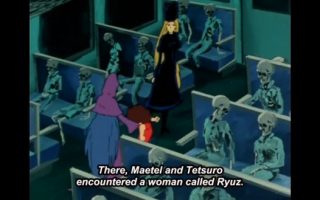
Hello folks, and welcome back to Wrong Every Time. With the site still boasting drafts of every single currently outstanding reader project, I’ve been hacking away at the novel for much of this past week, burning through a major back-half sequence and successfully extracting myself from the narrative hole I’d created. I’ve also been munching through Galaxy Express 999 episodes at a feverish pace, and thoroughly enjoying Matsumoto’s diverse, fantastical planetary concepts. There’s obviously some repetition of themes and structures (Tetsuro’s had his pass stolen at least twenty times by now), but it’s nonetheless hard to imagine coming up with such distinct worlds and stories on a weekly basis. I also conquered Baby Steps’ imposing Manbreaker, a preposterous mountain-climbing challenge that absolutely solidified the game as a personal favorite, possessing one of the most mechanically rewarding control schemes I’ve ever interacted with. I’ll have to figure out what to do with myself now that The Mountain is behind me, but for now, let’s break down the week in films!
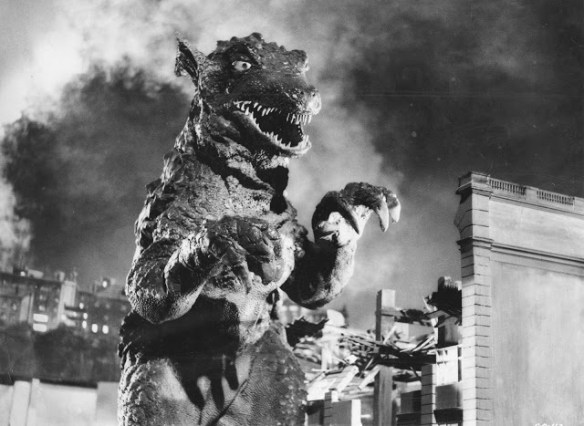
First up this week was Gorgo, a ‘61 creature feature directed by Eugène Lourié, and featuring the effects work of the reliable Tom Howard, whose credits run from the 1940 Thief of Baghdad through 2001: A Space Odyssey. Bill Travers and William Sylvester star as partners running an ocean salvage operation, seeking treasure off the coast of Ireland. After damage to their ship forces them to recuperate on Nara Island, they learn of a sea beast haunting the island’s harbor, and decide to claim the creature and haul it back to England.
As you can see by that description, Gorgo obviously isn’t the most innovative production – it’s clearly a post-Godzilla take on an aquatic King Kong, and proceeds largely how you’d expect given those influences. That said, I was quite taken by the film’s slow burn across its first half; the ominous, highly suspicious islanders give off a strong Shadow over Innsmouth vibe, and the initial plumbing of the harbor’s depths offers plenty of murky underwater photography and inexplicable acts of destruction. It’s a truism that the monster you don’t see is the scariest of all, and Gorgo does a fine job of evoking that fear through its first third. That atmospheric opening plus the conclusion’s generous London-crushing effects extravaganza make Gorgo a perfectly reasonable take on a British kaiju feature.
I then checked out Grizzly Man, the ‘05 documentary written and directed by Werner Herzog, considering the life and death of conservationist Timothy Treadwell. Largely constructed out of Treadwell’s own archival footage, the film digs into Treadwell’s unconventional tactic of actually spending his summers at Katmoi National Park in Alaska, camping alongside grizzly bears out in the wild.
Any fan of Herzog would likely understand why he found Treadwell so fascinating. The man is essentially one of his Klaus Kinski adventurers, a lone figure who believes himself exempt from the laws of nature, or at least uniquely capable of surmounting them. Treadwell emerges from early professional disappointments and addiction to reimagine himself as the bears’ stalwart defender, the only one capable of saving them from the threat of poachers, tourists, and rampaging industrialists.
Of course, bears are bears, creatures ill-equipped to appreciate the moral dimensions of Treadwell’s allegiance. Nonetheless, there is something fascinating and oddly human in Treadwell’s attempt to abandon his humanity, and live among creatures he considers more noble, more sincere and genuinely alive than modern man. As Herzog notes, there are clear elements of Thoreau and McCandless in Treadwell’s philosophy, and though Treadwell’s beliefs would ultimately lead to his death, it’s easy to see why the film’s other interview subjects found something poignant or noble in his quest.
Alongside serving as a compelling character study, Herzog’s appreciation of Treadwell often highlights the man’s clear gifts as an artist, as well as the fertile distance between the self-aggrandizing intent of Treadwell’s footage and its stark, unmediated beauty. Treadwell captures many moments of astonishing natural beauty, as bears rummage for food while foxes dance in the grass, the grandeur of nature indifferent to Treadwell’s pretensions (a common Herzog refrain). Treadwell’s yearning is relatable and sympathetic, and so too is the distance between his intended result and the paeans to nature’s wonder he incidentally captures. Ultimately, Treadwell sought an emotional connection with the natural world that assumes a compassion or humanity that nature simply does not possess; however, in his striving for that connection, he created a legacy both intimate and universal.
We then screened the ‘51 scifi classic The Day the Earth Stood Still, directed by the exceedingly talented and wildly genre-stretching Robert Wise. Michael Rennie stars as Klaatu, an alien who emerges from a flying saucer stating that he arrives in a spirit of peace and good will, upon which he is immediately shot for the effort. After failing to negotiate for a simultaneous meeting with all world leaders, Klaatu escapes to the streets of Washington D.C., taking up lodging as a man named Carpenter while he seeks another way to offer mankind his terrible warning.
The Day the Earth Stood Still feels urgent and iconic, encapsulating the fears of the atomic era, and providing a stern challenge to humanity in the form of the eminently likable Klaatu. Rennie’s congenial demeanor makes humanity seem all the more ridiculous, as he lends a paternalistic smile to our relentless squabbling and overwhelming fear of the outsider. It’s sort of like if an alien Mr. Rogers was forced to inform earthlings that they’re scheduled for demolition if they don’t shape up, making for an oddly charming viewing in spite of its stark subject matter. Also a worthy viewing purely for the context it offers to subsequent scifi dramas, like its clear descendent Giant Robo.
Last up for the week was Burst City, an ‘82 punk rock quasi-musical directed by Gakuryū Ishii. Set in a vaguely post-apocalyptic urban wasteland, the film centers on a variety of rebels of various stripes, most of whom are members of actual punk rock groups of the era. Along with documenting their riotous performances, the film offers a loosely defined story of rebellion against a yakuza-backed industrialist, along with many sequences simply luxuriating in the anger, ennui, and street racing fervor of the era.
Burst City is an intriguing artifact of the late ‘70s/early ‘80s Japanese punk rock scene – part concert documentary, part rebel manifesto, and part post-apocalyptic action film. And yes, I know, my use of the word “artifact” tends to accompany films that feel more like historical curiosities than recommendable features, and indeed that holds true here. With so little narrative to speak of, the film definitely drags through its two hour running time, and scenes of punks snarling “don’t fuck with me” at each other tend to get a little repetitive after a while (if anything, the film indeed convinced me their parents ought to have imposed harsher curfews).
That said, it was also quite compelling to get this snapshot of Japan on the border of its international resurgence, contrasted against the defiant, defeatist culture of those who fell through the asphalt cracks of its increasing urban wasteland. Additionally, Ishii’s camerawork is lively and inventive throughout; I can see the seeds of something like Tetsuo: The Iron Man in his wild confluence of filming techniques, as well as the film’s occasional gestures towards body horror. A film you can feel free to project on the wall during a raucous warehouse party – in fact, it almost seems like that’s the way it was intended.