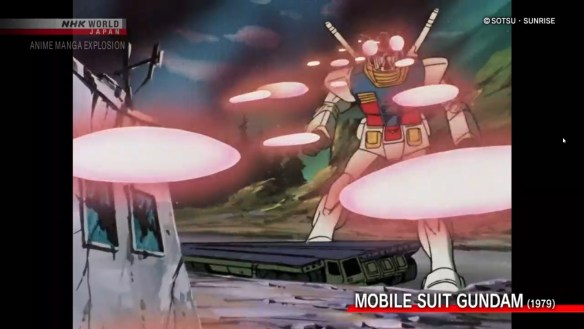
Hello folks, and welcome back to Wrong Every Time. Today we’re checking out something a little different from our usual fare, as we watch an NHK special program centered on Yasuhiko Yoshikazu, the character designer and animation director for the original Mobile Suit Gundam. As the designer behind the most formative and iconic real robot mecha series, Yoshikazu essentially defined the style of ‘80s scifi anime protagonists, casting an enormous shadow over one of the most prolific and acclaimed eras in anime history. He’d go on to make further contributions to this wild era, creating the scifi manga Arion and Venus Wars, both of which he’d eventually adapt into film. He’d later return to Gundam as well, penning the much-loved Mobile Suit Gundam: The Origin manga, which he would also personally adapt into animation.
Yoshikazu belongs to a prior generation of anime luminaries, back when the medium was almost inextricable from the pro-labor, anti-war sentiments of its young, politically conscious creators. Anime has quite frankly gotten more insular and reactionary in the years since, and Yoshikazu himself has expressed frustration with shifts like Gundam’s turn towards the more fantastical, individualist focus on Newtypes, a clear drift from the solidarity and martial antipathy of its origins. Of course, such a narrative of artistic evolution is far too simplistic to account for the ways anime has shifted over the years, and also paints a picture of Yoshikazu himself that I’m sure this program will complicate. So let’s get to it then, and see what he has to say for himself!
Episode 1
We unsurprisingly open with his biggest claim to fame, the monumental, genre-defining 0079 Gundam
“At its creative core is Yasuhiko Yoshikazu.” True, though Tomino’s such a distinctive guy it feels odd not to share the credit. Both Tomino’s directorial style and his somewhat clinical approach to human drama were essential to Gundam’s impact; as in many Tomino productions, Gundam’s wars feel beyond the scale of human intervention, like great leviathans we cannot possibly steer. Space Runaway Ideon goes even further into this idea that it is difficult to be more than a spectator to history, but Tomino Gundams also tend to be defined by the impossibility of any one person ending human conflict or saving the world
“Amuro and Char stood out for their emotional depth.” No question there. It was quite something watching 0079 and realizing how much of Evangelion’s alleged revelations were already present in Amuro’s story. And Char is rightfully one of the most compelling and enduring characters in anime history, the tragic avatar of history’s implacable course, idealistic and cruel, romantic and cynical, a man ultimately consumed by his desperate need to set humanity right
After 1989, he stepped away from anime for a quarter-century before returning for Gundam: The Origin. Considering his substantial work as mangaka, character designer, and animation director, it’s little surprise his storyboards look precise and animation-ready
We jump to a 2025 talk with various luminaries of mecha anime, including the original Mobile Suit Gundam’s mecha designer Okawara Kunio, Go Nagai, and Takachiho Haruka, who created classics like Crusher Joe and Dirty Pair
“He nails it in one go. No extra lines.” That definitely seems true of both his character designs and storyboarding. Amuro and Char are iconic without being busy, a common fault of many modern designs
“Animation directors are very skilled artists.” It does feel like an enormous, never-ending responsibility, a crushing combination of big-picture and hands-on work
Apparently Yoshikazu is currently working on a new manga called “Silver Road,” set in the 1870s and centered on the true story of a man who revived the Handa Silver Mine. Great storytellers always draw from a broad array of influences, and it’s no surprise that Yoshikazu in particular would be an avid student of history. One of the great weaknesses of much modern anime is that many creators only consume works in the same subgenre they themselves are working in, resulting in myopic, creatively impoverished productions
Quite nice to get a look around his studio, and breath in the tactile, mechanical aspects of traditional anime production
“This is a pegbar. It’s all you need to create anime.” Love seeing their veneration of these fundamental tools, something that also stood out in Yasuo Otsuka’s special
“I think this is from Mushi Productions. I got it around fifty years ago.” Always wild to be reminded how much of anime’s history is still in living memory
“At Mushi Pro, animators were like factory workers. I felt I was capable enough to join them.” Huh! Interesting to hear that the very lack of respect offered to animators in order to comply with Osamu Tezuka’s initial TV animation bargain was part of what actually made the industry seem non-threatening to Yoshizaku
His initial personal drawings are already rich in personality, as well as a sense of motion. He leapt up to the role of key animator after only six months
Even before his work on Gundam, he was already doing consistent character design as a freelancer. No surprise he swiftly proved to be too large of a talent for Mushi Pro’s factory system
Love his diminutive little goblins he uses for his own comic avatar. A charming trend among mangaka
“You don’t know who’s on whose side, or why they’re even fighting. I felt that ambiguity made it appealing.” As I said, war is always a senseless misuse of human lives in Tomino’s work. There is no such thing as a truly just war, and the apparent heroes of one conflict often go on to facilitate the violent oppressors of the next
“Amuro was an introvert, the complete opposite of the typical robot hero full of confidence.” Yep. Eva goes deeper, but it was all laid out here
“A thin, high-strung 15 year old boy.” Even Amuro’s initial designs convey his sense of nervous energy, and the anger just beneath his surface
Amusingly, Tomino’s only instruction regarding Char was “make him good-looking,” while it was Yasuhiko who gave him the mask. That feels like one of the most consequential character design choices in anime history, given practically every subsequent Gundam features either Char himself or a Char equivalent marked by their blonde hair, red suit, and mask
“I wanted people to wonder what’s behind the mask.” Great character designs tend to echo the fundamental nature or conflict of their characters, and Char being a character who hides his true motivations behind a charming facade is basically as fundamental as it gets
And even when provided with the masked design, Tomino’s first question was “he’s good-looking, right?” Love that man
We then interview an enthusiast who’s a big fan of Kai Shiden. Kai is indeed one of 0079’s most compelling secondary characters, a natural cynic who becomes invested in the conflict in spite of himself, growing in diverse and often painful ways while still maintaining that core frustration with the absurdity of their mission
Yasuhiko reveled in the chance to animate characters who couldn’t admit to their own feelings, who through hope or fear or responsibility or ambition tended to say things contrary to what they were actually experiencing
“Mobile Suit Gundam had a team of five animators.” Absurd how small the teams were back then. Many of the Toei Doga films had just a handful of animators as well. I imagine the crunch was brutal, but also that having such small teams likely led to a greater sense of visual unity across the production. For modern productions, even a mere enthusiast like me can often notice the shifts between different key animators
Itano Ichiro was only twenty when he worked on Mobile Suit Gundam, and describes Yasuhiko’s drawings as possessing a “softness” that his lacked
We then get into the specifics of Yasuhiko’s approach to the beam saber attacks, how it sort of bends backwards and then snaps forward, almost like a whip rather than a steady blade. Itano divides this movement into two parts – “tame” (the held motion as the beam is first positioned) and “tsume” (the snap, when it swings forward and actually bends, thus creating a greater sense of motion and consequence)
An interesting framing of techniques also described in The Illusion of Life, combining squash and stretch, anticipation, and follow through
His frame-by-frame analysis of this technique makes it even clearer – rather than the saber moving down and forward across five frames, it actually pulls back in the second frame in anticipation of the swing, and then bounces back again in frame five from the recoil of the strike. A key difference that results in the motion not feeling mechanical, and instead feeling weighted, taking account for choreography and momentum
Thus tame refers to the wind-up second frame, and tsume to the compressing of the actual action frames in order to create a greater sense of speed
“You feel the weight. It’s heavy. It’s hard to stop a fast-moving, heavy object.”
Yasuhiko was apparently also a great delegator, and saw quickly that Itano’s talents lay in the robot and explosion scenes
“I can tell he knows how to punch up a cut.”
“With Tomino at the helm and a dedicated team behind him, Mobile Suit Gundam became a breakout hit.” I… don’t think that’s actually true? As I recall, it actually got cancelled partway through its run, and only became a phenomenon over time via word-of-mouth and immense fan support (with particular credit going to the female fans who strongly connected with the characters)
We then move on to Yasuhiko’s later ‘80s work, much of which I still need to see. Venus Wars was a delight, but I still need to check out Crusher Joe
Yasuhiko reflects that he “couldn’t compete” with the new era of prestige, high-budget films embodied by directors like Miyazaki and Otomo. It seems like he was much more comfortable in the earlier era of smaller studios, which presumably informed his choice to only return to the industry for The Origin, where he’d be surrounded with old friends
“I felt like anime wasn’t for me anymore.” Wild to consider the most famous designer of the early ‘80s would already feel out of place by the end of the decade. But I suppose that just goes to show how swiftly this medium shifts, in terms of both aesthetic and production trends. I’m certainly a relic in my own way at this point, given how the medium’s narrative and aesthetic trends have shifted relative to my interests
Thus he left the industry at 42. God, they were all so young
He then dedicated himself to manga, embracing the fundamental solidity of historical dramas
“I can’t, and don’t want to, draw from a broad perspective. I like telling small stories from low angles.” What a wonderful way of phrasing that. And I totally agree – it’s in the small stories from low angles that you really conjure the human perspective
We then jump another ten years forward, reflecting on the changes he brought to Mobile Suit Gundam while writing The Origin – updated designs, more humanized mech motions, more details
He explains that he expanded on Char’s backstory in part so he could understand Char himself. Quite something how even Char’s creators have difficulty understanding his motives; although that also partially comes down to the fact that Char was an ensemble creation, and thus the Char of Z Gundam feels significantly different from the Char of Char’s Counterattack
It seems it was actually just his annoyance with the prioritizing of Gundam side stories over the original narrative that actually motivated him to direct The Origin’s adaptation. Spite can be a powerful motivator!
Itano had shattered his hand in a motorcycle accident, but Yasuhiko was unimpressed. “Get yourself fixed, we’re bringing ‘Gundam’ back.”
Thus, just as Yasuhiko pushed Itano to greater heights during 0079’s original production, he also pushed him to reclaim his ability to draw for The Origin
Yasuhiko’s only comment on Itano’s opening storyboards was “needs more Char.” These guys
He considers collaboration the true “joy of anime,” as it has to be. Only through collaboration and the combination of distinct skill sets can such a preposterously labor-intensive artform thrive
“At a young 77 years old, his creative world keeps expanding.”
And Done
Well that was quite the handy documentary! I particularly liked how this special dug into some extreme specifics of Yasuhiro’s animation technique, as well as how those techniques and his general presence impacted Itano’s career. I wasn’t aware of quite how close they were, and now have significantly more incentive to get back to my general Gundam project and finally watch The Origin. A restless creative drawing from all the moral and human complexity of world history – it’s no surprise that Yasuhiko’s works have endured, or that he’s still finding ways to expand his horizons. Also very endearing to hear that everyone involved with Char’s creation ended up as enraptured by him as the audience. And yeah, I think that bumps Crusher Joe up to immediate screening territory. I’ll keep you all posted on how that goes!
This article was made possible by reader support. Thank you all for all that you do.