Hello folks, and welcome back to Wrong Every Time. Today we’re striding forth boldly into March, though sadly, here in New England that still means it’s the middle of winter. Though I seem to recall the existence of spring and fall from my childhood, lately it’s felt like there’s only two seasons around here: the blessed summer of May through October, and the hateful winter of November through April. Fortunately, we’ve still got plenty of stories to tide us through the cold, and I’m personally excited to be cracking the seal on a whole slate of new features. Having finished Fallout, Moribito, and the delightfully soapy Sandokan, we’re now returning to the Tomino well with Aura Battler Dunbine, while also looking forward to the upcoming second season of One Piece’s live-action adaptation. I’m frankly eager to get back to Dunbine right this minute, but first, let’s run down the week in film!
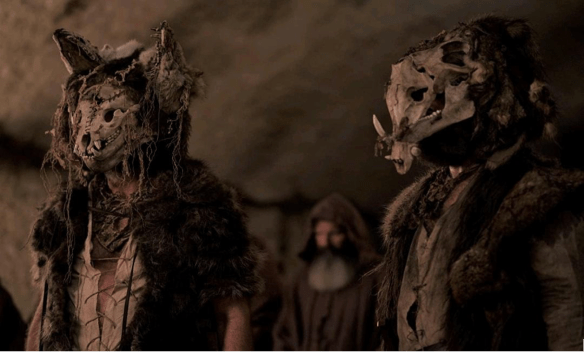
First up this week was Wrong Turn (2021), a reboot of the semi-distinguished direct-to-video cannibal hillbilly franchise. We follow a collection of young twenty-somethings on a road trip, making their way down the eastern seaboard and hiking the Appalachian Trail as they go. The group run afoul of the locals while stopping at a small town, after which things turn from bad to worse when they diverge from the trail path, and realize they are far from alone in the woods.
I’ve gotten a fair amount of enjoyment out of the grimy Wrong Turn franchise, but there is frankly only so much juice you can squeeze out of “inbred brothers eviscerate hapless tourists.” Given that, a reboot sounded like a perfectly sensible direction for the franchise, and this is honestly a well-considered reimagining. Though the premise is the same, the nature of what precisely is stalking them gives this entry a nice folk horror twist, drawing as much from The Village or Wicker Man as from grindhouse features. Plus the kills are still suitably squelchy, and Charlotte Vega proves the series’ most compelling star since Henry Rollins showed up, successfully selling her Ripley-style personal evolution at every step. If you’re looking for a sturdy Appalachian spooker, you could do a lot worse.
I then checked out the 2000 Street Fighter Alpha OVA, starring Ryu, Chun-li, and a bunch of other Street Fighter regulars, alongside an anime-original little brother for Ryu. That little brother serves as our peppy Naota-voiced MacGuffin, leading our crew of combatants through violent street fights (of course), shady underground tournaments, and eventually to some sort of ill-defined mad scientist’s laboratory.
The story is in fact significantly more coherent than the first Street Fighter film, though still primarily a template for dynamic contests of will. More importantly, this one is directed Shigeyasu fuckin’ Yamauchi, with character designs by the equally accomplished Yoshihiko Umakoshi. Umakoshi’s designs here embody the animation-friendly fluidity he is known for, a collection of distinctively angled faces and realistic yet eminently flexible bodies tailor-made for action. And Yamauchi elevates every scene with his purposeful, evocative layouts, bringing the same superior eye for visual drama to Street Fighter that he uses to such remarkable effect in productions like Casshern Sins and Penguindrum. It’s always a fun surprise to stumble across a legend while sifting through an era’s ephemera, and Alpha’s twin legends ensure it’s a very easy watch.
We then continued our trek through the later Godzilla features with Godzilla Against Mechagodzilla. This one actually acknowledges some portion of the existing Godzilla canon, largely to explain the existence of its Anti-Megalosaurus Force (AMF) designed to fight them. During an attack by a new Godzilla, AMF pilot Akane Yashiro (Yumiko Shaku) freezes in combat, resulting in the deaths of several squadmates. However, she gets a chance for redemption when scientists use the original Godzilla’s bones and DNA to create a new guardian Mechagodzilla (affectionately named Kiryu), and hopefully solve this Godzilla problem for good.
This entry proves another victory for the millennium era, this time succeeding by once again blending its Godzilla DNA with another genre – in this case, a Top Gun-style human plot centered around Akane and the other prospective Kiryu pilots. Her emotional journey gives the story that human element essential to most superior Godzilla films, and the actual execution of the fights with Mechagodzilla play like half-kaiju, half-giant robot spectacles, including plenty of those mid-fight repairs and fears of power failure that make robot battles so spicy. With a generous apportioning of kaiju action and one of the smartest genre melds of the franchise, Godzilla Against Mechagodzilla can stand proudly alongside its more storied Godzilla brethren.
Alongside our film viewings, the last few weeks have also seen my house munching through Moribito: Guardian of the Spirit. Based on a novel by Nahoko Uehashi, the series takes place in a fantasy world evoking feudal China, centering on the spear-wielding bodyguard Balsa. After unexpectedly crossing paths with the crown prince Chagum, she is ultimately tasked by the prince’s mother with protecting his life – for as it turns out, Chagum’s body contains a mysterious water spirit, whose eventual fate could bring either salvation or ruin.
Moribito was one of the few holdouts on my original shortlist of must-see anime, an enduring favorite of the ‘00s directed by the reliable Kenji Kamiyama (GITS: SAC). Having finished the series, I can see why it’s maintained its acclaim; the show is simply solid, a sturdy fantasy drama told with confidence, establishing a precise series of variables and executing on them with distinction. The art design and character animation do a fantastic job of relating the texture of Balsa’s world; the show never makes a big deal of the things that separate this reality from our own, and its confidence in illustrating them without highlighting them makes its worldbuilding all the more convincing.
The character writing is similarly hardy; individual character voices are distinctive, characters clash for understandable reasons, and Chagum’s personal growth is earned and well-illustrated throughout. But as my tempered choice of superlatives is perhaps indicating, I ultimately found myself less moved or inspired by the production than I would have liked.
Moribito is a straightforward story told with confidence, perhaps almost to its detriment – its characters are never pushed to the breaking point, its narrative never bucks in an unexpected way, and its conflict resolves with a minimum of fuss. As such, there were never any moments where I felt the messiness of humanity breaking through; it’s all just rational people acting rationally, pursuing the best possible outcome for all parties at hand. The only moment that breaches that social contract is Balsa’s backstory, which was also unsurprisingly my favorite part of the story – but otherwise, I never found myself particularly gripped by its developments. Could it be that I just don’t relate that closely to a story about becoming a parent? Perhaps, but I’ve loved such stories before; regardless, all I can ultimately say is that Moribito is accomplished and well-executed in all respects, a fine production that simply didn’t resonate with me.