Hello folks, and welcome back to Wrong Every Time. Today we’re embarking on a new adventure, as we check out the first episode of The Mighty Nein. This animated series is adapted from the second campaign of the folks at Critical Role, following the tremendous success and numerous seasons of their prior The Legend of Vox Machina. Dungeons & Dragons has only continued to expand its cultural footprint since that first campaign, and that extends to my own tabletop; I began writing up Vox Machina back during my own first campaign as a player, and have since then consumed all three seasons of Critical Role’s original broadcasts, watched most of Dimension 20’s intrepid heroes campaigns, and run a multi-year campaign of my own, guiding my players from a lonesome roadside tavern to the throne of Asmodeus, Lord of the Nine Hells.
As one would imagine, my perspective on D&D and its various permutations has changed (I can’t grant myself “matured”) significantly in that time. I’ve come to accept, as I believe most dungeon masters must, that D&D itself is a flawed and limited system, a mechanism for illustrating combat that does a mediocre job of even that, and which can only gesture towards mechanizing any other form of character behavior. And yet, that’s also sort of what I love about it; I don’t want things like conversation to be mechanized, and I embrace the great DM strain involved in genuinely making choices in the moment, perceiving your players’ intent and conjuring an outcome that rewards both their aspirations and the fickle fortunes of the dice. Catching up on Dimension 20 has only solidified my faith and understanding of this style of D&D – Brennan Lee Mulligan frequently makes decisions that would incense any rule-focused audience, because he is not playing a game according to a static rule set, he is attempting to conjure a rewarding, dramatic collective experience.
(Quick warning – from here on out, I’ll be including some vague, sort of purpose-of-narrative spoilers for the overall Mighty Nein campaign. Consider yourselves warned!)
Given that education, I’m coming to The Mighty Nein’s animated adaptations with a fair few preconceptions relative to my first brushes with Vox Machina. I’ve watched through The Mighty Nein’s original tabletop journey, and on the whole consider it a charming character journey populated with Critical Role’s by-far best cast of player characters, but also a fundamental narrative failure. I can see why it probably failed; after assigning the party such a straightforward narrative as “collect the Dragon Balls and defeat the Chroma Conclave” in their first campaign, Matt Mercer likely wanted to give his players more agency to choose their own destiny, and thus engaged in much less DM-side railroading to ensure a specific outcome. Unfortunately, he combined this with a general narrative background that demanded specific sequences of player engagement, and his players simply… chose not to engage with such things. To put it bluntly, they fled narrative consequence until the campaign’s main plot had ended, at which point Mercer stapled on an epilogue just to give them a climactic foe to face.
Obviously Matt Mercer is a far more practiced, expressive, and generally accomplished DM than myself, but it does feel like as Critical Role has continued, his simultaneous desire for grand narratives and absolute player agency has increasingly undercut the drama of his campaigns. He is a tremendous distance down the “agency versus narrative” line from someone like Mulligan, who plots out his players’ campaigns so precisely that D20 can commission custom sets for each fight the party is inevitably bound to encounter. And while I can’t say either of their methods are “more correct” (plenty of people like total sandbox campaigns, and that’s fine!), I can say that if you’re attempting to tell a grand fantasy narrative via tabletop roleplaying, you absolutely need a robust series of Session Zeroes, wherein you and your players collectively affirm the campaign’s tone, themes, narrative structure, and integration of individual player narratives. Good stories simply do not happen accidentally; they must be cultivated from the start, fitted with the struts and scaffolding necessary to let them flourish.
Given all that, this animated adaptation of The Mighty Nein presents a unique opportunity: to restructure the events of the original campaign such that they do make dramatic sense, with the characters actually latching onto narrative hooks rather than fleeing from them, and their journeys proceeding coherently from their dramatic origins. The adventure that The Mighty Nein could be is easily the best story Critical Role has told; as I said, the cast is far and away their best, with a strong balance of distinctive, complex individuals with meaningful ties to their world. I don’t know how complete or effective such a revision might be; some of the worst choices made in this campaign are also among the most consequential and inescapable. But I genuinely do love The Mighty Nein as characters, and am eager to see if this team’s own post-campaign reflections match my own rigorous critiques. Let’s find out!
Episode 1
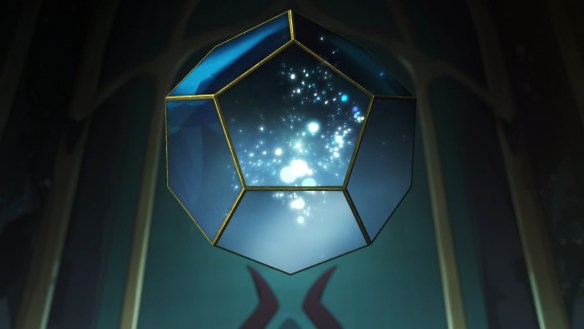
We open by panning through what appears to be a vast cosmos contained within a floating dodecahedron. Even this immediate choice is setting player expectations in a very different, more focused way compared to the actual campaign – this device is the MacGuffin of the campaign at large, yet the players in the original campaign never really came to understand its value. Perhaps the first major point of divergence between the campaign Mercer designed and the campaign the players experienced came down to him not effectively conveying the importance of this object, thus prompting them to carelessly abandon it
An ailing woman appears to be sacrificed in front of the dodecahedron; her presumed husband is assured that “the body dies, but the soul lives for eternity within the Luxon.” Huge divergence right from the start, taking advantage of the fact that this animated series can include scenes where none of the actual party members are present. All of this is setting up information the players wouldn’t receive for dozens of episodes, a choice that goes some distance in explaining the players’ eventual confusion with and rejection of their prescribed narrative
A crucial lesson for any DM in that – ominous machinations behind the scenes are well and good, but the players will only become attached to things they’re actually aware of. I know one weakness of my own first campaign as DM was how long I took to introduce the true villain, and how infrequently his presence was directly felt by the players. Sure, he might be “responsible” for all the stuff they’re suffering, but unless he’s there himself directing the carnage, they have no reason to care about him
As promised, the dodecahedron appears to claim the silvery soul of the departed
“I cannot wait to see who you become, my love.” Thus a core aspect of this society’s culture is revealed – the resurrection of souls in new forms through this device. Again, this is absolutely nothing like the campaign’s original beginning; there was no prologue or anything, and the characters wouldn’t know any of this information for hundreds of hours. Opening this way feels like a statement of purpose, emphasizing how dedicated this production team is to dramatic revision in service of a more coherent narrative
Suddenly, an attack – thunder in the distance, and the “beacon” is stolen by three cloaked figures
Another crucial shift here; these characters are essential to the personal narratives of the Mighty Nein, but were rarely granted more than brief expository references for most of the campaign. “Background presences” don’t gain much mindshare among players; if you want a character to be important to your players (or a secondary audience of viewers, for that matter), they need to be an active agent in the ongoing narrative
I promise, I actually did like the Mighty Nein! It’s to this adaptation’s credit that it’s immediately opening by correcting some major mistakes of the original campaign, but that does mean I’m also talking about those mistakes
These cloaked figures’ glowing, banded arms and crystals neatly identify them as something like magical alchemists, people accustomed to squeezing all possible advantage out of the arcane
One of the three seems to burn a leaf in her hand, thus conjuring a fire spell. This is something the campaign did a phenomenal job of – finding drama and flavor in the nitty-gritty mechanics of component-based wizarding. Wizard spell components are one of many ways D&D affixes an ill-fitting bandaid over a fundamental design failure – wizards are simply better spellcasters than everyone else, and the “balance” for that is that it’s expensive to be a wizard, that they must pay for components to cast their spells. But most people don’t find fun in using all their hard-earned treasure in order to pay for their class’s functionality, and thus many tables handwave components altogether, leaving wizards as simply too powerful. The Mighty Nein actually leans into this paradigm; their wizard is constantly scrounging for ingredients, a mechanical constraint that actually echoes the arc of his life story, and which allows for all sorts of flavorful, desperate near-misses regarding needed spell components. It’s an excellent facet of what may well be Critical Role’s most fully articulated character
This production definitely feels much more confident in general than Vox Machina. That adaptation was frontloaded with canned jokes, and basically relied on genre self-awareness to fast-forward through the formation of its team. Likely a necessary concession given even the live campaign started with the party assembled and leveled, but it’s nice to see this adaptation actually starting where the story begins, and trusting its audience to follow a narrative that doesn’t so fully explain itself
Also just much easier to get a feel for these characters with visual depictions. One unfortunate repercussion of Critical Role’s increasing fame was portions of the audience reaching a degree of fanaticism that meant including fanart during the episode breaks actually put artists at risk. Perfectly understandable that they stopped including those sequences, but given how much of any given session might go by without any references to their physical situation, it became exceedingly difficult after that to actually visualize the campaign and its characters
I appreciate how much of the magic cast by these intruders feels visually “wrong,” like a break or splinter in reality. I’m quite fond of that framing of magic – like it’s not a natural aspect of the world, but a contamination spreading upon it
Our OP bounces between various key events or characteristic demonstrations of our various heroes, while also including more crucial characters that wouldn’t be known for many, many episodes of tabletop play. Some of the original campaign’s issues might be too foundational to be ironed out in adaptation, but every indication so far is that they’re determined to make the best possible narrative out of their raw materials
We open with the aforementioned wizard, currently getting beaten by children and tossed in a pile of manure. Caleb is fairly close to the main character of the Mighty Nein, a role which suits his player Liam quite well – he’s one of those players who acts almost like a backup DM at the table, extrapolating on provided information with passion and clarity. The success of Caleb also reflects a general lesson that is inconsistently heeded across this party: if you want your D&D character to have a satisfying arc, that arc should be seeded within the narrative fundamentals of the campaign itself. I was able to give my rogue a satisfying arc because they were secretly an ex-soldier of the campaign’s villain, and my ranger because they were a born member of the noble factions the players would be forced to align; meanwhile, my sorcerer who preferred an “I’ll define my character based on emerging events” style is still seeking definition far into the post-game
I should perhaps clarify once again that there are endless ways to enjoy D&D, and these suggestions aren’t “hard rules.” I personally want to take part in sprawling, dramatically satisfying fantasy adventures, and everything I’ve learned is calibrated towards that goal; none of these rules of thumb are necessarily relevant to a sandbox campaign, because you’d never find me participating in one
Caleb scares off his bullies by pretending to chant a magical incantation. A smart choice for both new and campaign-familiar viewers; a demonstration of his sense of humor and scrappy intelligence that secretly serves as a self-effacing reflection on who and what he is. Caleb is a diamond in the shit, bound by both personal failures and an uncomfortable relationship with his own base instincts
He walks over an advertisement for some sort of circus event without noticing. A clear advantage of adaptation: objects can be included in a visual composition in order to foretell future events without alerting the players to their significance, something less convenient when you’re actively describing everything the players see. The only way to achieve a similar effect in tabletop is to bury your clues in the scenery – to describe five elements of the scenery in a row, and thus conceal the one detail out of the five that possesses further significance
Caleb fails to lockpick his way into a magical supply shop, and flees to an alley at the sound of dogs. Efficient characterization of a desperate man running scared
He realizes he’s been pickpocketed by a goblin wearing a porcelain mask, and swiftly gives chase. Another opportunity afforded by this adaptation; these two came as a package deal at the beginning of the tabletop campaign, which this adaptation can expand on to further explain their bond. It can be hard to justify why any given group of adventurers stick together; “we all meet at a bar and pick up a job together” only goes so far, and frequently results in an adventure with a splinter right at its core, a hole where their collective motivation should go. Of course, this is less a limitation than an opportunity – Critical Role’s currently ongoing campaign spent four episodes establishing the reasons its characters are connected, and those might be the most impressive episodes of D&D I’ve ever seen
Their chase typifies their strengths: the goblin dashes easily up a series of scaffoldings, while the wizard spies a pulley he can manipulate to cross the distance. Liam specifically designed Caleb to essentially be all-seeing; he could identify objects at tremendous distances, and always recall everything he’d seen
Upon being cornered, the goblin pulls a knife on the wizard. Another desperate soul, pushed to the point where they can barely recognize themselves – there’s a real urgent, sympathetic bond between these two right from the start
The wizard loses the exchange, but his desperate “please” draws the goblin’s attention. These two are my favorite part of Critical Role at large, which I suppose makes sense. I love broken people trying their best to fix each other
“Refill my flask at the tavern and I’ll help you break in.” An excellent initial bargain for these two, as each of them helps the other reach towards a vanishing past (or drown out that past with liquor, as the case may be)
We then jump to another mage, a “Master Trent Ikithon” whose opening lecture demonstrates both his total lack of moral sentiment and his obsession with cheating death. Another character whose cruciality to the campaign would only become clear many, many sessions in, and whose presence here indicates more structural adjustments in order to make a coherent narrative out of the base material. As I said regarding my own campaign, if a villain is so well-shrouded the players barely meet them, they’re not really a tangible villain at all
Really loving these establishing shots of the various cities. They’re hitting the scale necessary to believe these are truly the capital cities of a great continent, with all the distinctive visual features necessary to stick in the mind; the great diamond of the beacon’s home city, or these twin towers for the empire
Trent is summoned by the king of the empire, who then calls on the Bright Queen of the Kryn Dynasty, from whom the beacon was stolen. This was clearly Mercer’s grand plot for campaign two – a conflict that would thrust the entire continent into war, with the Mighty Nein trapped in the middle of it. However, it seems like he didn’t actually clear this with his players beforehand, as they took every chance possible to simply avoid engaging with the war until it was over, going so far as to spend dozens of episodes “playing pirates” instead of engaging with the plot. It is so, so important to match DM and player expectations, and there’s basically no way to manage that without a robust session zero
“This ‘beacon’… it is important to their so-called religion?” “Their entire society is based on it.” Thus Trent’s duplicitous villainy and emphatic disrespect for other cultures is immediately established, alongside the significance of the beacon itself. The team seems to agree that making the beacon a mystery to uncover was a seriously bad call, and that it works much better as an establishing truth of the narrative
Mulligan generally takes pains to avoid these sorts of misunderstandings; some players would undoubtedly call his style too on-rails, but I appreciate that he generally ensures players understand the potential consequences of their decisions. D&D shouldn’t be like one of those videogames where you choose a line of dialogue, and then what your character actually says has a totally different implication
A mention of the “Cobalt Soul” investigating the border attack leads us to our next lead, a monk currently engaging in that investigation. She is swiftly established as a keen, open-minded investigator in the context of her oblivious, Kryn-hating superior
Her investigation reveals a crucial detail – it seems like someone was able to command time to speed up, to create a pillar of violently accelerated time
She also finds a fragment of green crystal among the wreckage, while loudly showing off her disdain for authority. “Loud disdain for authority” is basically a given with Marisha’s characters, but this is likely the character where it’s put to the best use, as a coherent aspect of this monk’s growth
We return to wizard and goblin planning their heist. The goblin girl is easily getting the most expressive character acting of anyone so far, and with good reason; she’s adorable, and one of the general highlights of this campaign. This character was basically the reason I chose a goblin for my own character in my house’s currently ongoing campaign
Excellent banter between the two of them, hitting natural jokes without leaning too much on the wincingly scatological standard of Vox Machina
The wizard briefly thinks the goblin tricked him; a key recurring beat, how both of these two are incapable of believing anyone else would genuinely care about them
“We do not say ‘balls’ in the sacred hall of the Knowing Mistress.” As I said, this monk character is a terrific application of Marisha’s preferred style, as Beau’s brashness is actually an in-universe truth with real consequences
“Ego, Beauregard, is unbefitting of a Cobalt Soul monk.” A clear grounding conflict for one of the Mighty Nein’s most subtly characterized yet deeply compelling leads
We then jump back to our wizard and goblin, with our goblin thief seemingly disappointed by the sight of her own reflection. A truth she currently shares with her new partner, though the resolution of these disappointments will range between the campaign’s greatest successes and worst failures
“Take anything else you want.” This pair’s general moral flexibility is also a great asset to the narrative; a campaign centered on genuinely evil characters tends to get boring swiftly, but there’s always meaty conflict to be found in a party that contains both straight-laced do-gooders and flexible scoundrels
The goblin notices a wanted poster boasting a hefty sum for her smelly wizard friend
Elsewhere, Beau tracks her tutor into the slums and through a secret door, into a lab constructing more of those magic-enhancing green crystals
It’s funny; everything that I actually appreciate about this adaptation in terms of separating itself from the original campaign also makes it pretty much impossible to critique it in D&D terms, because this adaptation has so successfully disentangled itself from D&D’s narrative limitations. A solo prologue adventure that slowly introduces one character after another? Great idea, but not really feasible in D&D (unless, again, you are aspiring to the preposterous ambition of Critical Role’s currently ongoing campaign)
Her mentor is meeting with Owelia, one of Trent’s subordinates, thus underlining the overall conspiracy here
Beau then shifts her tail to Owelia, but is swiftly discovered. Terrific action sequence between the two of them – excellent combat choreography that neatly demonstrates their distinctive martial arts styles, with Owelia always going for an assassin’s killing blows while Beau practices classic disarming techniques
Owelia’s overpowering magic wins out, and Beau awakes in the private sanctum of another Cobalt Soul monk named Dairon
Dairon tells us Owelia is a “Volstrucker,” a wizard assassin trained by someone in the Cerberus Assembly. Further necessary frontloading of information that took dozens of episodes to reach in the original campaign. A presumably persistent lesson of this adaptation, another version of “don’t hide the stuff the players actually need to care about”
Beau states that Dairon is an “expositor,” a type of Cobalt Soul spy. Not exactly the most graceful exposition, but there is a lot to get through here – the Mighty Nein’s campaign involved a great deal of espionage and backroom political dealing, it was all just largely unnoticed by the players themselves. It’s dull to repeat myself, but I have to emphasize how many of this campaign’s problems arose from not properly aligning the DM and players’ expectations through pre-campaign prep work
And honestly, even beyond that, I imagine it was quite difficult for the players to jump from several years of fully inhabiting their prior characters to hitting the ground running in campaign two, with all of them possessing secret histories that they themselves weren’t entirely familiar with yet. It’s a tough ask, and a likely incentive to keep at least a few characters straightforward – something this campaign nails with its as-of-yet unintroduced breakout character
“We stand up to the big guys!” Already this narrative is making smart use of Beau and Marisha’s mutual love of rebellion, by harshly complicating the idea that the Cobalt Soul is some independent force of truth and justice
It can naturally be an awkward topic, but matching player, character, and narrative is a difficult balancing act in its own right. My house’s currently ongoing campaign has hit a bit of a snag in that regard, in that I’m the player who is most comfortable taking the reigns and speaking in-character, but also the character with the weakest charisma score, while our ostensibly loquacious, perpetually flirting bard is played by someone more comfortable in a supporting role. These sorts of playing-against-type combos are fun experiments for short adventures, but can become dramatically problematic over a longer haul, as players are continually asked to perform outside their natural instincts
We get just a sliver of mention of Beau’s father before Dairon recruits her. Now that is some effective seeding – a fragment of information that doesn’t just exist in the abstract, but which offers alluring yet incomplete context regarding the personality of someone we’re already invested in. Character is always the path to audience investment; hidden information is only compelling if it’s tethered to something we actually care about
Granted, I’m sure mystery aficionados would disagree, but I’ve been making my thoughts on mysteries clear for a decade now
We then return to wizard and goblin, where our goblin’s shakes make clear the degree of her dependency. This was generally just played for laughs at the table, so it’s nice to see this adaptation illustrating the sense of guilt and constant surveying for the next release that tends to accompany addiction
Our goblin preps to clobber and betray the wizard, just before he summons a spectral cat that he greets as an old friend. She can’t betray such a sympathetic, human instinct, thus setting the tempo for the greatest character dynamic in Critical Role – two characters who can no longer see the humanity in themselves, but who find salvation in what they see in each other
“We can steal stuff. For your magic.” “You would… help me?” Liam’s really killing it in this adaptation; all of his lines carry that weight of self-hatred, that disbelief that anyone would willingly assist him
Thus Caleb Widogast and Nott the Brave make their formal introductions
Our match cut from Caleb to Trent offers a wealth of context all by itself, even before we get to Trent’s casual willingness to dispatch his own subordinates
Then the last scene introduces a big barbarian lady hunting the beacon, who will presumably be doing that for most of this season, as other professional responsibilities largely kept Ashley away from the livestreams. Damn you, professional responsibilities!
And Done
Holy shit, they’re doing it! This isn’t even “the Mighty Nein’s campaign with some tidying done,” this is a fully original take on the narrative, inviting us to understand the grand political context of this campaign’s drama right from the start. I can already see how the characters might be guided towards their original meeting from here, but it was absolutely delightful getting all this origin material on Beau, Caleb, and Nott, all of which served to emphasize how in spite of their individual struggles, they are inextricably bound to the consequences of this coming war. And crucially, Nott and Caleb’s poignant personal chemistry has survived the shift in format and then some; it was their story that hooked me on Critical Role as a whole, and I’m glad this production is treating them as the icons they are. There is certainly room for Vox Machina or Honor Among Thieves-style D&D riffs that embrace the eccentricities of their source format, but I am beyond delighted to see that Mighty Nein is taking an alternate path, and discovering just how compelling its source material could have been. Onward to adventure!
This article was made possible by reader support. Thank you all for all that you do.