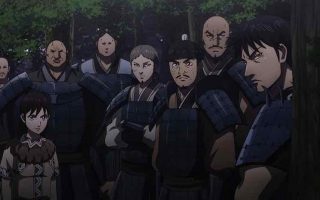
Hello folks, and welcome back to Wrong Every Time. This week I concluded my rewatch of Turn A Gundam, which proved just as inventive, character-rich, and generally charming as on my first watch. The show has a dynamite cast, a delightfully novel premise, and some of the best art design of any Gundam, all with a kinder, more thoughtful Tomino at the helm – it’s a well-deserved classic, and a show I’d recommend to basically anyone. With that behind us, my house has since checked out Bleach’s Thousand Year Blood War, which has proven to so far be an excellent adaptation of a shapeless and derivative story. Kubo just completely ran out of ideas after Soul Society, but I do appreciate how this production is leaning heavily into the impactful individual compositions that are his greatest strength; the man was aura farming when the term’s creators were in diapers, and he has not slowed down in the years since. That covers my current anime journeys, so let’s dive into the Week in Review!
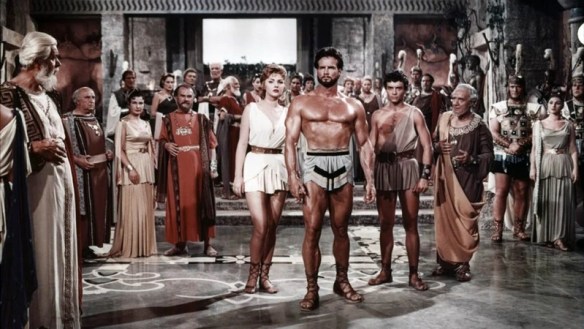
First up this week was Hercules Unchained, the sequel to the iconic ‘58 sword-and-sandle feature Hercules, again starring bodybuilder Steeve Reeves as our larger-than-life hero. This time it’s apparently personal, as Hercules finds himself litigating a quarrel between brothers Eteocles and Polynices over who should rule his home city of Thebes. Then a series of improbable events lead to Hercules losing his memory and becoming charmed by the queen of Lydia, before eventually returning to wage glorious battle for his wife and country.
Hercules Unchained provides most of the same pleasures as its predecessor, with Steeve Reeves cutting an appropriately chiseled and competently acted form as he muscles his way through a variety of adventures. I have at this point seen enough renditions of the “Ulysses is charmed by Circe” beat to recognize it as a go-to narrative crutch of these sword-and-sandal features, essentially an excuse to put the protagonist in time-out to raise the stakes and show off some exotic dancers. Fortunately, the film recovers with a terrific final clash of brother against brother, with Reeves back in his element tearing down siege towers and wrestling tigers. An altogether pleasant, easy watch.
We then continued our rampage through the Gamera canon with Gamera vs Gyaos, the big fella’s third cinematic outing. Gamera has been largely domesticated at this point, and our drama mostly concerns the emergence of the bat-like Gyaos from a mountain cave. While locals bicker about land rights and the development of a nearby expressway, the heroic young boy Eiichi heads a squadron of soldiers and government officials, all determined to aid Gamera in his battle against the incorrigible Gyaos.
After the slipshod and disorganized second entry, Gamera’s third adventure hones in on that “friend to the children” flourish garnishing Gamera’s original outing, resulting in a much more tonally coherent and altogether effective film. It’s quite charming watching the Japanese military being led around by the tactical know-how of an eight-year-old boy, the action sequences are frequent and escalate coherently, and Gamera crucially has a worthy opponent this time.
Gyaos is mechanically straightforward and visually compelling – as director Noriaki Yuasa intended, he is basically “Dracula as a kaiju,” a flying, angular mass of rage and laser beams. His superior costume design and the film’s innovations in gushing kaiju blood make for a genuine sense of terror and consequence, counterbalancing the lightness of the film’s often child-oriented storytelling. A win for Gamera, and likely a foundational feature in defining who Gamera actually is.
Our next viewing was Tusk, Kevin Smith’s bizarre and oft-maligned horror-comedy. Justin Long stars as an exploitative podcaster who’s lured to a remote mansion in pursuit of fresh material. He soon finds himself imprisoned by a deranged former mariner obsessed with walruses, who endeavors to turn Long into a walrus through a series of alarming medical procedures. And that’s basically it – there’s a running thread of Long’s partner and girlfriend attempting to track him down, but the essential pitch of this film is that Justin Long suffers through total walrusification.
I’m sure it would not surprise you to learn Kevin Smith conceived this film during a stoned podcast session of his own, even down to the tone-undercutting musical cues grasping for maudlin sentimentality. The erratic script and cloying self-awareness make it seem like no one behind the camera believes in the film as anything more than a Dogma-style shitpost, but Tusk is somewhat redeemed by its unexpectedly strong lead performances. Justin Long has built a successful career out of playing characters you don’t mind seeing murdered (Jeepers Creepers, Barbarian), while Michael Parks absolutely commands the scene as his bombastic nemesis, selling impossible dialogue with total confidence. Parks alone is worth the price of entry; I could listen to him ramble about the beauty of the walrus soul for hours.
Last up for the week was Being There, a ‘79 satire starring Peter Sellers as Chance, a simple-minded man who has lived on the Washington DC estate of “the old man” all his life, serving as gardener and otherwise gleaning all he knows from television. When his caretaker dies, Chance is thrust onto the streets of DC, and swiftly taken in by the wife (Shirley MacLaine) of a wealthy businessman, who mistakes his name of “Chance the Gardener” for “Chauncey Gardiner.” Thus begins a comedy of errors in which “Chauncey” becomes close advisor to a dying DC scion and even the president himself, impressing all with his homespun wisdom and straight-talking manner.
Being There is a delicate yet thoroughly rewarding film, a sedate farce with occasional flourishes of profundity, held together through a tight maintenance of tone that only occasionally veers into clumsy absurdity. It would be easy for Chance to seem impossible as a character, given his obvious limitations; that he maintains the trust and even adoration of his compatriots is a credit to the film’s careful scripting and editing, which always dance around the moments Chance simply could not avoid blowing his unintended cover.
Fortunately, moments that lean on Chance as a direct source of comedy are rare. Instead, Chance works as a mirror – his widely interpretable garden metaphors and tendency to echo those around him reveal only what his companions want to think of themselves. This obviously makes him exceedingly popular among the kingmaking DC set, and even more so once his wisdom finds a larger audience. By finding a method of glorifying such a fundamentally misinterpreted man, Being There demonstrates the hollowness at the core of both political spectacle and personal achievement; America loves Chauncey for what they think he says about them, not recognizing the mild-mannered urges towards decency and comfort that actually guide his actions. Being There treats its fools with fondness, seeing life and glory as ephemeral and strange in spite of all our best efforts.