
Hello folks, and welcome back to Wrong Every Time. This week has been defined by an extremely nostalgic journey for me, as I’ve been hacking my way through Final Fantasy VIII for the first time since junior high. Though it’s always been overshadowed by the apparently immortal FFVII, I’ve always been fond of FFVIII’s unique aesthetic style and highly personal story, and have been enjoying seeing my fond memories rewarded with a cast of characters that’s just as endearing as I remembered. The whole junction-refining magic system also scratches the Persona fusion center of my brain just right; I can see why many players would prefer a more traditional approach to spellcasting, but I really appreciate how Squaresoft followed up the titanic FFVII with such a bold swing, particularly considering their fearful, self-cannibalizing recent development choices. I actually got stuck somewhere in Ultimecia’s castle as a teenager, so I’ll also be enjoying actually beating the game for the first time sometime next week – but in the meantime, let’s run down the week in films!
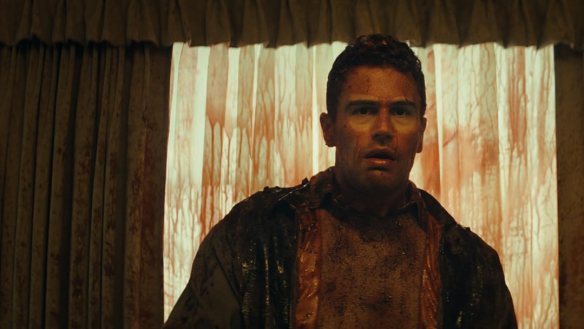
First up this week was The Monkey, a recent adaptation of an admittedly so-so Steven King story. Theo James stars as twin brothers Hal and Bill Shelburn, who discover a mysterious wind-up monkey toy among their absentee father’s possessions. After the improbable deaths of their babysitter, mother, and uncle, they realize the monkey conjures ruin whenever its key is wound, and thus attempt to bury it deep within the earth. Twenty-five years later, the equally implausible death of their aunt announces the monkey’s resurfacing, prompting a race to contain its horrifying power.
The Monkey feels like a welcome course correction for director Osgood Perkins, whose prior film Long Legs struck me as a lot less clever than it thought itself. Long Legs was a B-movie slasher aspiring to Silence of the Lambs-esque grandiosity; in contrast, The Monkey is a Final Destination-adjacent meat grinder that embraces being exactly what it is, offering a preposterous procession of grisly conclusions all along the way. Fun bit performances by familiar faces like Elijah Wood and Adam Scott sadly overshadow Theo James’ unconvincing duel role, but The Monkey isn’t really a film that prioritizes acting in the first place. What is truly on offer here is an invitation to question how exactly a hibachi grill, suspiciously placed beehive, or tragically angular mailbox might play into the dissembling of whoever’s unfortunate enough to find themselves in the monkey’s periphery, and judged by that metric, The Monkey impresses at every turn.
Our next screening was The Black Scorpion, a ‘57 creature feature (or as Wikipedia describes it with endearing precision, a “black-and-white giant arachnid horror film”) directed by Edward Ludwig, detailing the unlikely fallout of a new volcano’s eruption in Mexico. Richard Denning and Carlos Rivas star as a pair of scientists studying the geological eccentricities of this volcano, whose professional duties are put on hold when they discover giant fucking scorpions emerging from the earth. Together with the local police and an understandably concerned cattle rancher, the pair must race against time to devise an effective giant scorpion repellant.
The Black Scorpion is pure creature comfort food, an obviously post-Them! film with little of its predecessor’s tightly scripted urgency, but plenty of scorpion action to compensate. The film’s stop-motion effects were actually handled by Willis O’Brien, mastermind behind the original King Kong’s effects, and mentor of my beloved Ray Harryhausen. O’Brien’s miniatures are marvelous, though I found the film’s frequent closeups on a larger and much goofier “scorpion face” model significantly less convincing.
Still, even that is part of the appeal of a film like this, and with creature feature veteran Richard Denning (I immediately recognized him from Creature from the Black Lagoon, which I suppose says something about my own cinematic canon) leading the cast, the human-side drama remains relatively engaging. The Black Scorpion isn’t exactly top-notch as either a creature feature, stop-motion tableau, or kaiju drama, but it serves as a fair enough example of all three to make for an eminently easy watch.
We then checked out Winchester ‘73, a ‘50 western directed by Anthony Mann. James Stewart stars as Lin McAdam, a talented gunslinger who, while pursuing the man who killed his mentor, ends up first winning and then losing a prized “One in a Thousand” Winchester rifle. As McAdam continues his quest for revenge, we simultaneously follow that impressive yet seemingly accursed Winchester, as one would-be owner after another succumbs to the violent avarice of their successor.
Winchester ‘73 is sturdy, efficient, and incisive, one of those expertly polished westerns that simultaneously embodies and interrogates the genre’s pleasures. By centering largely on its titular gun’s passage from one owner to another, the film inherently challenges the heroic, self-sufficient image of the classic cowboy, insisting that we are less masters of our fate than driftwood in the tide, incapable of controlling much more than our own greed (and rarely that). This approach also makes the film something of a genre-spanning ensemble, as the Winchester travels from marksman’s prize to poker cheat’s ace to field-leveling tool of vengeance and so on.
James Stewart is as reliable as ever, offering a dignified drawl and humility to a role that’s frankly pretty thin on paper. Better here is Shelley Winters, whose inability to direct her turns of fate imbue her with both a charmingly cynical perspective and a role similar to the Winchester itself, as cold observer to the follies of man. The script weaves Stewart, Winters, and Winchester together with a grace that seems effortless, all while taking time to indulge at least one exemplary version of practically every traditional western setpiece. An exceedingly well-executed adventure.
Last up for the week was Man Finds Tape, a recent horror mockumentary centered on a pair of siblings investigating the strange happenings in their Texas hometown. After fledgling videographer Lynn Page (Kelsey Pribilski) is called back home by her frantic brother Lucas (William Magnuson), the two discover a conspiracy that threatens their entire community, and a force of evil beyond human imagination.
It is a very difficult thing to find a single creepy image worth constructing a film around. Zach Cregger’s Weapons did precisely that – that image of children setting out into the night, their arms held like wings as they disappeared into the darkness, felt like he was tapping into something deep and terrible. Man Finds Tape offers a similarly unsettling image in its raw security footage of a crowded intersection collectively falling asleep, their consciousness seemingly stolen by something invisible yet ever-present, a force whose presence is incompatible with human understanding.
Unfortunately, while Cregger did a fine job of complimenting Weapons’ one undeniable image with comedy and committed performances, Man Finds Tape struggles to follow up its perfect moment. That said, asking the whole film to be that good is a high bar; there’s still plenty of novel found footage trickery at work here, alongside some fun practical effect gooeyness, and a conclusion that just barely gestures at the film I wanted it to be. As far as variations on found footage format go, Man Finds Tape is inventive and alluring; as a debut for its two directors, it’s certainly sold me on whatever their followup may be.